Facts
The petitioner, a police employee deployed to guard a prisoner admitted in a hospital, was charged departmentally with negligence and unauthorised absence after the prisoner committed suicide in the hospital toilet at approximately midnight.
Source reference: para. 3, 7, 10The petitioner stated that his duty was initially from 12:00 p.m. to 6:00 p.m.; he later admitted that he had left for the Police Lines to have dinner because food was unavailable at the hospital and returned at about 12:30 a.m., after learning of the incident.
Source reference: para. 3, 7, 10Following a departmental inquiry in which the petitioner cross-examined the witnesses, the charges were found proved and one increment was withheld with cumulative effect by order dated 25 August 2014.
Source reference: para. 2, 10–11His appeal and mercy appeal were rejected.
Source reference: para. 5The petitioner relied on a separate judicial inquiry, which reportedly concluded that the prisoner’s suicide was attributable to no one and resulted from personal problems.
Source reference: para. 6, 14He therefore challenged the punishment, appellate order, and mercy-order before the High Court under Article 226 of the Constitution.
Source reference: no citationIssues
1. Whether the departmental authorities were justified in finding the petitioner guilty of negligence and unauthorised absence and imposing the punishment of withholding one increment with cumulative effect.
Source reference: para. 10–112. Whether the High Court, exercising judicial review under Article 226, could reappreciate the evidence or interfere with the disciplinary orders on the basis of the separate judicial inquiry.
Source reference: para. 12–153. Whether the punishment imposed was disproportionate, perverse, without jurisdiction, or otherwise liable to interference.
Source reference: para. 13, 15Law Applied
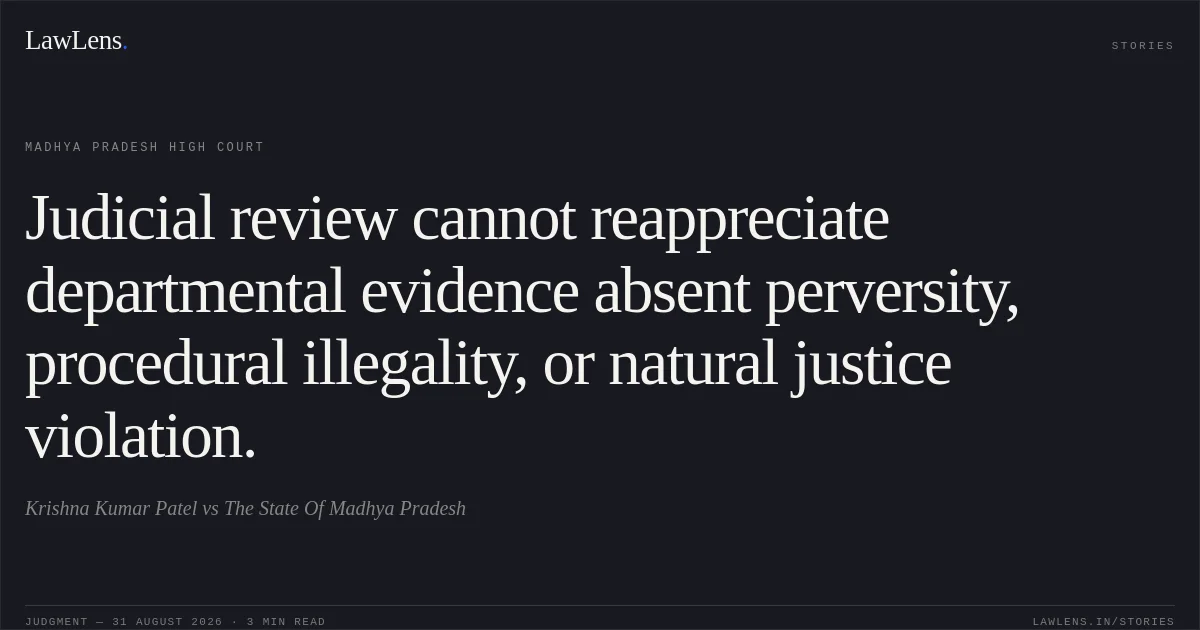
The Court applied the limited scope of judicial review under Article 226 in disciplinary matters, holding that the High Court does not act as an appellate authority and cannot reappreciate evidence unless there is an error of law, procedural illegality, violation of natural justice, perversity, or manifest miscarriage of justice.
Source reference: para. 12–13Relying on Government of Andhra Pradesh v. Mohd. Nasrullah Khan, (2006) 2 SCC 373, the Court reiterated that judicial review is not equivalent to adjudication on merits by reassessing departmental evidence.
Source reference: para. 12The Court further applied the principle that disciplinary punishment may be interfered with only where it is wholly unjustified, disproportionate, perverse, or imposed without jurisdiction.
Source reference: para. 13Reasoning
The departmental inquiry complied with procedural requirements: the petitioner was given an opportunity of hearing and cross-examined the departmental witnesses.
Source reference: para. 10His own statement established that he was absent from the hospital when the prisoner committed suicide and that he had left his place of duty to obtain dinner.
Source reference: para. 10–11This constituted a sufficient evidentiary basis for the findings of unauthorised absence and negligence.
Source reference: no citationThe Court declined to reassess the departmental evidence or accept the petitioner’s alternative interpretation of his duty hours, consistent with the restricted scope of Article 226 review.
Source reference: para. 7, 12–13It also held that the judicial inquiry served a different purpose—ascertaining the circumstances and possible cause of the suicide—and did not determine whether the petitioner had committed departmental misconduct by negligence or absence from duty.
Source reference: para. 14Since the petitioner failed to establish perversity, procedural unfairness, lack of jurisdiction, or disproportionality, the disciplinary orders did not warrant interference.
Source reference: para. 13, 15Holding
The High Court held that the findings of negligence and unauthorised absence were supported by the petitioner’s own admissions and the departmental record.
The separate judicial inquiry did not exonerate him from the distinct disciplinary charges.
Source reference: para. 15–16Finding no perversity or legal infirmity in the punishment, appellate order, or mercy-order, the Court dismissed the writ petition and declined to grant any relief.
Source reference: para. 15–16Original Court PDF
Krishna Kumar PatelvsThe State Of Madhya Pradesh
Click to open original judgment
Original judgment, available to read, download and summarize on LawLens.in