Facts
The petitioner sought review under Section 114 read with Order XLVII Rule 1 of the Code of Civil Procedure, 1908, of the High Court’s common judgment dated 03.04.2025 in F.A. No. 477 of 2022 and F.A. No. 428 of 2022.
Source reference: para. 1By that judgment, the High Court affirmed the decree dated 08.02.2022 passed by the Vth District Judge, Ratlam, in C.S. No. 267A/2010, granting specific performance of an agreement to sell and related reliefs.
Source reference: para. 1The petitioner disputed the findings concerning the agreement to sell dated 17.04.2009, the alleged payment of the balance consideration and readiness of the plaintiff, and the subsequent transfers of the property.
Source reference: para. 3She contended that the appellate judgment incorrectly treated several disputed matters as undisputed, failed to properly consider documents marked Exhibits D/1 to D/7, and overlooked the denial of those documents by witnesses.
Source reference: paras. 4–5The respondent argued that the review petition sought impermissible re-appreciation of evidence; that the agreement, readiness and willingness, and the petitioner’s failure to establish forgery had been concurrently found in favour of the plaintiff; and that subsequent transfers were subject to the doctrine of lis pendens.
Source reference: paras. 6–7It was also brought to the Court’s notice that a sale deed had been executed by the Executing Court in favour of the respondent on 24.10.2025.
Source reference: para. 6Issues
Whether the judgment dated 03.04.2025 contained an error apparent on the face of the record by recording disputed facts as undisputed or by failing to consider material documents and evidence.
Source reference: paras. 4–5, 20–21Whether the review petition could be used to re-appreciate evidence or seek a different conclusion on the merits of the specific-performance dispute.
Source reference: paras. 9, 16–17, 20–21Whether the petitioner established any ground under Order XLVII Rule 1 CPC, including discovery of new and important evidence, mistake or error apparent on the face of the record, or any analogous sufficient reason, warranting review of the judgment.
Source reference: paras. 18–21Law Applied
The Court applied Section 114 and Order XLVII Rule 1 CPC, under which review is permissible only upon discovery of new and important matter despite due diligence, an error apparent on the face of the record, or another sufficient reason analogous to those grounds.
Source reference: paras. 18–19, 38Relying on S. Murali Sundaram v. Jothibai Kannan, Board of Control for Cricket in India v. Netaji Cricket Club, and Rajender Singh v. Lt. Governor, Andaman & Nicobar Islands, the Court held that review is not an appeal in disguise, although a clear misconception of fact or law or non-consideration of material documents may justify review.
Source reference: paras. 9–11On the limits of review, the Court relied on Kerala State Electricity Board v. Hitech Electrothermics & Hydropower Ltd., Tirupati Rao v. M. Lingamaiah, Aribam Tuleshwar Sharma v. Aribam Pishak Sharma, Meera Bhanja v. Nirmala Kumari Choudhury, and Haridas Das v. Usha Rani Banik, holding that an error must be self-evident and not require a long-drawn process of reasoning; factual findings cannot be reconsidered merely because another view is possible.
Source reference: paras. 16–17The Court also noted the principles governing specific performance and lis pendens from Sughar Singh v. Hari Singh, Usha Sinha v. Dina Ram, and Shingara Singh v. Daljit Singh.
Source reference: paras. 13–15Reasoning
The Court examined the petitioner’s challenge in light of the narrow scope of review jurisdiction.
Source reference: no citationIt held that the trial Court and the first appellate Court had concurrently evaluated the documentary and oral evidence and had recorded findings supporting the agreement to sell, the plaintiff’s readiness and willingness, and the failure of the petitioner to prove forgery.
Source reference: para. 20The High Court’s appellate judgment had considered the relevant aspects of the case, and the petitioner’s assertion that Exhibits D/1 to D/7 deserved a different interpretation amounted to a challenge to the appreciation of evidence rather than identification of a patent error.
Source reference: para. 21The Court therefore declined to reopen factual findings or substitute an alternative view.
Source reference: no citationSince the documents were not shown to have been wholly ignored and no self-evident error, newly discovered material, or other legally sufficient ground was established, the requirements of Order XLVII Rule 1 CPC were not satisfied.
Source reference: paras. 20–21Holding
The Court answered the issues against the petitioner.
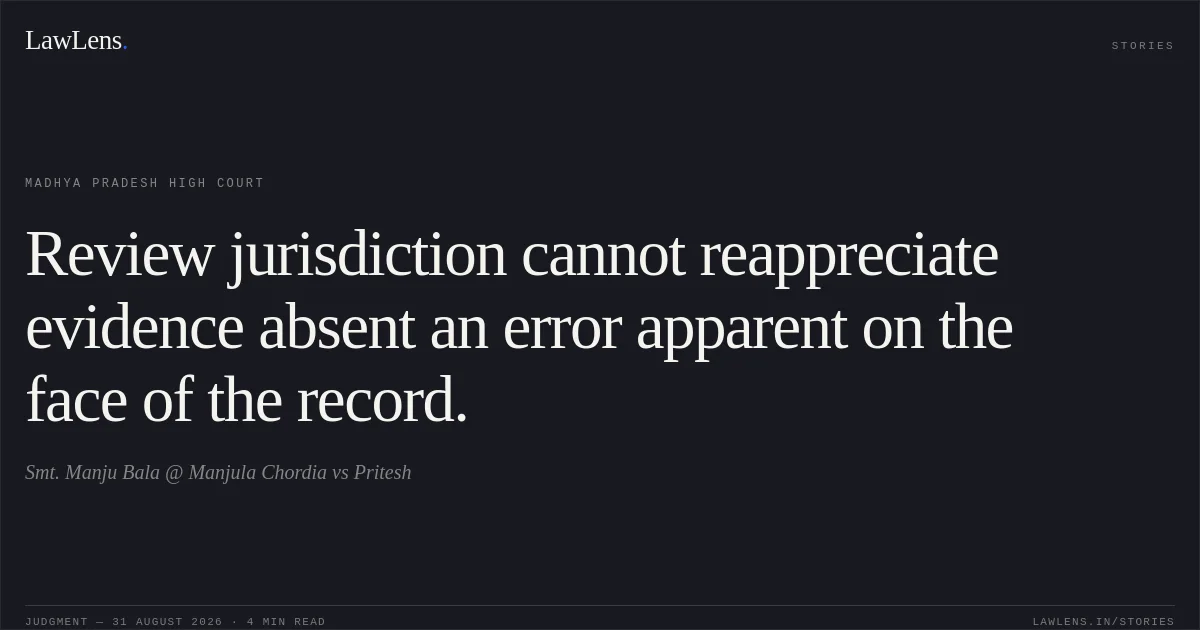
It held that no error apparent on the face of the record or other ground for review had been established, and that the petition impermissibly sought re-appreciation of evidence and reconsideration of concluded factual findings.
Source reference: para. 21The review petition was accordingly dismissed, leaving undisturbed the High Court’s judgment dated 03.04.2025 affirming the decree for specific performance.
Source reference: para. 22Acts & Sections Cited
2 provisions across 1 statute referred to in this judgment. Each provision opens on LawLens.
Code of Civil Procedure, 19082
Original Court PDF
Smt. Manju Bala @ Manjula ChordiavsPritesh
Click to open original judgment
Original judgment, available to read, download and summarize on LawLens.in