Facts
Shree Ram Mandir, Khachrod, containing idols of Shri Ram and other deities, was an ancient temple whose ownership was ultimately claimed by the deity. Mahant Gopaldas had managed the temple and its properties, and after his death his disciple Murlidas assumed management and performed priestly duties.
Source reference: paras. 50, 54–56, 75–78Murlidas subsequently requested the Auqaf Department of the erstwhile Gwalior State to take the temple under State supervision; the request was accepted in 1930, and Murlidas continued as priest under the Department’s control.
Source reference: paras. 50, 54–56, 75–78After Murlidas’s death, the appellant Ratandas claimed succession through a customary Bhekh ceremony conducted by ascetics of the Ramanand sect. He was subsequently appointed priest by the Auqaf Department and was handed over charge of the temple in 1948. Following objections by members of the Maheshwari community, the charge was taken back, although Ratandas continued to perform worship as priest.
Source reference: paras. 79–84, 107–108The Maheshwari respondents relied upon a registered Will allegedly executed by Gopaldas in 1907 and an agreement executed by Murlidas in 1919, asserting that the community had authority to manage the temple and appoint or remove its priest. Ratandas challenged these claims and sought declarations regarding his right to manage and worship at the temple, the invalidity of subsequent administrative orders, and a perpetual injunction against interference.
Source reference: paras. 62–73, 15The trial court dismissed the suit, holding that Ratandas was merely a pujari and licensee, that the Maheshwari community could appoint or remove him, that a married person could not continue as priest, and that the suit was barred for want of consequential relief and limitation.
Source reference: paras. 34–39The Supreme Court later remanded the appeal for fresh consideration on merits and directed that all issues remain open.
Source reference: para. 42Issues
1. Whether the temple was a Math or a temple, and whether its priest was required by custom to be a Nihang or bachelor?
Source reference: paras. 57–61, 82–862. Whether Ratandas had established his status and right to continue as pujari after his appointment and subsequent marriage?
Source reference: paras. 79–883. Whether the Will executed by Gopaldas and the agreement executed by Murlidas conferred management or Shebait rights upon the Maheshwari community?
Source reference: paras. 62–73, 89–914. Whether the State Auqaf/Revenue Department had authority to manage the temple and appoint or remove its pujari?
Source reference: paras. 74–80, 91–935. Whether a suit for declaration and injunction was maintainable without a separate prayer for possession?
Source reference: paras. 94–996. Whether the suit was barred by limitation, Order II Rule 2 or Order IX Rule 9 CPC, or the earlier dismissal of the plaintiff’s suit?
Source reference: paras. 100–106Law Applied
The Court applied Section 34 of the Specific Relief Act, 1963, holding that consequential relief is necessary where a plaintiff seeks declaration of title while being out of possession; however, the bar does not apply where the plaintiff seeks recognition of a status or office and no consequential relief of possession is legally required.
Source reference: paras. 94–99Under Sections 63(c) of the Indian Succession Act, 1925 and 68 of the Indian Evidence Act, 1872, a Will must ordinarily be proved through an attesting witness; the presumption under Section 90 of the Evidence Act for documents more than thirty years old does not, by itself, prove a Will.
Source reference: paras. 65–67; Ashutosh Samanta v. Ranjan Bala Dasi, (2023) 19 SCC 448; Kavita Kanwar v. Pamela Mehta, (2021) 11 SCC 209The Court also relied on the principles that Shebaitship is a hereditary and heritable office, though not freely alienable, and may in appropriate circumstances devolve by Will.
Source reference: para. 70; Ram Rattan v. Bajrang Lal, AIR 1978 SC 1393Under Section 58 of the Evidence Act, admitted facts need not be independently proved.
Source reference: para. 68The Court applied the distinction between a Math and a temple: a Math requires a religious or spiritual institution involving disciples and religious instruction, whereas a temple is primarily a place of worship.
Source reference: paras. 58–61It further held that, under Order 41 Rule 22 CPC and the principles stated in Banarsi v. Ram Phal, (2003) 9 SCC 606, a respondent may support the decree by challenging adverse findings without filing cross-objections where no modification of the decree is sought.
Source reference: paras. 46–48Reasoning
The Court found that the evidence did not establish that the shrine was a Math or that it contained a religious institution for training or housing ascetics. It was therefore an ordinary temple, and the alleged requirement that its pujari must remain a Nihang or bachelor was not proved.
Source reference: paras. 59–61The oral evidence supported the performance of the Bhekh ceremony and Ratandas’s appointment, while the respondents failed to establish that his marriage automatically terminated his right to serve as priest.
Source reference: paras. 79–84The Court accepted that Gopaldas had managed the temple but held that his Will did not transfer ownership of the deity’s property or conclusively confer management rights upon the Maheshwari Panchas. Further, the respondents did not properly prove the Will in accordance with the statutory requirements.
Source reference: paras. 62–78, 89–91Murlidas’s 1919 agreement and his request for State supervision showed, at most, consent to administrative management by the Auqaf Department; they did not transfer the deity’s property or permanently vest Shebait rights in the Maheshwari community.
Source reference: paras. 62–78, 89–91The temple and its properties belonged to the deity, while management had been assumed by the Auqaf Department and subsequently the State Revenue Department.
Source reference: paras. 76–80, 87, 91Since Ratandas had been appointed priest by the competent State authority, the Maheshwari community had no independent power to terminate his appointment. The Court nevertheless distinguished the appellant’s right to serve as pujari from any proprietary or independent management right in the temple.
Source reference: paras. 76–80, 87, 91The objection under Section 34 of the Specific Relief Act was rejected because the suit concerned recognition of the appellant’s status and right to worship and perform priestly duties, not declaration of ownership accompanied by recovery of possession.
Source reference: paras. 98–99The limitation objection also failed because the right to worship and perform priestly duties was treated as continuing, and the suit was filed after the State’s response directing the parties to approach the civil court. The earlier suit did not bar the present action because it involved a different cause of action and was instituted in different procedural circumstances.
Source reference: paras. 100–106Holding
The appeal was partly allowed and the trial court’s decree was set aside.
The Court declared that the deity of Shri Ram was the owner of Shree Ram Mandir, Ramolla, Khachrod, and all properties attached to it.
Source reference: para. 111(a)–(d)It further declared that the temple was under the management of the State through the Revenue Department and that the Auqaf Department had authority to appoint the pujari.
Source reference: para. 111(a)–(d)Ratandas was held to have been duly appointed as pujari and entitled to perform priestly duties in the temple.
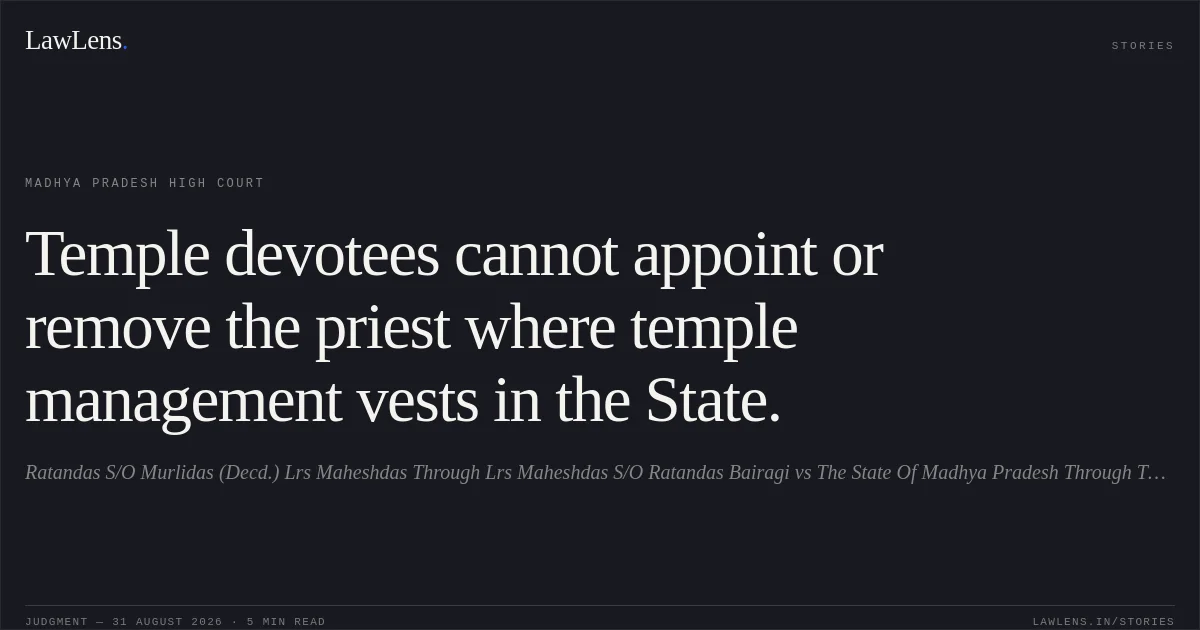
Source reference: para. 111(a)–(d)The Court did not grant a perpetual injunction against the Maheshwari community, holding that its members were devotees of the temple and had contributed to its development, but possessed no independent right to manage the temple or appoint or remove its priest.
Source reference: paras. 91, 110–111(e)There was no order as to costs.
Source reference: para. 111(f)Acts & Sections Cited
3 provisions across 3 statutes referred to in this judgment. Each provision opens on LawLens.
Code of Civil Procedure, 19081
Indian Succession Act, 19251
Specific Relief Act, 19631
Original Court PDF
Ratandas S/O Murlidas (Decd.) Lrs Maheshdas Through Lrs Maheshdas S/O Ratandas BairagivsThe State Of Madhya Pradesh Through The Collector
Click to open original judgment
Original judgment, available to read, download and summarize on LawLens.in