Facts
The petitioner was employed by the Vellore District Central Co-operative Bank and was promoted as Assistant Manager. In 2011, while officiating as Assistant Manager/Passing Officer, he permitted credit of ₹1,00,000 to a customer’s account even though the cheque presented for clearance had been returned by the drawee bank for insufficiency of funds. The amount was subsequently redeposited into the Bank, and no ultimate financial loss was caused.
Source reference: para. 2; p. 3Disciplinary proceedings were initiated, resulting in punishment of withholding of one increment for two months. The petitioner’s challenge was unsuccessful before the appellate and reviewing authorities. He thereafter approached the High Court under Article 226, seeking quashing of the disciplinary/revisional orders, refund of salary allegedly deducted, and promotion from the date on which his juniors were promoted. He also claimed discriminatory treatment because a co-employee involved in the same transaction had been exonerated.
Source reference: paras. 1, 3, 6, 10; pp. 2–6, 9Issues
1. Whether the disciplinary and reviewing authorities’ findings that the petitioner was negligent in crediting ₹1,00,000 despite dishonour of the cheque were perverse, unsupported by evidence, or otherwise liable to be quashed in judicial review under Article 226?
Source reference: paras. 6–8; pp. 5–82. Whether the punishment of withholding increment for two months was shockingly disproportionate to the misconduct proved against the petitioner?
Source reference: para. 9; p. 83. Whether the petitioner was entitled to parity with the co-employee who was exonerated in connection with the same transaction, and consequently to arrears and promotion from the date of promotion of his juniors?
Source reference: paras. 10–11; pp. 9–10Law Applied
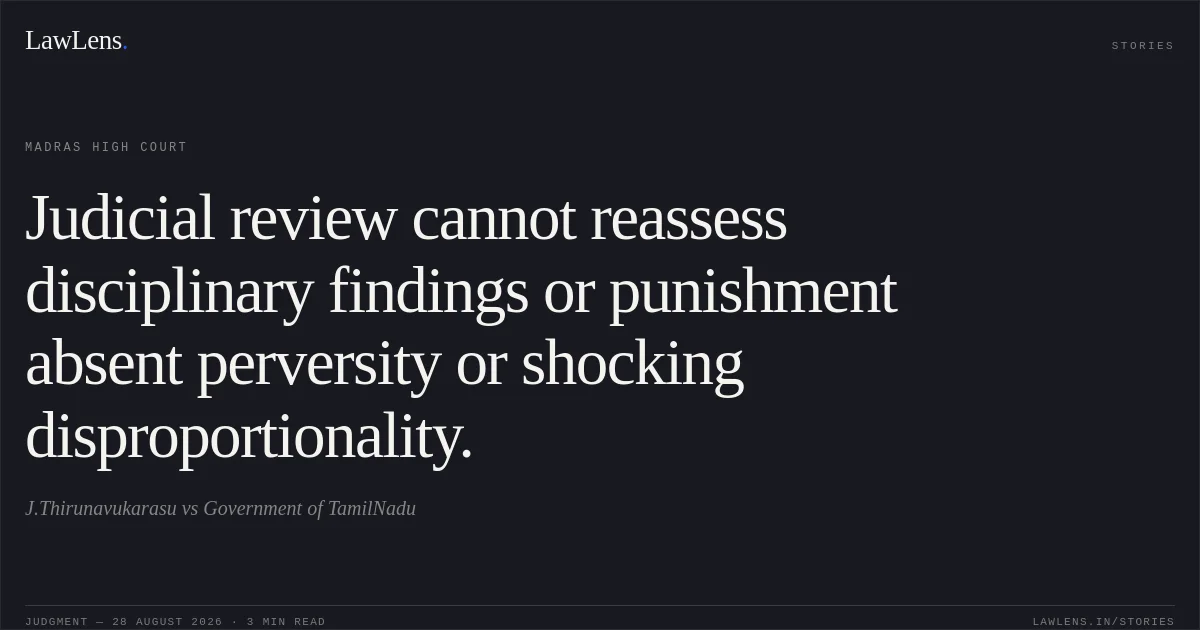
The Court applied the limited scope of judicial review over disciplinary proceedings under Article 226. Relying on B.C. Chaturvedi v. Union of India, Deputy General Manager (Appellate Authority) v. Ajai Kumar Srivastava, and The Indian Oil Corporation v. Ajit Kumar Singh, it held that judicial review is not an appellate reconsideration of evidence; interference is justified only where there is violation of natural justice, perversity, absence of evidence, incompetence of the authority, or a punishment that is shockingly disproportionate.
Source reference: para. 7; pp. 6–7The Court also considered Man Singh v. State of Haryana, relied upon by the petitioner for the principle against discriminatory disciplinary treatment, but held that parity depends upon the employees being similarly situated.
Source reference: paras. 3, 10–11; pp. 3–4, 9–10Reasoning
The petitioner admitted that the amount was credited despite the cheque having been returned, while explaining the incident as an inadvertent error caused by work pressure and a subordinate’s incorrect entry. The Court held that this explanation did not displace the disciplinary authority’s positive finding of negligence, particularly since the petitioner was the superior officer and Passing Officer responsible for the transaction.
Source reference: para. 6; p. 5As the petitioner did not allege violation of natural justice or denial of adequate opportunity, and as the findings were supported by the material on record, the Court declined to reappreciate the evidence or substitute an alternative factual conclusion. The subsequent redeposit of the money and absence of ultimate loss had already been considered as mitigating circumstances; therefore, withholding increment for two months was viewed as lenient and proportionate, not shockingly disproportionate. The claim of discrimination also failed because the co-employee had acted only on the petitioner’s instructions, whereas the petitioner, as the superior Passing Officer, bore independent responsibility and was not similarly situated.
Source reference: paras. 7–11; pp. 6–10Holding
The High Court held that the disciplinary findings were neither perverse nor unsupported by evidence, that the two-month withholding of increment was proportionate to the misconduct, and that the petitioner could not claim parity with the differently placed co-employee.
The writ petition was dismissed, the impugned orders were not interfered with, and no direction was issued for refund of salary or grant of retrospective promotion. No order as to costs was made.
Source reference: para. 12; p. 10Original Court PDF
J.ThirunavukarasuvsGovernment of TamilNadu
Click to open original judgment
Original judgment, available to read, download and summarize on LawLens.in
![Courts will not interfere with transfers absent mala fides or violation of statutory rules.. M Ramya vs EMPLOYEES STATE INSURANCE CORPORATION (ESIC). CAT - ['Chennai']. LawLens](/stories/thumbnails/courts-will-not-interfere-with-transfers-absent-mala-fides-or-violation-of-statutory-rules-a6845e9ca6f548fca284c51c8351957f.webp)
![Courts cannot direct one-time recruitment age relaxation absent authority in the governing rules or advertisement.. UT OF PUDUCHERRY vs M ANDAL. CAT - ['Chennai']. LawLens](/stories/thumbnails/courts-cannot-direct-one-time-recruitment-age-relaxation-absent-authority-in-the-governing-895d78fde47143e2a8ed0207c4b6a44f.webp)
![A review cannot correct an allegedly erroneous decision absent an error apparent on the record.. Ajit Kumar Jha vs RAILWAY BOARD. CAT - ['Delhi']. LawLens](/stories/thumbnails/a-review-cannot-correct-an-allegedly-erroneous-decision-absent-an-error-apparent-on-the-re-8ac952fd4eba470c92f7da20af72a220.webp)