Facts
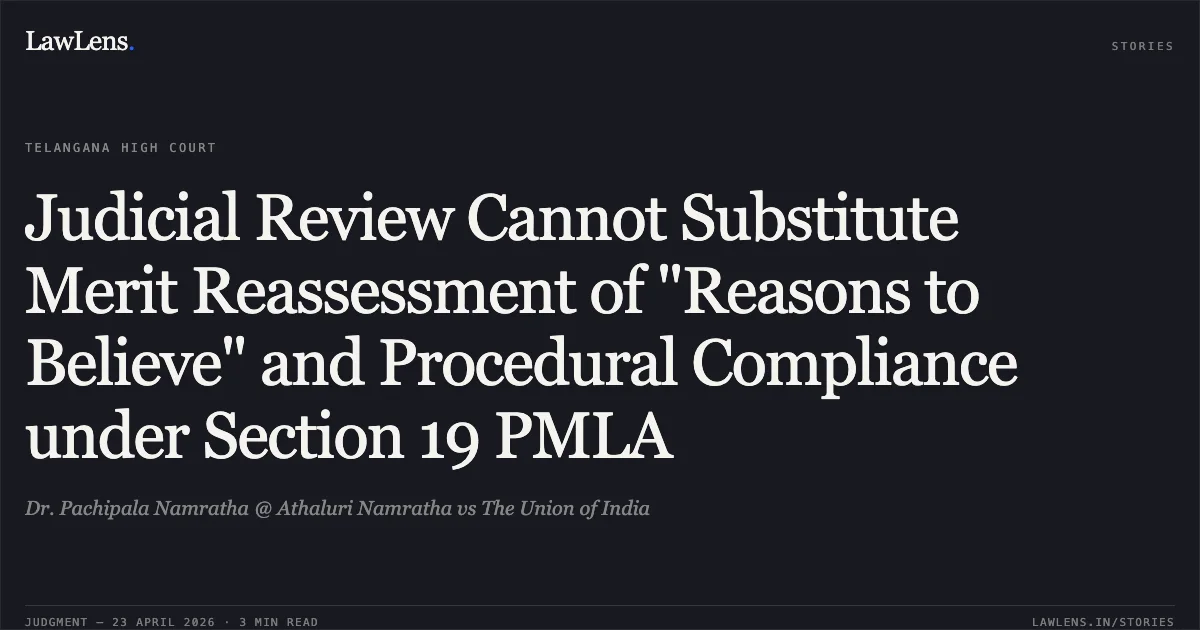
The petitioner, a fertility specialist, was arrested on 12.02.2026 by the Enforcement Directorate (ED) under Section 19 of the PMLA.
Source reference: p.6The investigation originated from multiple FIRs (predicate offences) alleging illegal surrogacy, child trafficking, and cheating under the BNS, the Surrogacy (Regulation) Act, 2021, and the JJ Act.
Source reference: p.5The ED recorded ECIR/HYZO/46/2025 based on these predicate offences, alleging that the petitioner generated proceeds of crime by conducting medical practices during a period of license suspension and by deceitfully projecting childless couples as biological parents.
Source reference: p.31-33The petitioner challenged the arrest and the subsequent remand order passed by the Special Sessions Judge, Nampally, as being arbitrary, mechanical, and in violation of statutory safeguards.
Source reference: p.4-6Issues
1. Whether the writ petition is maintainable under Article 226 when an efficacious statutory remedy of bail under Section 45 of the PMLA exists.
Source reference: p.54, para. 30(a)2. Whether the arrest was vitiated for non-compliance with Section 19(1) of the PMLA regarding "reasons to believe" and communication of "grounds of arrest".
Source reference: p.54, para. 30(b)3. Whether the remand order was mechanical due to the Special Court's failure to form a "secondary opinion" on the validity of the arrest.
Source reference: p.55, para. 30(c)Law Applied
Section 19 of the PMLA, which empowers authorized officers to arrest a person if there is "material in possession" giving "reason to believe" they are guilty of money laundering.
Source reference: p.16, para. 208Vijay Madanlal Choudhary v. Union of India, establishing that "proceeds of crime" must derive from a scheduled offence.
Source reference: p.11, para. 109Arvind Kejriwal v. ED, which mandates that "reasons to believe" must be founded on objective material and are subject to judicial review, though not merit review.
Source reference: p.8, 48Principle from V. Senthil Balaji v. State, holding that once a person is in judicial custody, challenges to remand orders should generally follow statutory remedies rather than writ jurisdiction.
Source reference: p.47, para. 30Reasoning
The Court observed that the authorized officer had recorded "reasons to believe" in writing based on substantial material, including predicate FIRs, bank trails, and Section 50 statements.
Source reference: p.57, para. 33It rejected the petitioner's argument that the "reasons to believe" and "grounds of arrest" were identical, noting that similarity in facts does not equate to non-application of mind.
Source reference: p.57, para. 33The Court emphasized that at the arrest stage, the ED is not required to provide trial-ready proof or a full discovery of the case file, but merely a rational nexus between the material and the belief of guilt.
Source reference: p.58-59Regarding the remand order, the Court held that brevity does not imply a "mechanical" approach; the Special Court perused the remand diary and satisfied itself of statutory compliance, which constitutes a valid "secondary opinion".
Source reference: p.62-63The Court noted that the serious nature of the allegations—involving the commodification of children and manipulation of parenthood—requires that investigations proceed unhindered unless manifest illegality is shown.
Source reference: p.64-66Holding
The Court answered all issues against the petitioner, ruling that the petition was not maintainable, the arrest met the threshold of "reasons to believe", and the remand order was not mechanical.
The Court dismissed the writ petition, holding that the arrest and remand were legally sound and complied with Section 19 of the PMLA, and relegated the petitioner to the Special Court to pursue statutory remedies.
Source reference: p.67, para. 44Acts & Sections Cited
20 provisions across 4 statutes referred to in this judgment. Each provision opens on LawLens.
Prevention of Money-Laundering Act, 2002
Bharatiya Nyaya Sanhita, 20236
Code of Criminal Procedure, 19732
Bharatiya Nagarik Suraksha Sanhita, 20231
Original Court PDF
Dr. Pachipala Namratha @ Athaluri NamrathavsThe Union of India
Click to open original judgment
Original judgment, available to read, download and summarize on LawLens.in