Facts
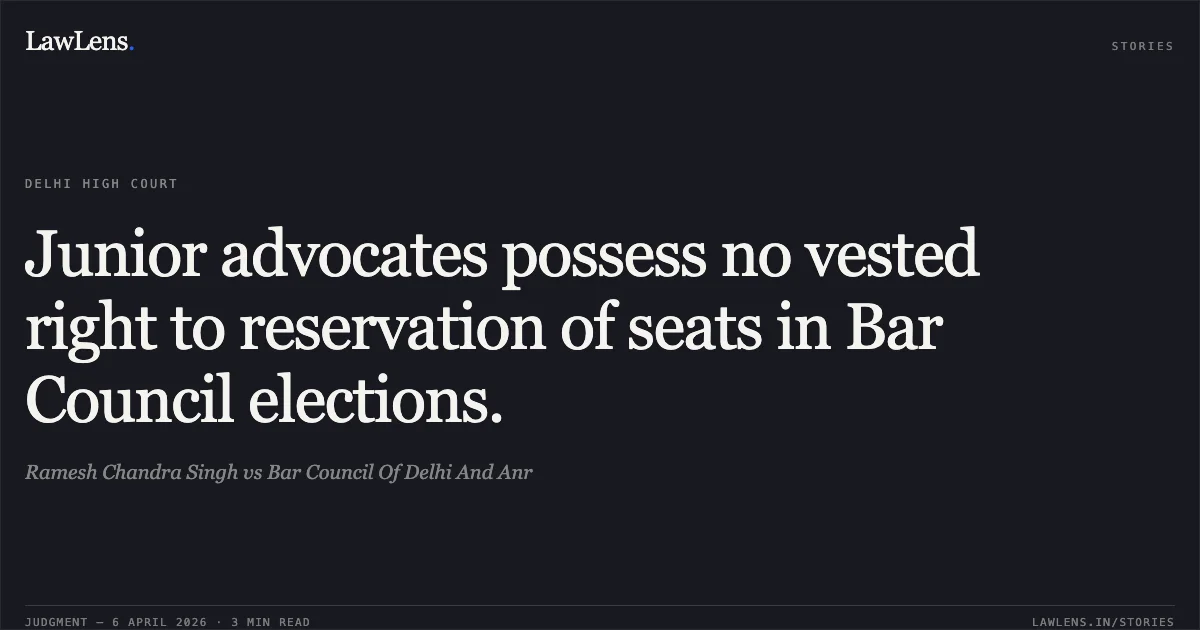
The Appellant, a practicing advocate and candidate in the Bar Council of Delhi (BCD) Election 2026, challenged a notification dated 24.12.2025 issued by the BCD.
Source reference: p. 1-2The notification reserved 12 out of 23 posts for advocates with over 10 years of experience and 5 posts for female advocates.
Source reference: p. 1-2The Appellant filed a Writ Petition seeking a direction to reserve the remaining 6 posts exclusively for "young advocates" with less than 10 years of practice, arguing that senior advocates should not be permitted to contest in the unreserved pool.
Source reference: p. 2The Single Judge dismissed the Writ Petition on 19.03.2026 on grounds of delay, laches, and the absence of a "vested right" for such reservation.
Source reference: p. 2-3The Appellant filed the present intra-court appeal while the counting of votes was already underway.
Source reference: p. 3Issues
1. Whether the Writ Petition was maintainable in light of the Supreme Court's directions in M. Varadhan v. Union of India & Anr.
Source reference: p. 4, para. 10-112. Whether Section 3(2)(b) of the Advocates Act, 1961, creates a vested right for advocates with less than 10 years of practice to have seats reserved for them.
Source reference: p. 4, para. 9 & 123. Whether the challenge to the election notification was barred by delay and laches.
Source reference: p. 3, para. 7-8Law Applied
The court applied Section 3(2)(b) of the Advocates Act, 1961, which mandates that nearly one-half of elected members of a State Bar Council must be advocates with at least 10 years of standing.
Source reference: p. 2-3It relied on the Supreme Court’s directions in M. Varadhan v. Union of India & Anr. (W.P.(C) 1319/2023), which established that grievances regarding Bar Council elections must be addressed to High-Powered Election Committees and explicitly barred High Courts from entertaining such petitions.
Source reference: p. 4The court considered the 30% reservation for women advocates mandated by the Supreme Court in Yogamaya M.G. v. Union of India & Ors.
Source reference: p. 5It also applied the principles of Article 14 and 19(1)(g) of the Constitution regarding equality and the right to practice a profession.
Source reference: p. 2-3Reasoning
The Court first addressed maintainability, noting that the Supreme Court in M. Varadhan had specifically divested High Courts of jurisdiction over BCD election disputes, directing all grievances to Special or High-Powered Committees.
Source reference: p. 4Consequently, the Writ Petition was non-maintainable ab initio.
Source reference: p. 4On merits, the Court rejected the Appellant’s interpretation of Section 3(2)(b), reasoning that while the Act mandates a minimum 50% representation for senior advocates, it does not conversely mandate a reservation for junior advocates for the remaining seats.
Source reference: p. 4-5The Court observed that combining the 50% statutory reservation for seniors with the 30% judicial reservation for women already accounts for 80% of seats; reserving the final 20% for juniors would result in 100% reservation, which is inconsistent with the Advocates Act.
Source reference: p. 5The Court upheld the Single Judge’s finding on delay, noting the Appellant participated in the election and only challenged the December 2025 notification in March 2026 after counting had commenced.
Source reference: p. 3-4Holding
The Court dismissed the appeal and the pending application, holding that the Writ Petition was correctly dismissed as non-maintainable and devoid of merit.
It held that there is no "vested right" under the Advocates Act or the Constitution for advocates with less than 10 years of practice to claim exclusive reservation of seats.
Source reference: p. 4-5The Court affirmed that the High Court lacks jurisdiction to interfere in the election process governed by the Supreme Court’s monitoring committees in M. Varadhan.
Source reference: p. 4No order was made regarding costs.
Source reference: p. 5Acts & Sections Cited
1 provisions across 1 statute referred to in this judgment. Each provision opens on LawLens.
Advocates Act, 19611
Original Court PDF
Ramesh Chandra SinghvsBar Council Of Delhi And Anr
Click to open original judgment
Original judgment, available to read, download and summarize on LawLens.in