Facts
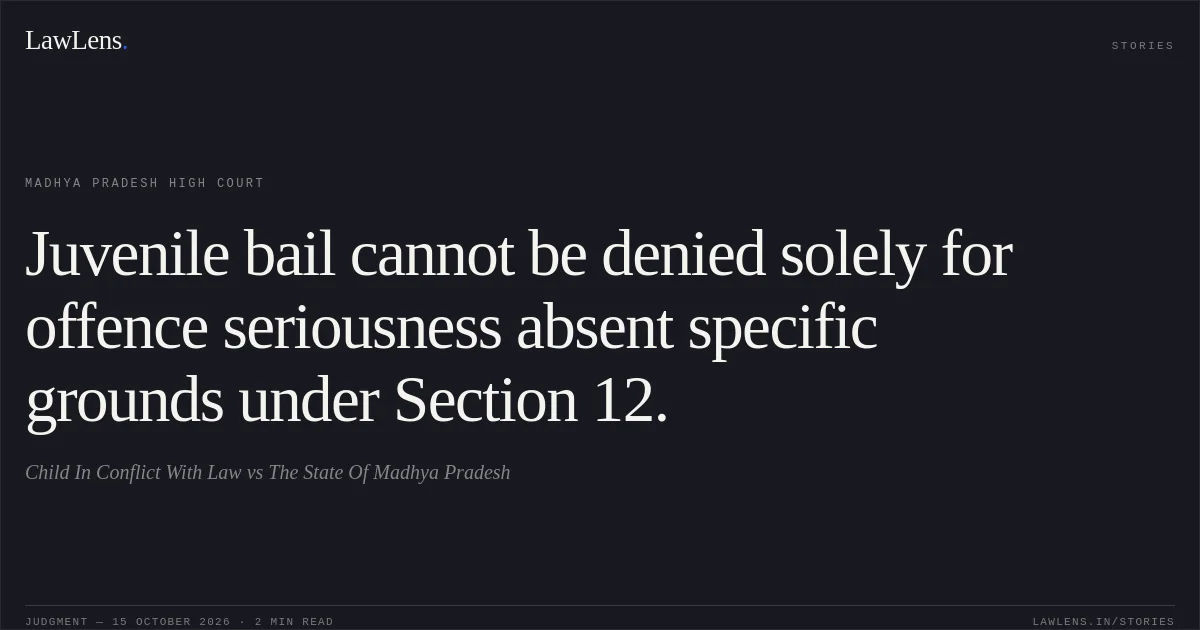
The child, through his mother, sought bail under Section 12 of the Juvenile Justice (Care and Protection of Children) Act, 2015 (“JJ Act”). The Juvenile Justice Board rejected the application, and the appellate court dismissed the appeal under Section 101; the child then filed this revision under Section 102.
Source reference: para. 1, 3The judgment contains inconsistent descriptions of the alleged offence: its factual summary refers to seizure of 69.48 bulk litres of illicit liquor from the child, while its discussion of the lower courts’ reasoning refers to alleged participation in a knife attack resulting in Chandu’s death.
Source reference: para. 2, 9The Court records that the child was under 18 on the date of the incident, had no previous criminal antecedents recorded in the social investigation report, and that his mother was willing to take custody and supervise him.
Source reference: para. 8–10Issues
Whether the Board and appellate court were justified in refusing bail under Section 12 of the JJ Act absent specific material establishing a ground for refusal under its proviso.
Source reference: para. 8–11Whether the child should be released into his mother’s custody, subject to conditions directed by the Court.
Source reference: para. 10–13Law Applied
Section 12(1) of the JJ Act requires a child in conflict with law to be released on bail, with or without surety, unless reasonable grounds exist to believe that release is likely to bring the child into association with a known criminal, expose the child to moral, physical or psychological danger, or defeat the ends of justice; the Board must record specific reasons for refusing bail.
Source reference: para. 8The Court also applied the JJ Act’s child-welfare objectives of the child’s best interests, rehabilitation and reformation.
Source reference: para. 10Reasoning
The Court found that the lower courts had relied principally on the seriousness of the allegations and observations in the social investigation report, but had identified no concrete material showing that release would trigger any of the risks specified in Section 12(1)’s proviso.
Source reference: para. 9It held that the seriousness of the offence or the stage of investigation, without more, did not justify refusal of statutory bail. The absence of recorded prior antecedents and the mother’s willingness to supervise the child further supported release; continued detention was inconsistent with the Act’s rehabilitation and reformation objectives.
Source reference: para. 9–10Holding
The High Court allowed the revision, set aside the refusal orders and directed the child’s release into his mother’s custody on a personal bond of ₹50,000 and a solvent surety for the like amount.
Conditions included parental supervision, the child’s attendance at hearings, compliance with further conditions imposed by the Board, and periodic monitoring by the Probation Officer; the Court stated that breach would result in automatic cancellation of bail. A copy of the order was directed to be sent to the Board and the Observation Home for compliance.
Source reference: para. 12–13, 15Acts & Sections Cited
3 provisions across 1 statute referred to in this judgment. Each provision opens on LawLens.
Juvenile Justice (Care and Protection of Children) Act, 2015.3
Original Court PDF
Child In Conflict With LawvsThe State Of Madhya Pradesh
Click to open original judgment
Original judgment, available to read, download and summarize on LawLens.in