01Facts
The petitioner was provisionally selected for the post of Stipendiary Cadet Trainee Police Constable (Civil) pursuant to the 2018 recruitment notification.
¶ 3During medical examination, he was found to have defective colour vision, and his provisional selection was cancelled by memorandum dated 22 February 2021.
¶ 11–12The petitioner subsequently applied under the 2022 recruitment notification and was provisionally selected for the post of SCT Police Constable (Telangana State Special Police).
¶ 8During antecedent verification, the respondents discovered that he had been involved in Crime No. 27 of 2009, registered under Sections 302, 307, 506 read with Section 34 IPC.
¶ 8The alleged incident concerned the murder of his mother and an attempt to murder his sister.
¶ 8The petitioner stated that he was a juvenile at the time of the incident and that the case had ended in his acquittal by the Principal Magistrate, Juvenile Justice Board, Warangal, on 1 February 2012.
¶ 9After issuing a show-cause notice and considering his explanation, the respondents cancelled his 2022 provisional selection by memorandum dated 25 June 2025, holding that his involvement in the case constituted moral turpitude and rendered him unsuitable for police service.
¶ 4, 9, 13, 17The petitioner challenged both memoranda, alleging arbitrariness and violation of Articles 14, 16 and 21 of the Constitution, and sought appointment with consequential benefits.
¶ 2, 502Issues
i.Whether the petitioner’s challenge to the cancellation of his 2018 provisional selection on the ground of defective colour vision was liable to be rejected on account of delay, laches and suppression of his criminal antecedents in the attestation form?
¶ 12ii.Whether the respondents were justified in cancelling the petitioner’s 2022 provisional selection on the ground that his involvement in a juvenile criminal case relating to murder and attempt to murder constituted moral turpitude under Rule 3(G)(vi) of the Telangana Police (Stipendiary Cadet Trainee) Rules, 1999?
¶ 13–19iii.Whether the principle of “fresh start” under Section 3(xiv) of the Juvenile Justice (Care and Protection of Children) Act, 2015, prevented the respondents from considering the petitioner’s past criminal involvement while assessing his suitability for appointment to the police force?
¶ 20–2103Law Applied
Rule 3(F) of the Telangana Police (Stipendiary Cadet Trainee) Rules, 1999 requires a candidate to satisfy the competent authorities that his character and antecedents qualify him for appointment; Rule 3(G)(vi) treats involvement in a case involving moral turpitude as a disqualification.
¶ 17Section 3(xiv) of the Juvenile Justice (Care and Protection of Children) Act, 2015 embodies the principle of fresh start, under which past records of a child should ordinarily be erased, subject to special circumstances.
¶ 21Relying on Commissioner of Police v. Mehar Singh, (2013) 7 SCC 685, the Court reiterated that police personnel must possess impeccable character and integrity, and that even an acquittal or discharge may be examined to determine whether the candidate has been completely exonerated.
¶ 17Applying the principles stated in State Bank of India v. P. Soupramaniane, 2019 SCC OnLine SC 608, the Court held that moral turpitude may be assessed by considering whether the alleged act shocks the moral conscience of society, whether the motive is base, the character of the accused, the victim, and the circumstances of the alleged offence.
¶ 18The Court also considered the principles in Union of India v. Ramesh Bishnoi, (2019) 19 SCC 710, and Gajula Thirupathi v. Telangana State Level Police Recruitment Board, 2026 SCC OnLine SC 1104, but distinguished them on the facts.
¶ 22Provisions in the judgment · 6 · Linked ones open on LawLens
Indian Penal Code, 1860 Section 302Section 307Section 506Section 34
Code of Criminal Procedure, 1973 Section 161
Juvenile Justice (Care and Protection of Children) Act, 2015. Section 3
04Reasoning
The Court held that the petitioner’s challenge to the 2021 memorandum could not be entertained because he had not disclosed the Tadvai criminal case in the attestation form and had approached the Court only after the subsequent cancellation of his selection; the challenge was therefore barred by delay, laches and suppression of material facts.
¶ 12As regards the 2022 selection, the Court treated the allegations involving the murder of the petitioner’s mother and attempted murder of his sister as exceptionally serious.
¶ 16–19Although the petitioner had been acquitted by the Juvenile Justice Board because the material witnesses did not support the prosecution case, the Court found that the acquittal was not a complete exoneration on merits.
¶ 16–19Given the heightened requirement of character and antecedent verification for police recruitment, the respondents were entitled to assess the petitioner’s suitability independently of the criminal court’s acquittal.
¶ 17–19The Court further held that the principle of fresh start under the Juvenile Justice Act was not absolute and that the alleged heinous nature of the offences constituted the “special circumstances” permitting consideration of the past record.
¶ 20–21Accordingly, the rejection under Rule 3(G)(vi) was found neither arbitrary nor inconsistent with the governing recruitment rules.
¶ 22–2405Holding
The High Court dismissed the writ petition as devoid of merit.
¶ 24–25It upheld the memoranda dated 22 February 2021 and 25 June 2025 cancelling the petitioner’s provisional selections for the 2018 and 2022 recruitments, respectively.
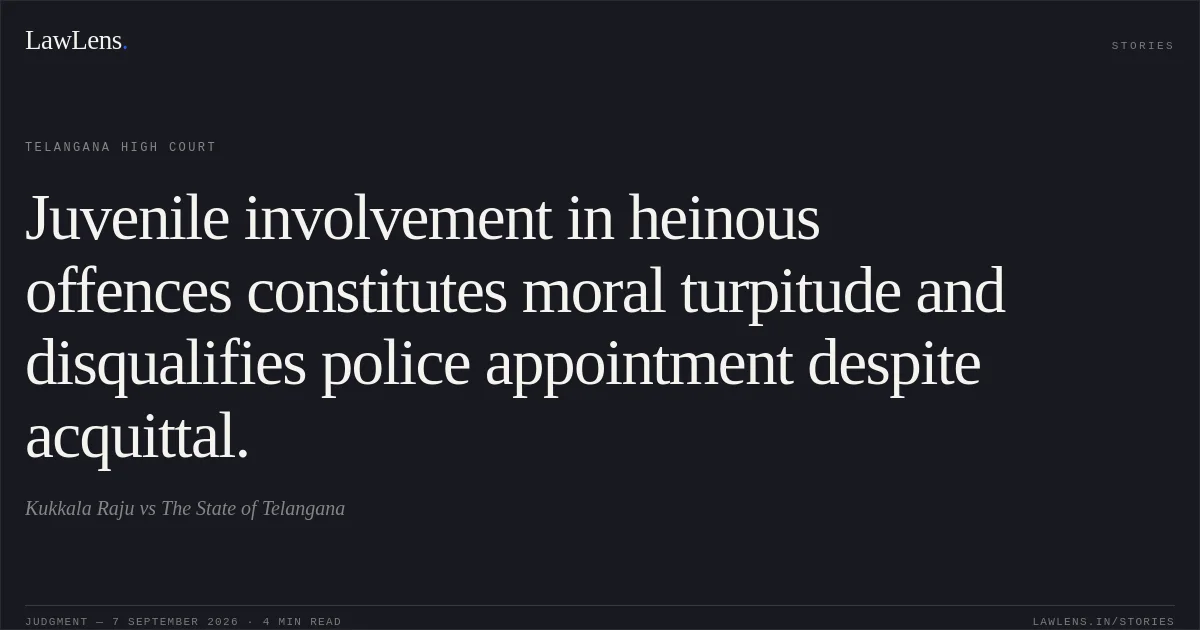
¶ 24–25The Court held that the first challenge was untenable due to delay, laches and suppression, and that the second cancellation was justified because the petitioner’s alleged involvement in a heinous criminal case constituted moral turpitude and rendered him unsuitable for appointment to the police force.
¶ 24–25No order was made as to costs, and all pending miscellaneous petitions were closed.
¶ 25–26Original Court PDF
Kukkala RajuvsThe State of Telangana
Click to open original judgment
Original judgment, available to read, download and summarize on LawLens.in