Facts
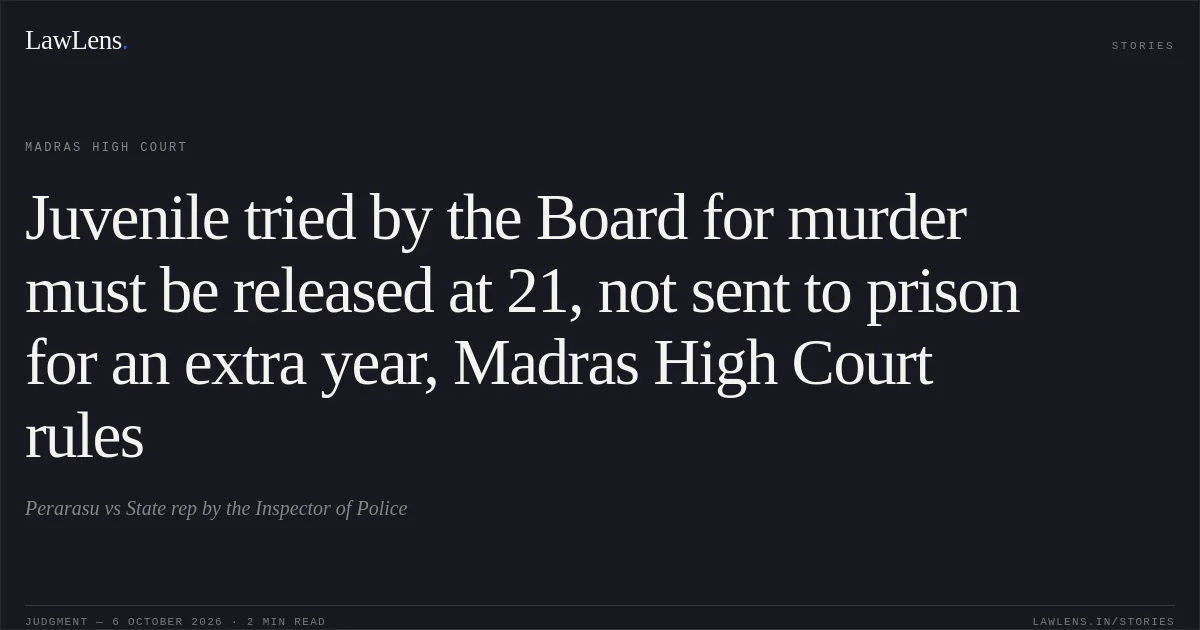
The petitioner, born on 25 June 2006, was found guilty by the Juvenile Justice Board of murder under Section 302 IPC for killing the deceased with a billhook on 17 February 2024.
Source reference: p.2The Board directed that he be kept in a Government place of safety until he attained 21 years, and thereafter in Central Prison, Coimbatore, until 26 November 2028. The appellate court affirmed the order.
Source reference: p.3In revision, the petitioner sought acquittal and challenged, in particular, the direction for post-21 imprisonment.
Source reference: p.6Issues
1. Whether the concurrent finding of guilt under Section 302 IPC disclosed a basis for interference in revision.
Source reference: p.42. Whether the Juvenile Justice Board could direct the petitioner to be confined in Central Prison after attaining 21 years of age.
Source reference: p.6Law Applied
The Court considered Section 302 of the Indian Penal Code, under which the petitioner was found guilty of murder.
Source reference: p.2The Court considered Section 18(1)(g) of the Juvenile Justice (Care and Protection of Children) Act, 2015, as the provision governing the Board’s power to make an order concerning the juvenile’s placement.
Source reference: p.6It held that an order placing the petitioner in a Government place of safety until he attained 21 years could stand, but that a further direction for confinement in prison was beyond the scope of an order the Board could make under Section 18.
Source reference: p.6Reasoning
The Court found that PW1 to PW4 supported the prosecution’s account of the occurrence and had not been discredited; it therefore saw no infirmity in the concurrent findings of guilt.
Source reference: p.5Although the doctor was not examined, the post-mortem report had been marked, and the Court did not regard this as undermining the findings on the record.
Source reference: p.5As to the sentence, the petitioner was a juvenile at the time of the offence, and the Court upheld his confinement in a Government place of safety until he attained 21 years.
Source reference: p.6It set aside the further prison-confinement direction as exceeding the Board’s authority under Section 18 of the Act.
Source reference: p.6Holding
The revision was dismissed with a modification to the sentence: the petitioner was directed to remain in the Government place of safety until 25 June 2027 and to be released thereafter.
He was directed to surrender before the Juvenile Justice Board within seven days of receiving the order; failing surrender, he was to be secured and produced before the Board for confinement in the place of safety.
Source reference: p.7Acts & Sections Cited
5 provisions across 4 statutes referred to in this judgment. Each provision opens on LawLens.
Bharatiya Nagarik Suraksha Sanhita, 20232
Juvenile Justice (Care and Protection of Children) Act, 2015.1
Indian Penal Code, 18601
Code of Criminal Procedure, 19731
Original Court PDF
PerarasuvsState rep by the Inspector of Police
Click to open original judgment
Original judgment, available to read, download and summarize on LawLens.in