Facts
The appellant, a child in conflict with law aged between 16 and 18 years, was accused in Sasaram (Muffassil) P.S. Case No. 102 of 2026, registered under Sections 103(1) and 3(5) of the Bharatiya Nyaya Sanhita, 2023, concerning the murder of Hasan Raja Khan.
Source reference: p. 2–3The prosecution alleged that the appellant, along with six co-accused, surrounded and assaulted the deceased with lathis, bricks, an iron rod and a gadasa; the appellant was allegedly seen dragging the deceased in CCTV footage.
Source reference: p. 23–24The Children Court rejected the appellant’s bail application under Section 12 of the Juvenile Justice (Care and Protection of Children) Act, 2015, principally relying on the Social Investigation Report, the alleged negative family environment, the appellant’s alleged “daredevil” disposition, and the CCTV material.
Source reference: p. 1–2The appellant challenged that order before the Patna High Court, asserting that bail under Section 12 was mandatory unless one of the statutory exceptions was established.
Source reference: p. 3–6The State and the informant opposed release, contending that the appellant’s father, uncles and cousins had criminal antecedents and that release into the family environment would impede his reformation and rehabilitation.
Source reference: p. 6–7Issues
1. Whether Section 12 of the Juvenile Justice Act, 2015 applies to a child aged between 16 and 18 years who is alleged to have committed a heinous offence and is being tried as an adult by the Children Court?
Source reference: p. 11–12; p. 21–222. Whether the seriousness or nature of the alleged murder could, by itself, justify denial of bail under Section 12 of the Juvenile Justice Act?
Source reference: p. 8–9; p. 12–163. Whether, on the facts of the case, the appellant’s release would defeat the ends of justice within the meaning of the proviso to Section 12(1), particularly in light of the Social Investigation Report and the appellant’s family environment?
Source reference: p. 19–25Law Applied
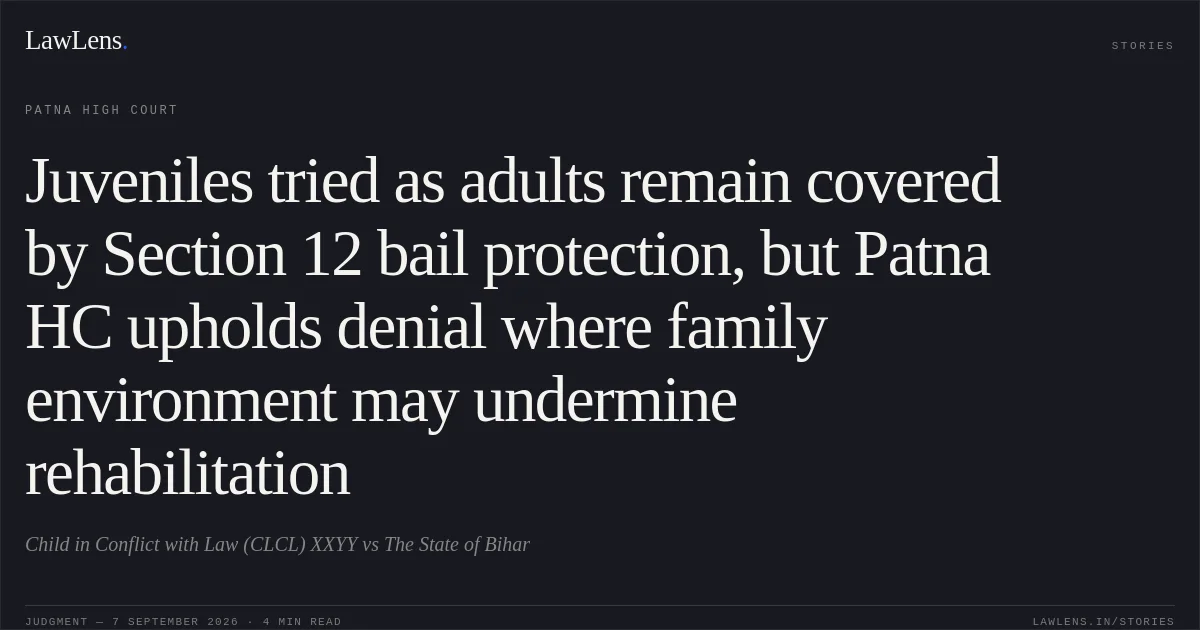
Section 12(1) of the Juvenile Justice (Care and Protection of Children) Act, 2015 makes release on bail the general rule for a child in conflict with law, irrespective of whether the alleged offence is bailable, non-bailable or heinous; bail may be refused only where there are reasonable grounds to believe that release would bring the child into association with a known criminal, expose the child to moral, physical or psychological danger, or defeat the ends of justice, with reasons recorded in writing.
Source reference: p. 7–9The Court held that this provision applies even where a child aged 16–18 years is being tried as an adult under Section 18(3) of the Act.
Source reference: p. 11–12Relying on Juvenile in Conflict with Law v. State of Rajasthan, 2024 SCC OnLine SC 5297, and Re: Exploitation of Children in Orphanages in the State of T.N. v. Union of India, (2020) 14 SCC 327, the Court reiterated that denial of bail requires a clear, material and reasoned finding that one of the statutory exceptions applies.
Source reference: p. 9–10Sections 3(iv), 3(v), 3(vii), 3(xii) and 3(xiii) of the Act require decisions to be guided by the child’s best interests, family responsibility, positive measures, institutionalisation as a last resort, and restoration to the family at the earliest.
Source reference: p. 16–20The Court further held that “defeat the ends of justice” must be understood in the reformative and rehabilitative context of the Juvenile Justice Act, rather than in the punitive sense applicable to ordinary criminal jurisprudence.
Source reference: p. 18–21Reasoning
The High Court accepted that Section 12 governed the application notwithstanding the appellant’s alleged involvement in a murder and his trial as an adult; the gravity of the offence and the CCTV material could not independently justify refusal of bail.
Source reference: p. 21–22; p. 23–24However, the Court distinguished the present case from one involving mere allegations of seriousness.
Source reference: no citationThe Social Investigation Report indicated a negative, domineering family environment, lack of appropriate guidance and moral education, and recommended continued institutional care for reformative and vocational purposes.
Source reference: p. 6–7; p. 24The appellant’s father had six criminal antecedents, including the present murder case, while other close relatives also had criminal records; the appellant’s mother was not shown to be financially independent or capable of providing a separate and conducive rehabilitative environment.
Source reference: p. 24–25On these facts, the Court concluded that release into the family setting would adversely affect the appellant’s development and rehabilitation and would therefore defeat the ends of justice in the specific, child-welfare-oriented sense contemplated by Section 12(1).
Source reference: p. 24–25Although the Children Court had not articulated the statutory grounds with sufficient precision, the High Court found that the record independently supported refusal of bail under the “ends of justice” exception.
Source reference: p. 24–25Holding
The appeal was dismissed.
The High Court held that Section 12 of the Juvenile Justice Act applies even to a 16–18-year-old child tried as an adult, and that the nature or seriousness of the alleged offence is not, by itself, a ground to deny bail.
Source reference: p. 21–25Nevertheless, in the present case, the adverse family environment, the criminal antecedents of close relatives, and the Social Investigation Report established that release would undermine the appellant’s reformation and rehabilitation and would defeat the ends of justice under Section 12(1).
Source reference: p. 21–25The appellant was directed to remain in the observation home; the authorities were directed to provide him appropriate educational, vocational and counselling facilities, and the Children Court was requested to expedite the trial.
Source reference: p. 25Acts & Sections Cited
7 provisions across 2 statutes referred to in this judgment. Each provision opens on LawLens.
Bharatiya Nyaya Sanhita, 20232
Juvenile Justice (Care and Protection of Children) Act, 2015.5
Original Court PDF
Child in Conflict with Law (CLCL) XXYYvsThe State of Bihar
Click to open original judgment
Original judgment, available to read, download and summarize on LawLens.in