01Facts
The prosecution alleged that the 19-year-old complainant met the appellant in 2013, entered into a relationship with him, and had sexual intercourse with him on 20 October 2013 after he promised to marry her.
¶ 3, 7 · pp. 2–3, 6–7She complained to the police on 7 December 2013, alleging that he later refused to marry her.
¶ 3, 7 · pp. 2–3, 6–7The Sessions Court convicted the appellant under Sections 376(1) and 417 of the Indian Penal Code (IPC), sentencing him to seven years’ rigorous imprisonment and a fine for the former offence, and one year’s rigorous imprisonment for the latter.
¶ 4 · pp. 4–5He appealed, challenging the sufficiency of the evidence, the unexplained delay in the complaint, and the medical evidence.
¶ 5 · p. 502Issues
i.1. Whether the prosecution proved beyond reasonable doubt that the appellant committed the alleged sexual assault and cheating.
¶ 5, 14 · pp. 5, 9–10ii.2. Whether the alleged consent to sexual intercourse, given on an assurance of marriage, was vitiated by a misconception of fact so as to attract Sections 376 and 417 IPC.
¶ 14 · pp. 10–1103Law Applied
The Court considered Sections 376 and 417 IPC, governing rape and cheating, respectively, and Section 164A of the Code of Criminal Procedure, which provides for medical examination of a rape victim.
¶ 14 · p. 10Relying on Uday v. State of Karnataka, (2003) 4 SCC 46, the Court stated that consent to sexual intercourse given in a relationship on a promise to marry does not, without more, amount to consent given under a misconception of fact; a false promise to marry is not by itself a fact within the meaning of the relevant criminal law provision.
¶ 14 · pp. 10–11The prosecution was required to establish guilt through cogent and convincing evidence.
¶ 14 · p. 10Provisions in the judgment · 4 · Linked ones open on LawLens
Code of Criminal Procedure, 1973 Section 374Section 313
Indian Penal Code, 1860 Section 376Section 417
04Reasoning
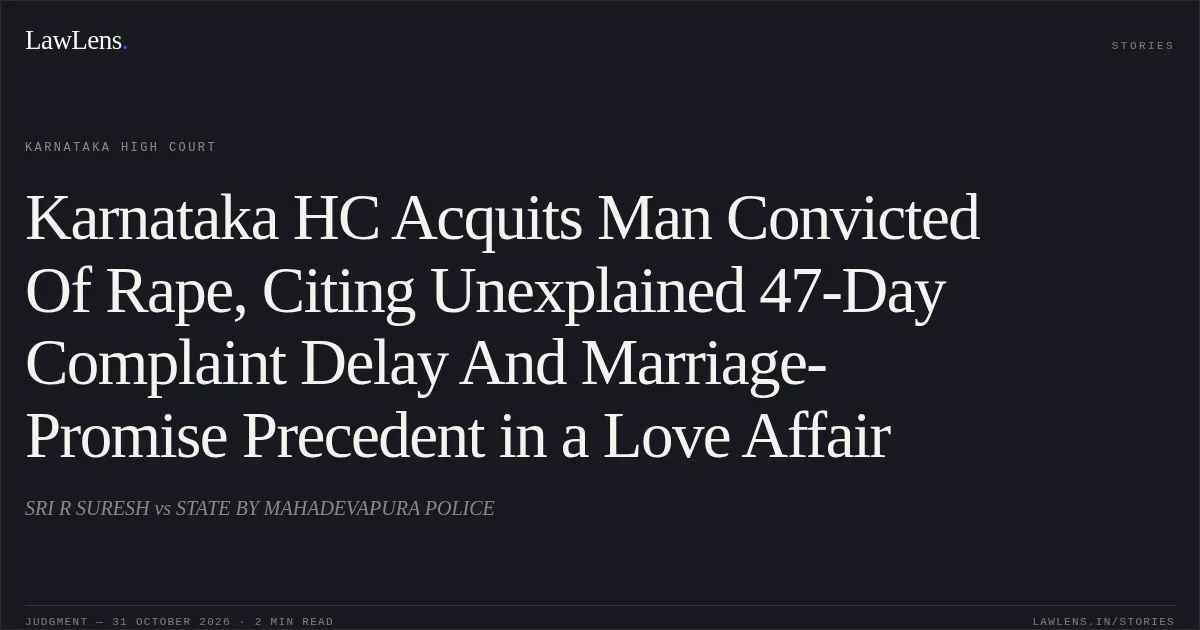
The Court found that the complaint was lodged 47 days after the alleged incident and that the prosecution had not explained the delay.
¶ 14 · pp. 9–10It also noted deficiencies in the medical evidence and the failure to explain the delay in the victim’s examination; the medical officer had not recorded a history of examination, and the Court found non-compliance with Section 164A CrPC.
¶ 14 · pp. 9–10The mother had not promptly informed the police or taken the complainant for medical examination, and the Court considered the conduct of both witnesses to create a reasonable doubt.
¶ 14 · p. 10The complainant’s and her mother’s evidence was, in the Court’s view, unsupported by medical or other evidence.
¶ 14 · p. 10Further, even assuming intercourse occurred on an assurance of marriage, the Court held, applying Uday, that this circumstance did not establish the offences charged.
¶ 14 · pp. 10–1105Holding
The High Court allowed the appeal, holding that the prosecution had not produced sufficient evidence to sustain the convictions.
¶ 15 · pp. 11–12It set aside the judgment of conviction and sentence and acquitted the appellant of the offences under Sections 376 and 417 IPC.
¶ 15 · pp. 11–12The appellant’s bail bond was cancelled, and the trial court was directed to refund any fine amount deposited.
p. 12Original Court PDF
SRI R SURESHvsSTATE BY MAHADEVAPURA POLICE
Click to open original judgment
Original judgment, available to read, download and summarize on LawLens.in