01Facts
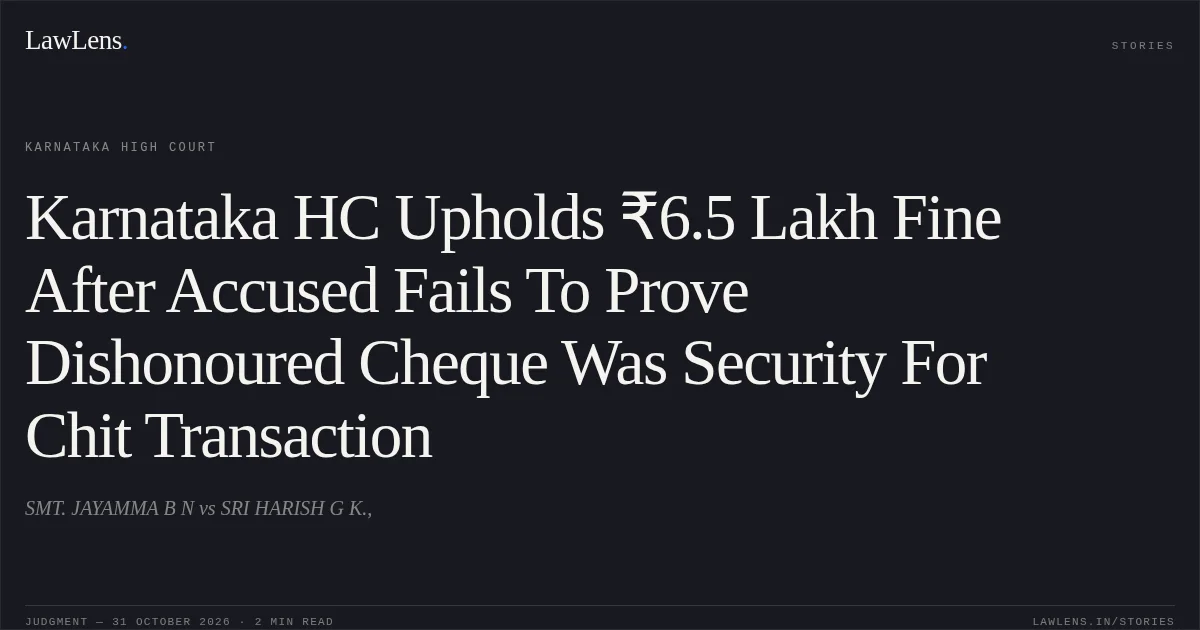
The complainant alleged that the accused borrowed ₹5,00,000 on 14 October 2016 and issued a cheque dated 14 February 2017 towards repayment. The cheque was dishonoured for insufficient funds, and the complainant initiated proceedings under Section 138 of the Negotiable Instruments Act, 1881 (NI Act).
¶ 21The trial court convicted the accused and imposed a fine of ₹6,50,000, directing ₹6,45,000 to be paid as compensation; the appellate court affirmed the conviction and sentence.
¶ 6–8In revision, the accused contended that the cheque had been given as security in a chit transaction with the complainant’s sister and that the complainant lacked the financial capacity to lend the money.
¶ 11–1202Issues
i.Whether the concurrent findings of conviction and sentence disclosed perversity, gross error, or another ground warranting interference in revision.
¶ 14ii.Whether the accused rebutted the statutory presumptions under Sections 118 and 139 of the NI Act by raising the defence that the cheque was security for a chit transaction or by challenging the complainant’s financial capacity.
¶ 24–2803Law Applied
Section 138 of the NI Act criminalises dishonour of a cheque issued towards a legally enforceable debt or liability when the statutory requirements concerning presentation, dishonour, notice and non-payment are satisfied.
¶ 18Once the foundational facts are established and the drawer’s signature and cheque are admitted, Sections 118 and 139 raise rebuttable presumptions that the cheque was issued for consideration and in discharge of a legally enforceable debt or liability; the accused may rebut them on a balance of probabilities.
¶ 19, 23–24, 28Under Sections 397 and 401 of the Code of Criminal Procedure, 1973, revisional jurisdiction is supervisory, not a second appeal; interference with concurrent findings is justified only on grounds such as perversity, gross error, consideration of irrelevant material, or failure to consider relevant material.
¶ 16–17*Kuntegowda v. Thurubaiah*, Criminal Appeal No. 3654 of 2026, and *State of Kerala v. Puttumana Illath Jathavedan Namboodiri*, (1999) 2 SCC 452.
¶ 16–17Provisions in the judgment · 4 · Linked ones open on LawLens
Code of Criminal Procedure, 1973 Section 200Section 313Section 397Section 401
04Reasoning
The accused admitted his signature on the cheque and that it was drawn on his bank account; the cheque’s dishonour and the subsequent statutory steps were also established, giving rise to the presumptions under Sections 118 and 139.
¶ 21–23The accused’s suggestions about the complainant’s financial capacity did not elicit evidence sufficient to rebut those presumptions, and the accused did not enter the witness box or produce the alleged reply to the legal notice.
¶ 25–28Although copies of an FIR and complaint were produced, they were not confronted to the complainant; the accused also did not summon the complainant’s sister to support the chit-transaction defence.
¶ 25–28The High Court found no basis to disturb the concurrent findings in its limited revisional jurisdiction and considered the fine proportionate in light of the time elapsed since the transaction.
¶ 29–3005Holding
The High Court held that the accused had not established perversity or other grounds for revisional interference and had failed to rebut the statutory presumptions under the NI Act.
¶ 29–31The criminal revision petition was dismissed, leaving the conviction and sentence affirmed by the lower courts undisturbed.
¶ 29–31Original Court PDF
SMT. JAYAMMA B NvsSRI HARISH G K.,
Click to open original judgment
Original judgment, available to read, download and summarize on LawLens.in