01Facts
Respondents had obtained consumer awards against the petitioners, which had attained finality, and filed execution petitions.
¶ 2In proceedings under Section 72 of the Consumer Protection Act, 2019, the District Consumer Disputes Redressal Commission recorded that the petitioner had evaded its process and directed that he remain in custody.
¶ 3The petitioner sought to quash the Commission’s orders and challenged his arrest and continued custody as premature, since no inquiry into the alleged offence under Section 72 had been completed.
¶ 4, 12–14Before the High Court, the petitioner referred to a proposed property-based settlement and stated that he had filed a bail application before the Commission on 16 September 2026; the application had not been entertained.
¶ 5–7, 15The respondents relied on the petitioner’s failure to comply with prior undertakings and noted that an appeal under Section 41 of the Act was available.
¶ 8–1002Issues
i.Whether the petitioner’s custody under the Commission’s orders could continue when no inquiry under Section 72(3) had been conducted.
¶ 12–14ii.Whether the High Court should grant relief in the writ petitions or direct the Commission to decide the petitioner’s pending bail application.
¶ 15–1903Law Applied
Section 72(1) of the Consumer Protection Act, 2019 prescribes imprisonment, fine, or both for failure to comply with an order of a Consumer Commission. Under Section 72(2), the Commission exercises the powers of a Judicial Magistrate of the First Class for trial of such offences, and Section 72(3) provides for summary trial.
¶ 13The Court stated that imprisonment under Section 72(1) may be imposed only after an inquiry as contemplated by Section 72(3).
¶ 13The respondents also referred to the appellate remedy under Section 41, but the Court did not determine its availability or effect on these petitions.
¶ 10Provisions in the judgment · 3 · Linked ones open on LawLens
Consumer Protection Act, 2019 Section 72Section 12Section 41
04Reasoning
The Court noted that the Commission had attributed the delay in proceeding with the Section 72 inquiry to the petitioner’s failure to make himself available. However, no inquiry had been conducted, and there had been no order determining the petitioner’s bail plea.
¶ 3–4, 14, 16As the petitioner stated that a bail application had since been filed, the Court considered it appropriate for the Commission to decide that application in accordance with law rather than keep the writ petitions pending. The Court did not determine the merits of the bail application or finally adjudicate the legality of the arrest.
¶ 15–1705Holding
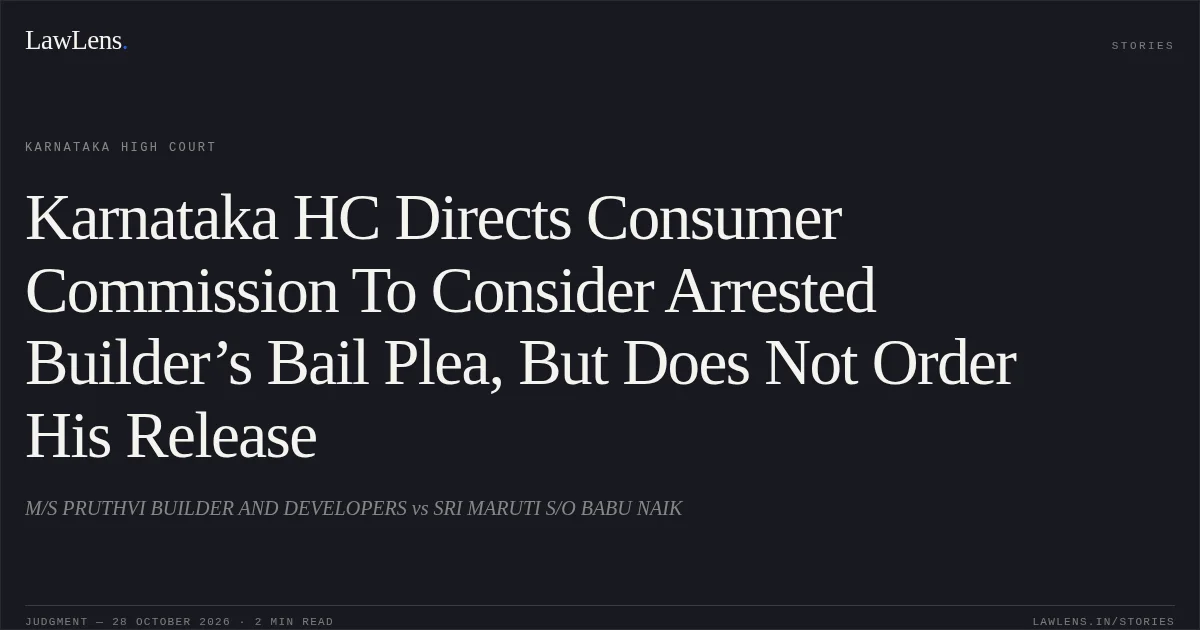
The Court disposed of the writ petitions, directing the District Commission to consider and decide the petitioner’s bail application said to have been filed on 16 September 2026, in accordance with law.
¶ 17–20The parties were left free to explore an amicable resolution, and the petitioner could seek any further relief permissible in law.
¶ 17–20Original Court PDF
M/S PRUTHVI BUILDER AND DEVELOPERSvsSRI MARUTI S/O BABU NAIK
Click to open original judgment
Original judgment, available to read, download and summarize on LawLens.in