01Facts
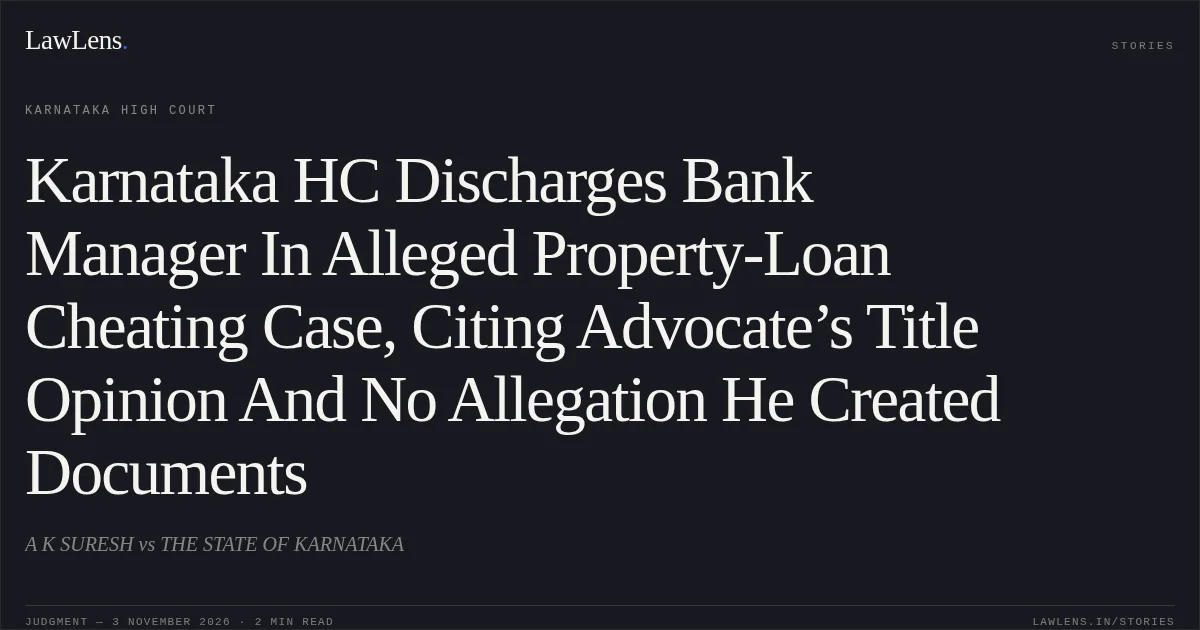
The petitioner, a bank manager and accused No. 5, was alleged to have assisted other accused in obtaining a loan against the complainant’s property.
pp. 2–3He sought discharge, contending that he sanctioned the loan after obtaining a legal opinion confirming the borrower’s title and was unaware of any alleged impersonation or conspiracy.
pp. 2–3The Magistrate rejected the discharge application under Section 239 CrPC, and the Revisional Court affirmed that decision.
p. 2The petitioner challenged both orders under Section 482 CrPC.
p. 202Issues
i.1. Whether the Trial Court erred in rejecting the petitioner’s discharge application and the Revisional Court erred in affirming that order, warranting interference under Section 482 CrPC?
¶ 6 · p. 4ii.2. What order should follow?
¶ 6 · p. 403Law Applied
The Court considered Section 482 CrPC, which empowers the High Court to intervene to prevent abuse of the process of court or miscarriage of justice, and Section 239 CrPC, under which discharge may be allowed where the case against the accused does not warrant proceeding to trial.
pp. 5–6It also considered Sections 415 and 420 IPC, observing that the offences require the relevant ingredients of cheating.
pp. 5–6The judgment cites no precedent.
pp. 5–6Provisions in the judgment · 4 · Linked ones open on LawLens
Code of Criminal Procedure, 1973 Section 482Section 239
Indian Penal Code, 1860 Section 415Section 420
04Reasoning
The Court noted that the petitioner’s case was that he relied on a legal opinion and title-related documents before sanctioning the loan, and that the prosecution did not allege he created the documents or participated in the alleged impersonation.
pp. 5–6Although witnesses stated that accused Nos. 5 and 6 assisted the other accused in securing the loan, the Court considered that the petitioner had acted on the legal adviser’s opinion and held that this, without more, did not establish that he was in concert with the other accused or satisfy the ingredients of cheating under Sections 415 and 420 IPC.
p. 6It concluded that the lower courts had failed to give due consideration to these circumstances and that continuing the proceedings against the petitioner would amount to an abuse of process.
p. 605Holding
The Court answered the first issue in the affirmative and allowed the petition.
¶ 7–8 · pp. 6–7It set aside the Magistrate’s order rejecting discharge and the Revisional Court’s order affirming it, and allowed the petitioner’s application for discharge under Section 239 CrPC.
¶ 7–8 · pp. 6–7Original Court PDF
A K SURESHvsTHE STATE OF KARNATAKA
Click to open original judgment
Original judgment, available to read, download and summarize on LawLens.in