01Facts
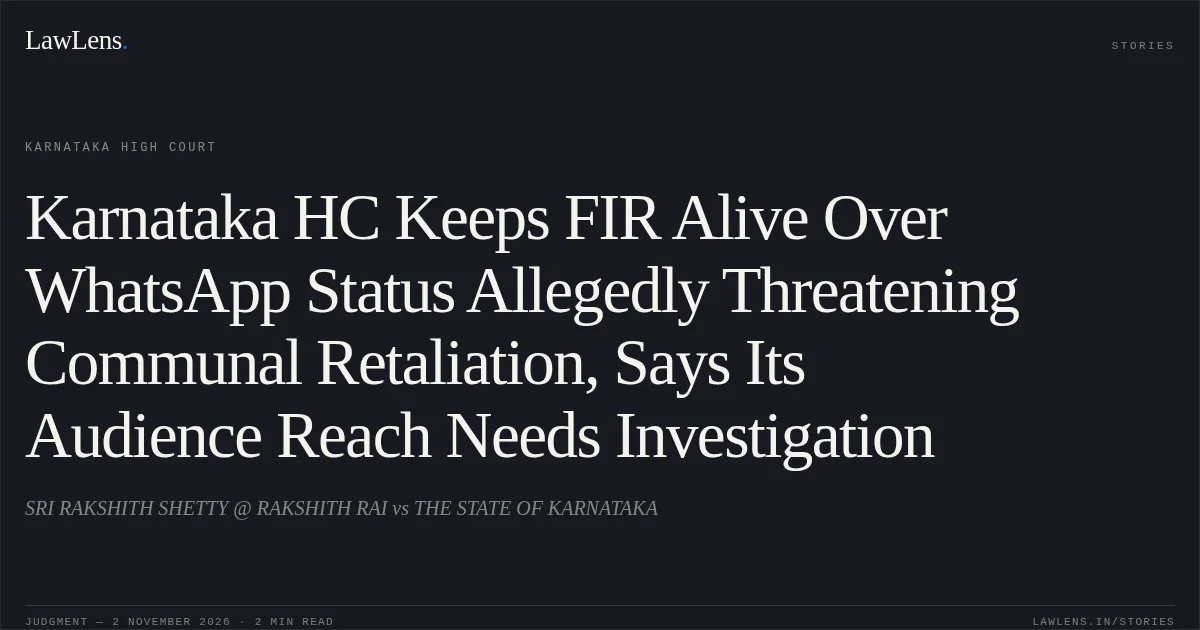
On 31 July 2025, a head constable monitoring social media came across a WhatsApp status posted by the petitioner.
¶ 2The complaint alleged that the status referred to retaliation for the killing of a Hindu leader and would create religious hatred, fear and disturbance of public tranquillity.
¶ 2–3, 9.2–9.3Belthangady Police registered Crime No. 69/2025 under Sections 353(1)(b) and 353(2) of the Bharatiya Nyaya Sanhita, 2023 (BNS); the petition’s opening recital also refers to Section 353(1)(d).
¶ 1, 3The petitioner sought quashing, arguing that a WhatsApp status was not a public communication and that the contents did not disclose the offences alleged.
¶ 1, 4, 4.102Issues
i.1. Whether the WhatsApp status could be treated as a statement published or circulated to the public, having regard to its accessibility.
¶ 6(i)ii.2. Whether the status, read as a whole, prima facie disclosed the ingredients of the offences alleged under Sections 353(1)(b) and 353(2) of the BNS.
¶ 6(ii)03Law Applied
Section 353(1)(b) BNS addresses statements, false information, rumours or reports made, published or circulated with intent to cause, or likely to cause, fear or alarm to the public or a section of it, whereby a person may be induced to commit an offence against the State or public tranquillity; Section 353(2) addresses such material intended or likely to promote enmity, hatred or ill will between specified groups or communities.
¶ 9.1In Bilal Ahmed Kaloo v. State of Andhra Pradesh, (1997) 7 SCC 431, the Supreme Court held, in relation to Sections 153-A and 505(2) IPC, that mens rea is required, publication or circulation is essential under Section 505(2), and the offence requires reference to at least two groups or communities; the Court considered those principles relevant to Section 353(2) BNS.
¶ 9.5–9.8On a quashing petition, the Court asks whether the allegations, accepted at face value, disclose an offence; it does not undertake a detailed assessment of evidence or resolve disputed facts.
¶ 9.15Provisions in the judgment · 4 · Linked ones open on LawLens
Code of Criminal Procedure, 1973 Section 482
Bharatiya Nagarik Suraksha Sanhita, 2023 Section 528
Bharatiya Nyaya Sanhita, 2023 Section 353
Indian Penal Code, 1860 Section 505
04Reasoning
The Court rejected the proposition that every WhatsApp status is necessarily private: its reach depends on privacy settings, selected audience and sharing features, and the police’ ability to view the status and the petitioner’s stated membership in WhatsApp groups were sufficient to leave accessibility for investigation.
¶ 8.1–8.12It treated the status as a whole and found that the complaint’s allegations and the message’s references to retaliation and other communities could not, at this stage, be held wholly insufficient to attract Section 353(2) or Section 353(1)(b).
¶ 9.10–9.16The Court left intention, actual accessibility, likelihood of inter-community enmity and the consequences contemplated by Section 353(1)(b) to be assessed on the investigation material.
¶ 9.11, 9.1405Holding
The Court held that the petitioner had not established grounds to quash the FIR and dismissed the petition.
¶ 9.17 · ¶ 10(i)It directed that its observations were confined to the quashing application and should not influence the investigation or subsequent proceedings, which were to continue in accordance with law.
¶ 10(ii)Original Court PDF
SRI RAKSHITH SHETTY @ RAKSHITH RAIvsTHE STATE OF KARNATAKA
Click to open original judgment
Original judgment, available to read, download and summarize on LawLens.in