01Facts
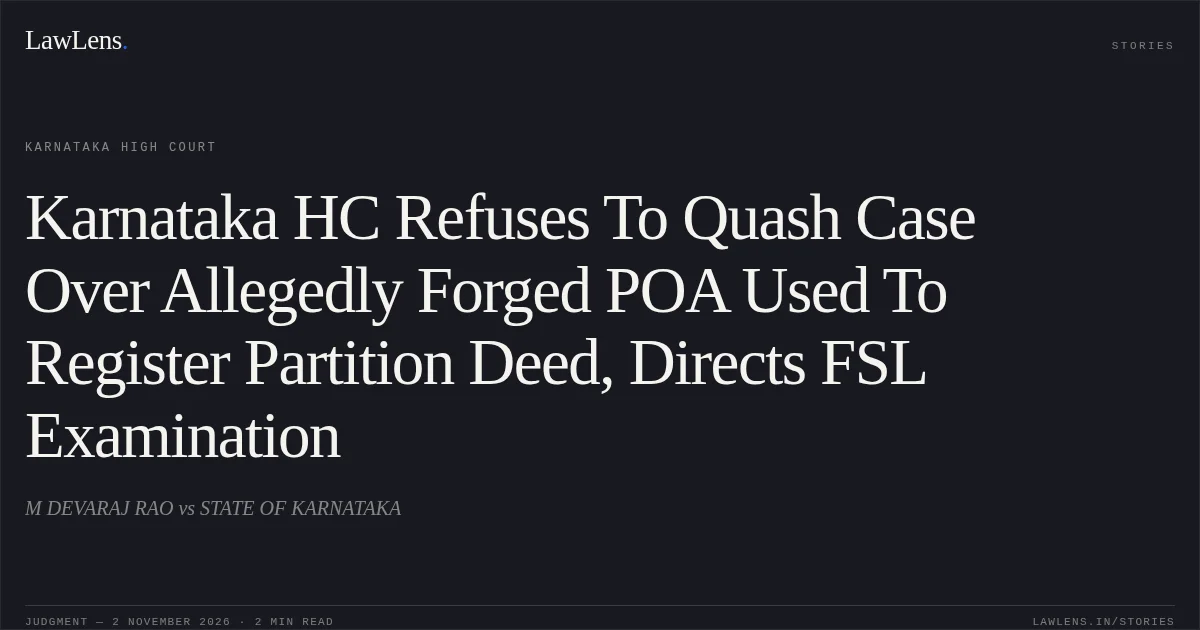
Respondent No. 2 alleged that the petitioners forged his signature on an unregistered, notarised power of attorney dated 22 February 2023 and used it to execute and register a partition deed on 3 March 2023 concerning properties in Udupi District.
¶ 2–5The police registered Crime No. 144/2024 for offences under Sections 420, 465, 468 and 471 read with Section 34 of the IPC.
¶ 3The petitioners sought quashing, denying the forgery and contending, among other things, that respondent No. 2 had suffered no loss and had received a share greater than his entitlement.
¶ 7, 902Issues
i.1. Whether the allegations of forging and using the power of attorney could be determined at the quashing stage, or required investigation, including forensic examination of the disputed signature.
¶ 7–8, 13ii.2. Whether the petitioners’ contention that respondent No. 2 suffered no loss, or received a larger share, justified quashing the proceedings for cheating under Section 420 IPC.
¶ 9–10, 1303Law Applied
The Court considered the alleged offences under Sections 420, 465, 468 and 471 read with Section 34 of the IPC and the High Court’s quashing jurisdiction under Section 482 CrPC; the petition also referred to Section 528 BNSS.
¶ 1, 3, 11The Court stated that quashing jurisdiction must be exercised sparingly and with caution. At that stage, the court assesses whether the allegations, taken at face value and accepted in their entirety, disclose an offence; it does not conduct a mini-trial, assess disputed evidence or determine the genuineness of disputed documents. Proceedings may be quashed where the allegations do not constitute an offence or their continuation would abuse the process of law.
¶ 11–12Provisions in the judgment · 7 · Linked ones open on LawLens
Code of Criminal Procedure, 1973 Section 482
Bharatiya Nagarik Suraksha Sanhita, 2023 Section 528
Indian Penal Code, 1860 Section 420Section 465Section 468Section 471Section 34
04Reasoning
The complaint specifically alleged that the petitioners forged respondent No. 2’s signature on the power of attorney and used it to execute and register a partition deed. The disputed signature required comparison with admitted signatures through forensic examination, and the circumstances surrounding the document’s creation and use required investigation; the Court therefore declined to determine the forgery allegation at the quashing stage.
¶ 7–8, 13The contention that respondent No. 2 received a larger share did not, by itself, negate cheating, because whether the transaction was undertaken without his consent and caused wrongful gain or loss required examination in the context of the entire transaction.
¶ 9–1005Holding
The Court dismissed the petition and declined to quash the proceedings, leaving the petitioners at liberty to raise permissible defences at the appropriate stage.
¶ 14It directed respondent No. 1 to collect the admitted and disputed documents, refer them to the Forensic Science Laboratory, conduct the investigation in accordance with law and submit the final report as early as possible.
¶ 15Original Court PDF
M DEVARAJ RAOvsSTATE OF KARNATAKA
Click to open original judgment
Original judgment, available to read, download and summarize on LawLens.in