01Facts
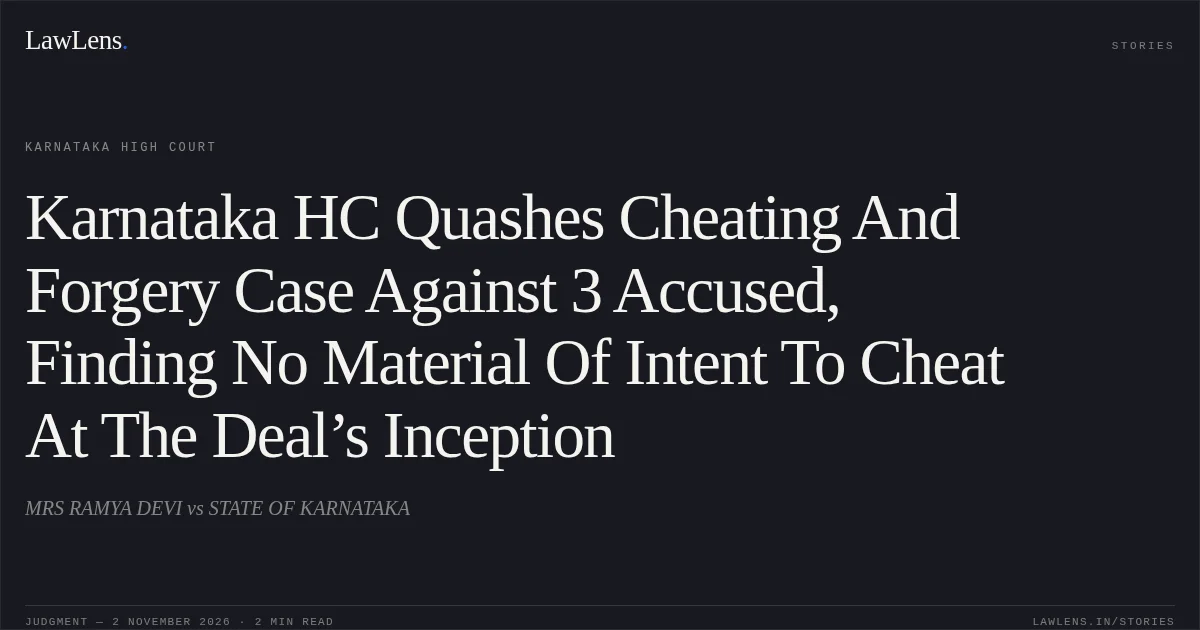
The petitioners, arrayed as accused Nos. 7 to 9, sought to quash the charge-sheet and proceedings in C.C. No. 12820/2020 for offences under Sections 415, 420, 468 and 471 read with Section 34 IPC.
p. 3The case originated in a private complaint referred for investigation under Section 156(3) CrPC.
p. 3The petitioners argued that the complaint was accompanied only by a verifying affidavit, not the affidavit required by Priyanka Srivastava, and that the investigation disclosed no material establishing their involvement in cheating.
pp. 3–8The State relied on a co-accused’s voluntary statement and bank records concerning payments to the petitioners.
pp. 3–802Issues
i.1. Whether the proceedings against the petitioners warranted quashing under Section 482 CrPC where the complaint referred under Section 156(3) was not accompanied by an affidavit of the kind discussed in Priyanka Srivastava
pp. 3, 7–8ii.2. Whether the material collected during investigation disclosed the ingredients of cheating under Sections 415 and 420 IPC, including dishonest intention at the inception of the transaction, so as to justify prosecution of the petitioners
pp. 6–903Law Applied
Section 482 CrPC empowers the High Court to quash criminal proceedings where their continuation would amount to an abuse of process or cause a miscarriage of justice.
p. 6, 9Under Priyanka Srivastava v. State of Uttar Pradesh, an application under Section 156(3) CrPC should be supported by an affidavit, with the requirement intended to deter frivolous applications; the judgment also refers to compliance with Sections 154(1) and 154(3) CrPC.
pp. 3, 7–8For cheating under Sections 415 and 420 IPC, the Court stated that material must disclose dishonest intention to defraud at the inception of the transaction.
p. 9Provisions in the judgment · 9 · Linked ones open on LawLens
Code of Criminal Procedure, 1973 Section 482Section 154Section 156
Indian Penal Code, 1860 Section 415Section 420Section 468Section 471Section 34Section 411
04Reasoning
The Court noted that the private complaint lacked an affidavit beyond the verifying affidavit, as contemplated in Priyanka Srivastava.
pp. 7–8It also considered the investigation material: the alleged payments of ₹25 lakh in 2016 and ₹20 lakh in 2018 to petitioners Nos. 1 and 2 were made before the agreement, and the Court found no material showing that they had the requisite dishonest intention at the transaction’s inception.
pp. 8–9As to petitioner No. 3, no witness spoke to his involvement; the material relied upon was a bank statement recording payments of ₹50,000 each after the agreement.
pp. 8–9The Court held that the payments and the co-accused’s statement, in the circumstances, did not establish the ingredients of cheating against the petitioners.
pp. 8–905Holding
The Court held that the material did not justify continuation of the proceedings against accused Nos. 7 to 9 and that doing so would amount to an abuse of process and miscarriage of justice.
pp. 9–10It allowed the petition and quashed the proceedings against the petitioners in C.C. No. 12820/2020.
pp. 9–10Original Court PDF
MRS RAMYA DEVIvsSTATE OF KARNATAKA
Click to open original judgment
Original judgment, available to read, download and summarize on LawLens.in