01Facts
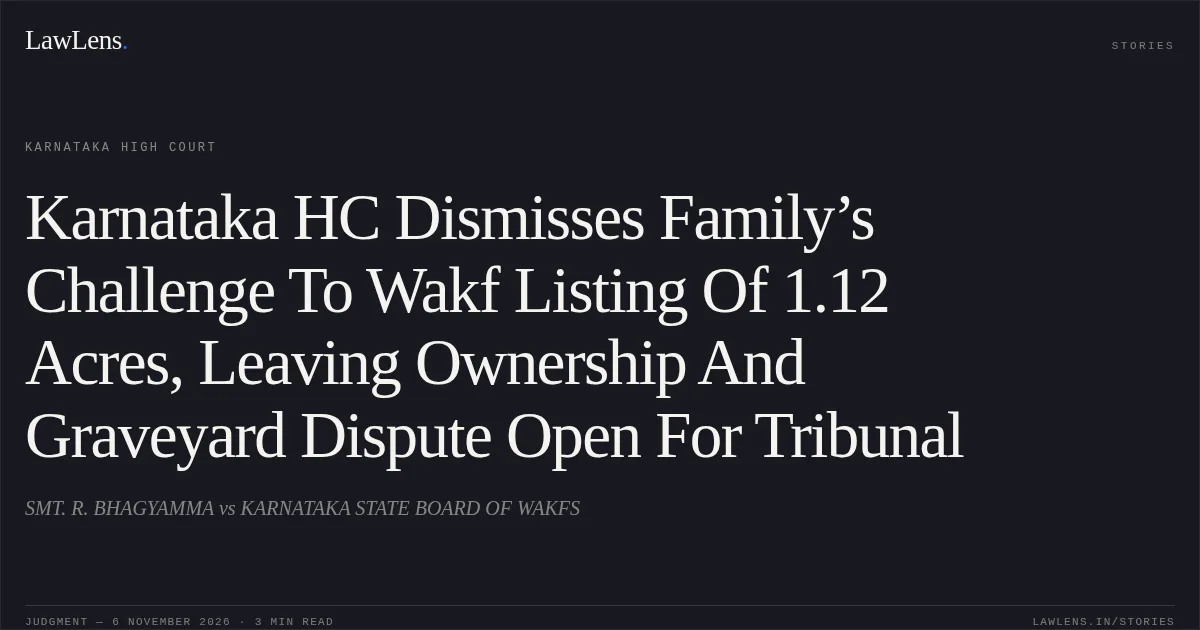
The petitioners claimed through a 1981 sale deed that they owned 1 acre 12 guntas in Sy. No. 56/1A, and challenged a 2010 corrigendum that included the land as Wakf property, as well as a 2019 notification concerning the same land
pp. 4–6 · ¶ 2–5The respondents disputed the identity and ownership of the land, relying, among other matters, on the sale deed’s description of Sy. No. 55/1A and on the land’s use as a burial ground
pp. 39–40 · ¶ 13.7, 15.5A survey conducted during the writ proceedings recorded graves in the disputed area, but the Court noted that the survey did not determine title or Wakf character
pp. 6, 59–60 · ¶ 6–7, 13.20–13.22The petitioners sought, among other reliefs, to quash the notifications, establish that the respondents had no rights over the land, and remove the burials
pp. 3–4 · ¶ 102Issues
i.Whether the disputed questions concerning the identity, location, ownership and Wakf character of the land, including the extent used as a graveyard, could be adjudicated in writ proceedings.
p. 49 · ¶ 11(i)ii.Whether the dispute fell within the jurisdiction of the Wakf Tribunal under Sections 83 and 85 of the Wakf Act, 1995, such that the petitioners should pursue that statutory remedy.
p. 49 · ¶ 11(ii)iii.Whether the writ petition should be dismissed with liberty to the petitioners to proceed before the competent Wakf Tribunal, without a decision on the merits.
p. 49 · ¶ 11(iii)03Law Applied
Sections 4 and 5 of the Wakf Act, 1995 provide for the survey of auqaf and publication of the list of Wakfs; Sections 6 and 7 provide a Tribunal remedy for disputes concerning whether property specified in that list is Wakf property; and Section 83(1) gives the Tribunal jurisdiction over disputes, questions or matters relating to a Wakf or Wakf property, while Section 85 bars other legal proceedings only in matters required by or under the Act to be determined by the Tribunal.
pp. 63–65 · ¶ 14.4–14.6The Court applied the principle that the existence of writ jurisdiction under Articles 226 and 227 is distinct from whether it should be exercised; a High Court may decline to decide disputed facts requiring oral evidence, while an alternative remedy is ordinarily relevant to the exercise of writ jurisdiction.
pp. 54–57 · ¶ 13.10–13.15It relied on State of Andhra Pradesh v. Andhra Pradesh State Wakf Board, Rashid Wali Beg v. Farid Pindari, and Board of Wakf, West Bengal v. Anis Fatma Begum on the scope of writ and Tribunal jurisdiction, and on Nishat Kasar v. State of Karnataka concerning the Tribunal’s inability to strike down a notification or corrigendum.
pp. 54–57, 65–68 · ¶ 13.11–13.15, 14.7–14.12The Court did not determine whether the impugned corrigendum was legally valid.
Provisions in the judgment · 19 · Linked ones open on LawLens
Unified Waqf Management, Empowerment, Efficiency and Development Act, 1995 17 provisions
Section 3Section 4Section 5Section 6Section 7Section 8Section 28Section 32Section 40Section 83Section 84Section 85Section 86Section 90Section 93Section 105Section 27General Clauses Act, 1897 Section 21
Limitation Act, 1963 Section 14
04Reasoning
The petitioners’ claim depended on resolving whether the 1981 deed—on its face describing Sy. No. 55/1A—conveyed Sy. No. 56/1A, and on assessing the chain of title, survey records, grave locations and evidence of burial use. The later correction of the survey number and the survey report did not conclusively establish those matters; their determination required evidence and a trial, which the Court considered inappropriate in the writ proceedings.
pp. 58–61 · ¶ 13.18–13.26The underlying dispute also concerned whether the land was Wakf property and the reliefs sought depended on that determination. The Tribunal could consider the relevant documents and evidence and grant appropriate relief, including interim relief.
pp. 64–67 · ¶ 14.6–14.10Although the Court retained constitutional jurisdiction, it declined to exercise it on the disputed factual issues and left the parties’ substantive claims open.
pp. 61–62, 67–68 · ¶ 13.27–13.28, 14.11–14.1405Holding
The Court held that it had jurisdiction under Articles 226 and 227 but declined to determine the disputed factual questions in the writ petition; the dispute and the reliefs sought fell within the Wakf Tribunal’s jurisdiction.
pp. 61–62, 67–68 · ¶ 13.27–13.28, 14.14It dismissed the petition without deciding the merits and reserved liberty to the petitioners to seek the same or similar relief before the competent Wakf Tribunal. The petitioners were granted the benefit of Section 14 of the Limitation Act for the time spent prosecuting the writ petition. The survey report remained on the record and could be relied on before the Tribunal, subject to the applicable rules of evidence.
p. 77 · ¶ 16.1Original Court PDF
SMT. R. BHAGYAMMAvsKARNATAKA STATE BOARD OF WAKFS
Click to open original judgment
Original judgment, available to read, download and summarize on LawLens.in