01Facts
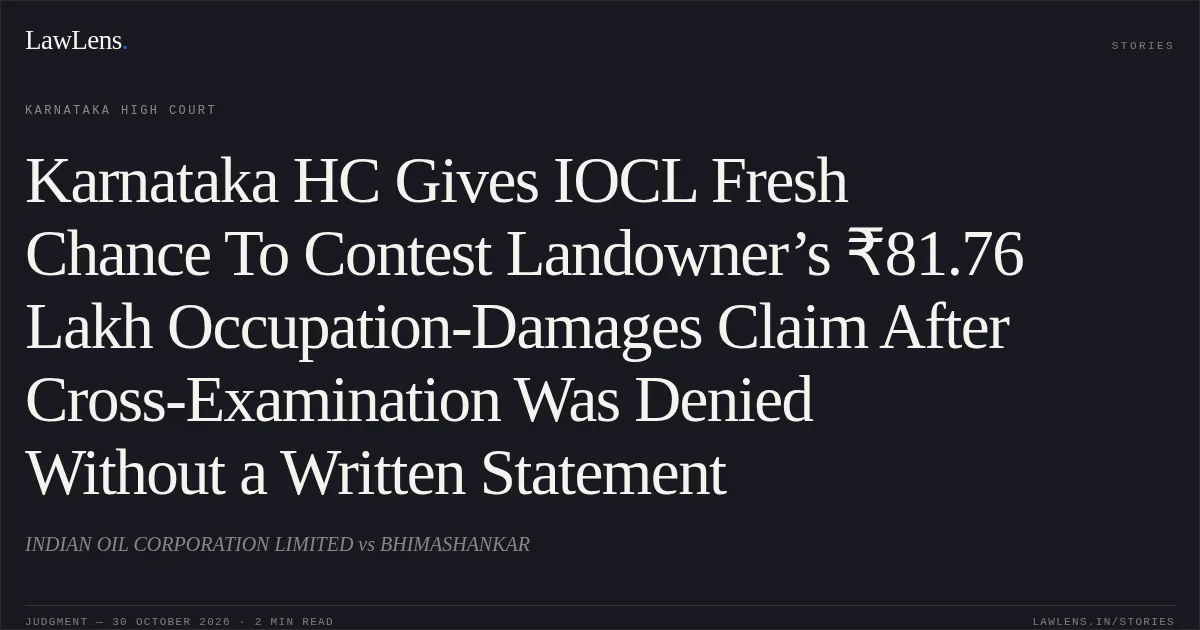
The plaintiff sought damages for continued occupation of land leased to Indian Oil Corporation Limited (defendant No. 1), alleging that the 25-year lease had expired in February 2019.
¶ 3–5, 9The Commercial Court decreed the suit against defendant No. 1 for Rs.81,76,000 with interest at 18% per annum from the date of suit.
¶ 3–5, 9Defendant No. 1 had not filed a written statement.
¶ 17–18On 23 July 2025, the Commercial Court recorded the plaintiff’s evidence, marked documents, treated cross-examination as “nil” because defendant No. 1 and its counsel were absent, heard arguments, and reserved judgment.
¶ 17–18Defendant No. 1 appealed, contending that it had been denied an opportunity to cross-examine the plaintiff.
¶ 1202Issues
i.1. Whether the Commercial Court was justified in refusing defendant No. 1 permission to cross-examine PW.1 because no written statement had been filed.
¶ 15ii.2. Whether the judgment and decree were in violation of the principles of natural justice.
¶ 1503Law Applied
Section 13 of the Commercial Courts Act, 2015 provides for an appeal from specified decisions of Commercial Courts.
¶ 1The proviso to Order VIII Rule 1 CPC, as amended for commercial disputes, imposes a 120-day limit for filing a written statement, after which the defendant forfeits the right to file it.
¶ 19–20However, the Supreme Court in Ranjit Singh v. State of Uttarakhand, 2024 INSC 724, recognised that a defendant may cross-examine the plaintiff’s witnesses to challenge the plaintiff’s case, including by raising legal bars apparent from the pleadings or evidence.
¶ 22The Court also relied on M/s Anvita Auto Tech Works Pvt. Ltd. v. M/s Aroush Motors, 2025 SCC OnLine SC 2181, which, in the circumstances of that case, permitted the defendant to file a written statement subject to costs and to cross-examine the plaintiff’s witnesses.
¶ 19–20Provisions in the judgment · 1 · Linked ones open on LawLens
Commercial Courts Act, 2015 Section 13
04Reasoning
The Commercial Court treated the absence of a written statement as a reason to deny cross-examination and, on the same day, closed the plaintiff’s evidence and heard arguments, without affording defendant No. 1 an adequate opportunity to test PW.1’s evidence.
¶ 17–18, 21The High Court held that failure to file a written statement does not, by itself, extinguish the defendant’s right to cross-examine the plaintiff’s witnesses.
¶ 22–23By proceeding otherwise, the Commercial Court acted contrary to the principles identified in Ranjit Singh and Anvita Auto Tech Works and violated natural justice.
¶ 22–2305Holding
The Court answered the first issue in the negative and the second in the affirmative.
¶ 24It allowed the appeal, set aside the judgment and decree, and restored Commercial O.S. No. 6 of 2022.
¶ 25Defendant No. 1 was permitted to file a written statement within 30 days of appearing before the Commercial Court, subject to payment of Rs.1,00,000 to the District Legal Services Authority, Kalaburagi District.
¶ 25The parties were directed to appear before the Commercial Court on 16 November 2026; the Court left all merits contentions open.
¶ 25Original Court PDF
INDIAN OIL CORPORATION LIMITEDvsBHIMASHANKAR
Click to open original judgment
Original judgment, available to read, download and summarize on LawLens.in