Facts
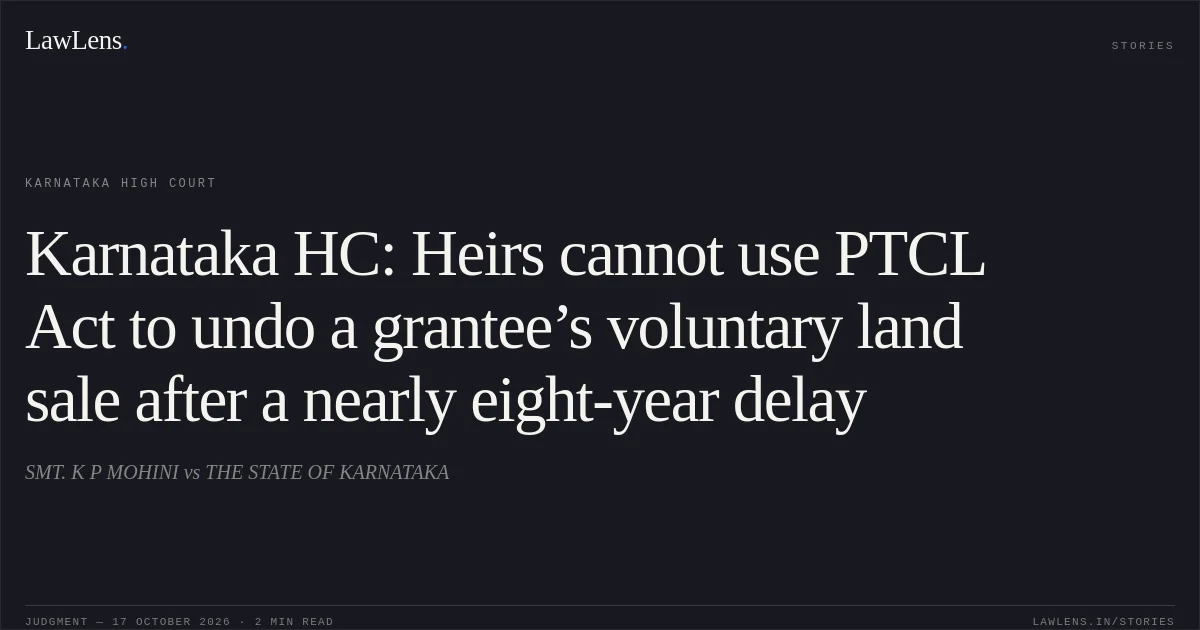
The land was granted in 1962. In 2003, the original grantee sold 20 guntas by registered sale deed.
Source reference: p.4–5Respondent No. 5, claiming to be the grantee’s legal heir, initiated resumption proceedings in 2011. The Assistant Commissioner allowed the claim, and the Deputy Commissioner affirmed that decision.
Source reference: p.4–5The purchaser challenged both orders by writ petition.
Source reference: p.4–5The authorities had found a violation of the PTCL Act because prior permission for alienation had not been obtained.
Source reference: p.5Issues
1. Whether the resumption orders could stand where the original grantee had voluntarily executed a registered sale deed and the claimed heir initiated proceedings after a delay of seven years and eleven months.
Source reference: p.4–62. Whether the petitioner was entitled to have the impugned orders quashed and her name restored in the revenue records.
Source reference: p.6–7Law Applied
The Court applied the PTCL Act’s protective purpose of preventing exploitation of Scheduled Caste and Scheduled Tribe grantees through unauthorised alienation of granted lands.
Source reference: p.5It stated that a grantee or the grantee’s heirs cannot rely on the Act to repudiate a voluntary transaction executed by the grantee, and that estoppel may operate against such a challenge.
Source reference: p.5–6The Court also stated that laches is a primary consideration in resumption proceedings and that restoration action brought after significant delay may be barred by laches.
Source reference: p.6No specific statutory provision or named precedent was identified in the order.
Source reference: no citationReasoning
The Court treated the 2003 registered sale by the original grantee as a voluntary transaction that had created third-party rights.
Source reference: p.5–6It held that the claimed heir’s application, brought seven years and eleven months later, could not defeat the purchaser’s accrued rights merely by invoking the PTCL Act.
Source reference: p.5–6In the Court’s view, the Act’s protective purpose did not permit the grantee’s family to repudiate the grantee’s own sale, and the authorities had failed to account for the delay and the effect of the transaction.
Source reference: p.5–6The Court therefore found the resumption orders legally unsustainable.
Source reference: p.6Holding
The Court allowed the writ petition and issued a writ of certiorari, quashing the Assistant Commissioner’s order dated 27 February 2012 and the Deputy Commissioner’s order dated 5 August 2023.
It directed the concerned authority to restore the petitioner’s name in the revenue records for the subject land.
Source reference: p.7Original Court PDF
SMT. K P MOHINIvsTHE STATE OF KARNATAKA
Click to open original judgment
Original judgment, available to read, download and summarize on LawLens.in