01Facts
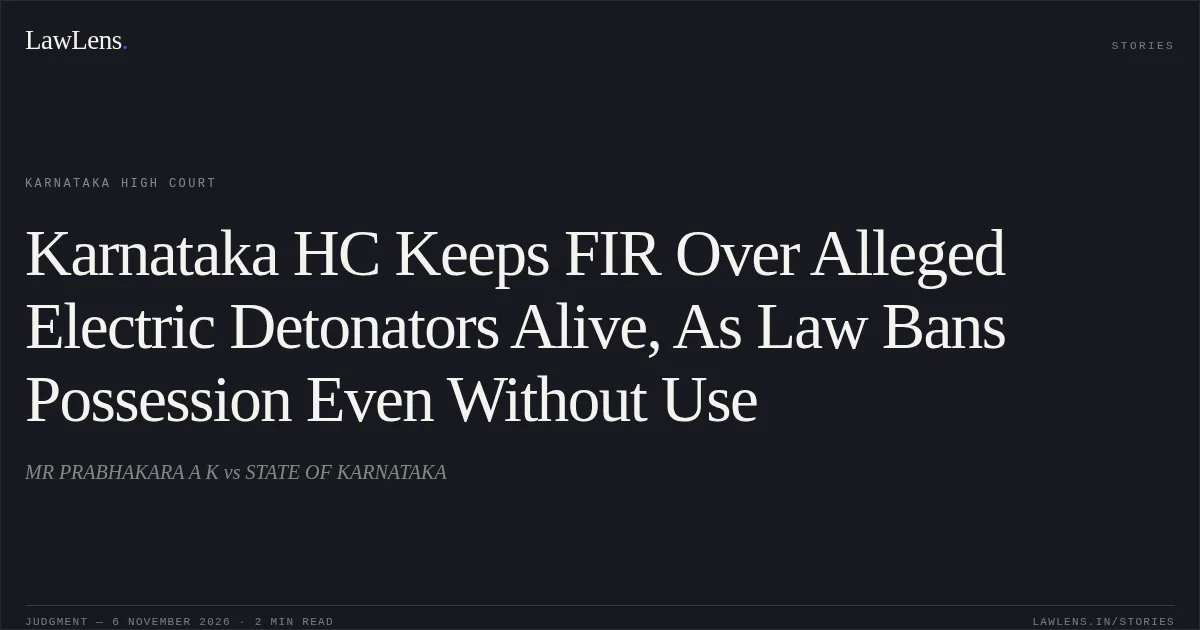
The petitioners, arrayed as accused Nos. 3 and 5, sought to quash the FIR registered against them for offences under Sections 3 and 5 of the Explosive Substances Act, 1908, Section 9(B) of the Explosives Act, 1884, and Sections 288 and 351(2) of the Bharatiya Nyaya Sanhita, 2023.
The complainant, a shot firer engaged to conduct controlled blasting at a development site, alleged that he was pressured to use explosives contrary to his licence, and that blasting using illegal methods was later carried out at the site.
pp. 3–6 · ¶ 3.1–3.5The State also relied on an inspection said to have revealed electric detonators at the premises and a 2025 notification prohibiting their possession.
pp. 7–8, 12–13 · ¶ 5.1, 10The petitioners contended that no illegal explosion had occurred and that the proceedings should therefore be quashed.
pp. 6–7 · ¶ 4.1–4.202Issues
i.1. Whether the absence of an actual illegal explosion, by itself, justified quashing the criminal proceedings despite allegations concerning possession and intended use of prohibited detonators.
p. 9 · ¶ 8ii.2. Whether the allegations and material concerning electric detonators disclosed circumstances warranting investigation into the petitioners’ possession, knowledge, or involvement.
pp. 18–19 · ¶ 16–1703Law Applied
Sections 3 and 5 of the Explosive Substances Act, 1908, and Section 9(B) of the Explosives Act, 1884, form part of a statutory scheme regulating explosive substances and their handling; the Court treated the prohibition on possession of electric detonators under DPIIT Notification S.O. 2920(E), dated 1 July 2025, as relevant to the allegations.
pp. 12–14 · ¶ 10–12Rule 10(3) of the Explosives Rules, 2008 prescribes restrictions on transporting explosives with detonators.
pp. 13–14 · ¶ 12Under Mohammad Usman Mohammad Hussain Maniyar v. State of Maharashtra, (1981) 2 SCC 443, Section 5 requires proof that the substance is explosive, that the accused made or knowingly possessed or controlled it, and that the circumstances gave rise to a reasonable suspicion that the possession was not for a lawful object; the burden shifts to the accused only after the prosecution establishes those ingredients.
pp. 15–16 · ¶ 13The Court also referred to Francies v. State and Tarkeshwar Jaiswal v. State of Jharkhand on the application of Section 5 and the character of explosive substances.
pp. 15–17 · ¶ 13–14Provisions in the judgment · 6 · Linked ones open on LawLens
Bharatiya Nagarik Suraksha Sanhita, 2023 Section 528
Explosive Substances Act, 1908 Section 3Section 4Section 5
Bharatiya Nyaya Sanhita, 2023 Section 288Section 351
04Reasoning
The Court held that the petitioners’ argument focused too narrowly on whether an explosion had actually occurred.
pp. 12–14 · ¶ 10–12The notification expressly prohibited possession of electric detonators, and the complaint and State’s submissions raised questions about the presence of such detonators, who possessed or controlled them, the petitioners’ knowledge or involvement, and whether the circumstances attracted the statutory offences.
pp. 12–14, 18–19 · ¶ 10–12, 16Those matters required investigation. The Court emphasised that its task at this stage was not to determine guilt, and that the absence of an accomplished explosion could not answer every allegation under a statutory framework that independently regulated possession.
p. 19 · ¶ 16–1705Holding
The Court rejected the petition, finding no basis to interfere with the investigation at that stage.
p. 19 · ¶ 18The interlocutory application, I.A. No. 1 of 2026, was also disposed of.
p. 19Original Court PDF
MR PRABHAKARA A KvsSTATE OF KARNATAKA
Click to open original judgment
Original judgment, available to read, download and summarize on LawLens.in