01Facts
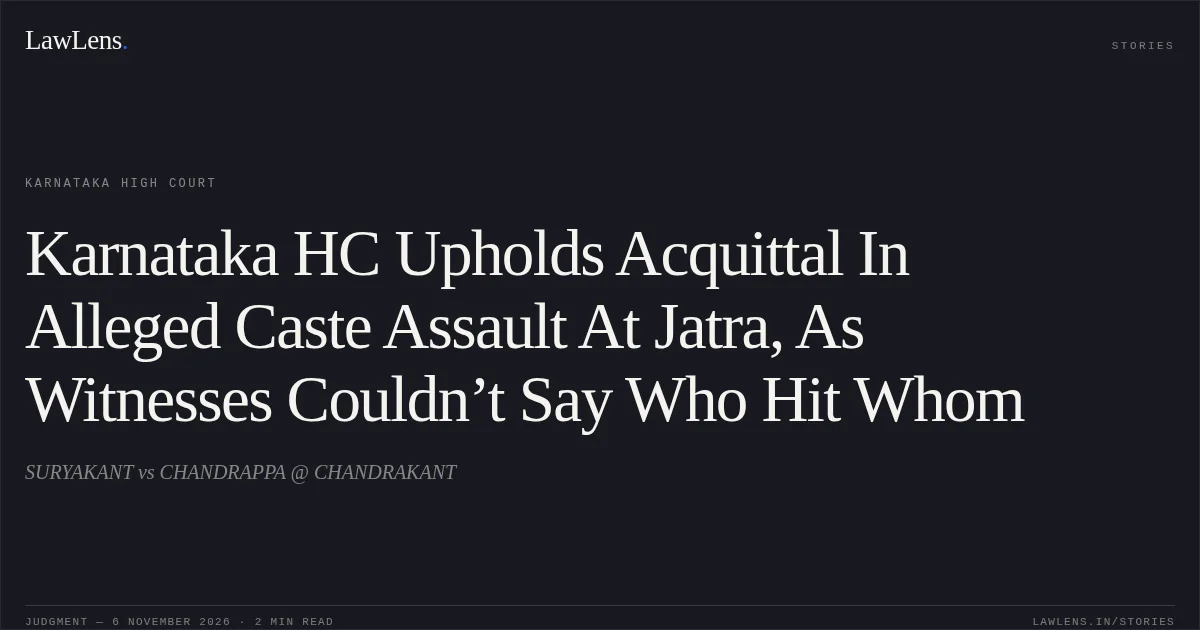
The prosecution alleged that, during a village fair on 25 March 2018, accused No. 1 insulted a tea-stall operator by referring to his caste and damaged his stall, and that the following morning the accused formed an unlawful assembly and assaulted and intimidated members of the complainant’s group.
pp. 5–9The accused were charged under various provisions of the Indian Penal Code, 1860, and the Scheduled Castes and Scheduled Tribes (Prevention of Atrocities) Act, 1989. The Trial Court acquitted accused Nos. 1–16 on 24 September 2025. The de facto complainant appealed under Section 372 of the Code of Criminal Procedure, 1973 (Section 413 of the Bharatiya Nagarik Suraksha Sanhita, 2023)
pp. 5–902Issues
i.1. Whether the appellant established that the Trial Court’s acquittal was arbitrary or perverse
p. 10 · ¶ 8ii.2. Whether the Trial Court’s assessment of the evidence and its conclusion that the prosecution had not proved guilt beyond reasonable doubt warranted appellate interference
pp. 14–15 · ¶ 1003Law Applied
The Court considered the charged offences under Sections 143, 147, 148, 323, 324, 326, 354, 427, 504 and 506, read with Section 149 of the Indian Penal Code, and Sections 3(1)(r), 3(1)(s), 3(1)(w), 3(2)(v) and 3(2)(va) of the SC/ST (Prevention of Atrocities) Act
pp. 5–8On an appeal against acquittal, an appellate court considers whether the trial court’s view is a possible one on the evidence; the presumption of innocence is strengthened by acquittal, and interference is justified only on accepted legal grounds. The Court applied this principle from Jafarudheen and Others v. State of Kerala, 2022 SCC OnLine SC 495
p. 15 · ¶ 11Provisions in the judgment · 17 · Linked ones open on LawLens
Bharatiya Nagarik Suraksha Sanhita, 2023 Section 413
Code of Criminal Procedure, 1973 Section 372Section 207Section 313Section 378
Indian Penal Code, 1860 11 provisions
Section 143Section 147Section 148Section 149Section 323Section 324Section 326Section 354Section 427Section 504Section 506Scheduled Castes and the Scheduled Tribes (Prevention of Atrocities) Act, 1989 Section 3
04Reasoning
The Court found that the complainant could not identify which accused assaulted which person or specify the weapon used; several other witnesses likewise could not identify individual assailants or their weapons.
pp. 10–15 · ¶ 9–10The evidence was also considered against the background of a large crowd and a pending counter-case. Although 400–500 people were present, the investigating officer had not recorded statements from independent witnesses at the scene. These evidentiary deficiencies supported the Trial Court’s finding that the prosecution had not proved the accused’s guilt beyond reasonable doubt. The acquittal was therefore a possible view of the evidence, not an arbitrary or perverse one warranting appellate interference
pp. 10–15 · ¶ 9–1005Holding
The Court answered the issue of arbitrariness and perversity in the negative
pp. 15–16 · ¶ 12upheld the Trial Court’s acquittal of accused Nos. 1–16, and dismissed the criminal appeal
pp. 15–16 · ¶ 12 and OrderOriginal Court PDF
SURYAKANTvsCHANDRAPPA @ CHANDRAKANT
Click to open original judgment
Original judgment, available to read, download and summarize on LawLens.in