Facts
The petitioner instituted a suit for specific performance based on an agreement of sale dated 02.04.2012.
Source reference: paras. 23–28The plaint also relied on subsequent agreements dated 02.07.2012 and 21.09.2012, and a registered General Power of Attorney dated 08.08.2013, which recorded further payment and referred to pending litigation concerning the property.
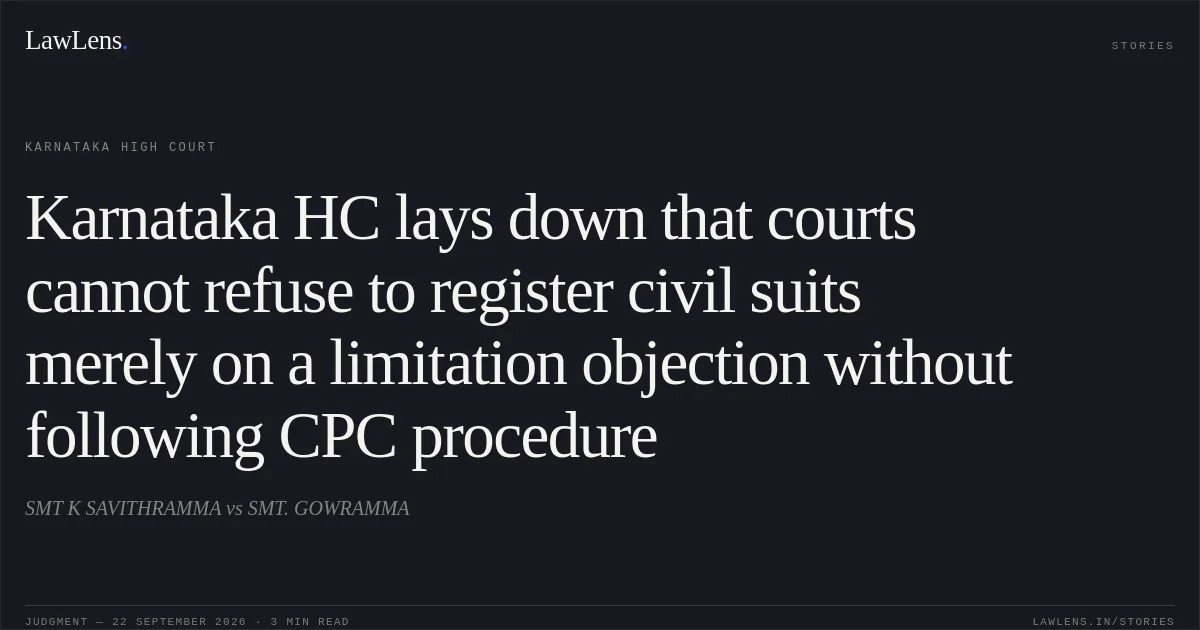
Source reference: paras. 23–28The Principal Senior Civil Judge and CJM, Chikkaballapur, declined to register the suit and returned the plaint on the ground that the claim was barred by the three-year limitation period under Article 54 of the Limitation Act, 1963, calculated from the date of the original agreement.
Source reference: para. 1; paras. 23–24The petitioner challenged that order under Article 227 of the Constitution.
Source reference: no citationIssues
Whether the Trial Court was justified in declining to register and returning the plaint on the ground that the suit for specific performance was barred by limitation under Article 54 of the Limitation Act, 1963?
Source reference: para. 22(i)Whether the Trial Court was required to consider the subsequent agreements and the registered General Power of Attorney before determining limitation?
Source reference: para. 22(ii)Whether the impugned order was liable to be interfered with under Article 227 of the Constitution?
Source reference: para. 22(iii)Law Applied
Section 26 and Order IV Rules 1 and 2 of the Code of Civil Procedure, 1908, distinguish presentation, scrutiny, admission and registration of a suit.
Source reference: paras. 4–7Order VII Rule 10 concerns return of a plaint for want of jurisdiction, whereas Order VII Rule 11(d) permits rejection only where the suit appears from the plaint itself to be barred by law.
Source reference: paras. 9–11Section 3 of the Limitation Act, 1963 makes dismissal of a time-barred suit mandatory, but the limitation question must first be properly adjudicated.
Source reference: paras. 16–18Under Article 54, a suit for specific performance must be filed within three years from the date fixed for performance, or, where no date is fixed, from the date when the plaintiff has notice that performance is refused.
Source reference: para. 19The Karnataka Civil Rules of Practice require scrutiny by the Registry but do not permit the Registry or the Court, at the registration stage, to treat a disputable limitation objection as a purely ministerial ground for refusing registration.
Source reference: paras. 12–15; para. 41Reasoning
The Trial Court mechanically calculated limitation from the original agreement dated 02.04.2012 and failed to consider the subsequent agreements, particularly the agreement dated 21.09.2012, under which the vendors undertook to secure disposal of pending litigation and thereafter execute the sale deed.
Source reference: paras. 23–26The registered General Power of Attorney dated 08.08.2013 also recorded the petitioner’s authority to represent the vendors in the pending litigation and acknowledged receipt of a further payment of Rs.12,30,000, making it a material subsequent document relevant to the subsistence and performance of the contractual obligation.
Source reference: paras. 27–28These documents could potentially affect the date fixed for performance, the date of refusal, acknowledgment, or the accrual of the cause of action under Article 54; their legal effect could not be determined without proper consideration.
Source reference: paras. 29–32Further, the Trial Court’s act of declining registration and returning the plaint was neither a valid adjudication under Order VII Rule 11(d) nor a proper dismissal under Section 3 of the Limitation Act.
Source reference: paras. 35–37However, the High Court expressly refrained from deciding whether the suit was ultimately within limitation or whether the subsequent documents legally extended or altered the limitation period.
Source reference: paras. 38–40Holding
The writ petition was allowed.
The order dated 02.08.2019 was quashed and set aside, and the matter was remitted to the Trial Court.
Source reference: para. 43(i)–(iii)The Trial Court was directed to register the suit, subject to compliance with law, and, if it proposed to examine limitation, to afford the plaintiff a reasonable opportunity of hearing and consider the plaint, the subsequent agreements dated 02.07.2012 and 21.09.2012, and the registered General Power of Attorney dated 08.08.2013.
Source reference: para. 43(iv)–(vii)All questions concerning limitation, the legal effect of the subsequent documents, and the merits of the specific-performance claim were left open.
Source reference: para. 43(viii)–(ix)Acts & Sections Cited
24 provisions across 2 statutes referred to in this judgment. Each provision opens on LawLens.
Code of Civil Procedure, 19081
Original Court PDF
SMT K SAVITHRAMMAvsSMT. GOWRAMMA
Click to open original judgment
Original judgment, available to read, download and summarize on LawLens.in