01Facts
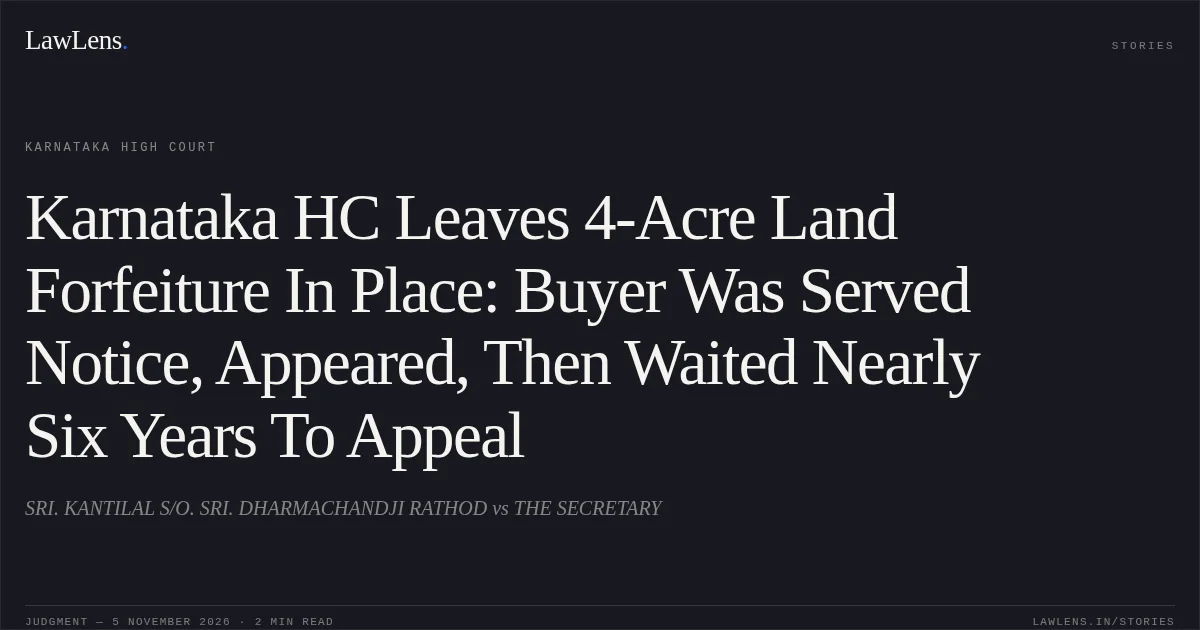
The appellant purchased four acres in Survey No. 295/F at Karajagi village in 2010, and the revenue entries were mutated in his name. Following a Tahsildar’s report that he did not belong to an agricultural family, the Assistant Commissioner, by order dated 26 December 2011, forfeited the land to the Government for alleged contravention of Sections 79A and 79B of the Karnataka Land Reforms Act, 1961 (KLR Act).
p. 3 · ¶ 3–4The appellant challenged that order before the Karnataka Appellate Tribunal on 18 December 2017, with an application to condone a delay of 5 years, 11 months and 22 days. The Tribunal rejected the application and dismissed the appeal as time-barred; the writ petition challenging that decision was dismissed by a learned Single Judge on 13 February 2023. The appellant then filed this writ appeal.
p. 4 · ¶ 502Issues
i.Whether the learned Single Judge’s refusal to interfere with the Tribunal’s rejection of the delay-condonation application called for interference
p. 8 · ¶ 8ii.Whether the appellant’s asserted merits—including his eligibility under Section 79A and the effect of the amendment to the income ceiling—required consideration despite his failure to establish sufficient cause for the delay
pp. 7–8 · ¶ 1103Law Applied
Under Section 5 of the Limitation Act, 1963, an applicant must establish “sufficient cause” for delay; the merits of the underlying case do not substitute for that requirement.
pp. 7–8 · ¶ 11The Court relied on Pathapati Subba Reddy (Died) by LRs v. Special Deputy Collector (LA), which states that a delay application must be decided by applying the principles governing condonation, and that the merits need not be considered at that stage; it also relied on Esha Bhattacharjee v. Managing Committee of Raghunathpur Nafar Academy and Basawaraj v. Special Land Acquisition Officer, which hold that a liberal approach does not extend to negligence, inaction or lack of bona fides. The Court applied the principle vigilanti bus non dormientibus jura subveniunt—the law assists the vigilant, not those who sleep over their rights.
pp. 7–8 · ¶ 11 · p. 8 · ¶ 12Provisions in the judgment · 5 · Linked ones open on LawLens
KARNATAKA HIGH COURT ACT, 1961 Section 4
KARNATAKA LAND REFORMS ACT, 1961 Section 82Section 83Section 118
Limitation Act, 1963 Section 5
04Reasoning
The Court found that the appellant’s claim that he had not been served was contradicted by the original-authority records: notice had been served on 5 November 2011 under an acknowledgment bearing his signature, he appeared on 9 November 2011 and sought time to produce documents, and he later failed to appear on the scheduled dates. His separate assertion that illness prevented him from acting was unsupported by any document. The Court therefore concluded that he knew of the proceedings but remained inactive for nearly six years, and had not shown sufficient cause for the delay.
p. 7 · ¶ 9–10In those circumstances, the claimed strength of his case on eligibility and the amendment’s effect did not require examination in deciding the delay application.
p. 8 · ¶ 1105Holding
The Court answered the issue of interference in the negative and dismissed the writ appeal.
p. 9 · ¶ 13It confirmed the Single Judge’s order dated 13 February 2023 and, consequently, the Tribunal’s order dated 12 March 2020 dismissing the appeal as time-barred; there was no order as to costs.
p. 9 · ¶ 13Original Court PDF
SRI. KANTILAL S/O. SRI. DHARMACHANDJI RATHODvsTHE SECRETARY
Click to open original judgment
Original judgment, available to read, download and summarize on LawLens.in