01Facts
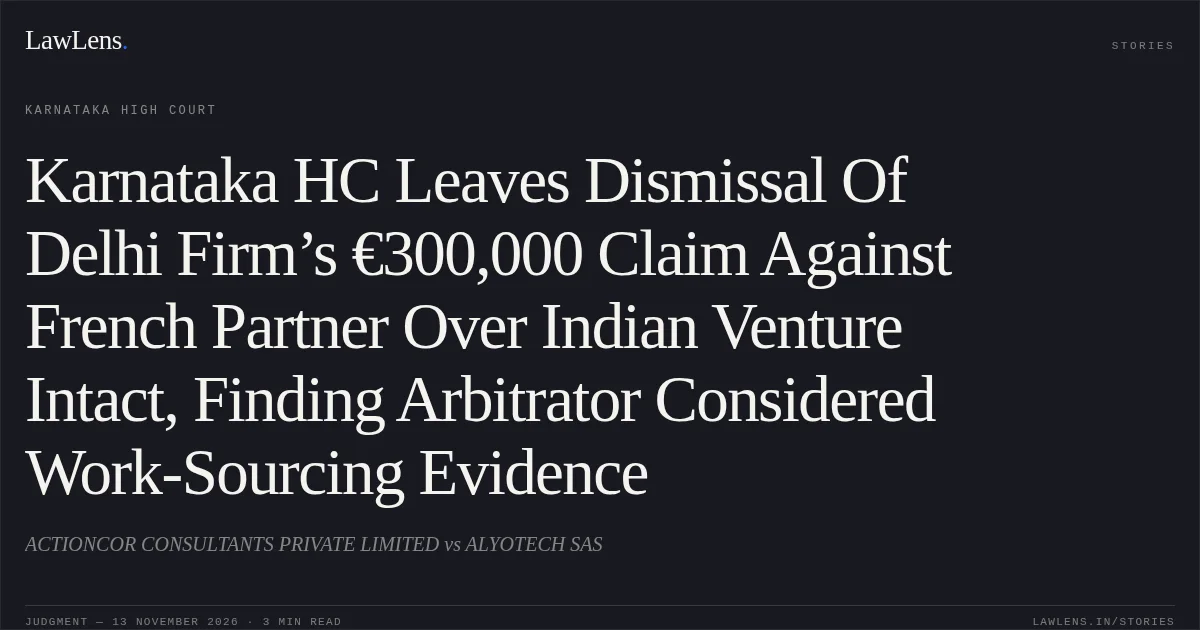
The parties entered into a Shareholders’ Agreement concerning their joint investment in Winfoware Technologies Ltd. (WTL).
¶ 1–4Actioncor alleged that Alyotech breached its obligations to use “best efforts” to refer and outsource work to WTL, provide training and support, and comply with other contractual obligations.
¶ 1–4The sole arbitrator dismissed both Actioncor’s claims and Alyotech’s counterclaim.
¶ 1–4Actioncor challenged the award under Section 34 of the Arbitration and Conciliation Act, 1996, alleging, among other grounds, departure from the agreed arbitral procedure, delay, inadequate reasons, and failure to apply the “best efforts” standard.
¶ 5.1–5.13The High Court recorded that the parties had presented oral evidence and submissions, and that the arbitrator had delivered the award on 25 April 2017.
¶ 11–1802Issues
i.Whether the award breached the parties’ agreed arbitral procedure and was liable to be set aside under Section 34(2)(a)(v) of the Act
¶ 10(i)ii.Whether the delay in delivering the award warranted setting it aside
¶ 10(ii)iii.Whether the award conflicted with the fundamental policy of Indian law by failing to apply the “best efforts” obligation in the Shareholders’ Agreement
¶ 10(iii)iv.Whether the award lacked reasons or mindful consideration of Actioncor’s case, contrary to Section 31(3)(a) of the Act
¶ 10(iv)03Law Applied
Section 34 permits only limited review of an arbitral award; the court does not reappreciate evidence, and intervention is available on the statutory grounds, including conflict with the public policy of India and, for a domestic award, patent illegality apparent on its face.
¶ 9, 26–29, 54–56Patent illegality must go to the root of the matter; a possible interpretation of the contract or an allegedly erroneous application of law is insufficient, while an award based on no evidence or ignoring vital evidence may be vulnerable.
¶ 9, 26–29, 54–56Section 31(3)(a) requires an award to state reasons, unless the parties have agreed otherwise.
¶ 5.2Under Lancor Holdings Ltd. v. Prem Kumar Menon, delay alone does not invalidate an award; the challenger must show an adverse effect on the award’s decision-making.
¶ 19The court considered Jai Narain Parasrampuria v. Pushpa Devi Saraf and Rhodia International Holdings Ltd. v. Huntsman International on the distinction between “best efforts” and less stringent efforts obligations.
¶ 31–33Section 73 of the Indian Contract Act, 1872, requires a basis for compensation in an established breach and proved loss.
¶ 49Provisions in the judgment · 10 · Linked ones open on LawLens
Arbitration and Conciliation Act, 1996 9 provisions
Section 5Section 14Section 18Section 28Section 31Section 34Section 37Section 75Section 81Indian Contract Act, 1872 Section 73
04Reasoning
The court found no procedural breach: although the agreed process contemplated a documents-only arbitration, the arbitrator allowed oral evidence and arguments at the parties’ request, and both sides participated fully.
¶ 11–14The delay did not justify setting aside the award because Actioncor failed to show that it adversely affected the arbitrator’s findings; the record included extensive evidence and submissions.
¶ 15–20On the merits, the arbitrator had considered the contractual “best efforts” obligation, the evidence of Alyotech’s business-development activities, and the cited authorities.
¶ 22–38, 54–58The High Court held that Actioncor’s challenge largely sought a reassessment of that evidence, which Section 34 does not permit.
¶ 22–38, 54–58It also found that the arbitrator had addressed the relevant documentary and oral evidence and that Actioncor had not established the investment and corresponding loss necessary to sustain its compensation claim.
¶ 44–49The arbitrator’s interpretation of the provisions concerning the Canadian operation was a possible contractual interpretation and therefore not open to substitution by the court.
¶ 50–5305Holding
The High Court answered the issues against Actioncor, holding that the alleged procedural departure, delay, failure to apply the “best efforts” standard, and inadequate reasoning did not establish a ground for interference under Section 34.
¶ 14, 20, 38–39, 58–60The petition was dismissed.
¶ 61Original Court PDF
ACTIONCOR CONSULTANTS PRIVATE LIMITEDvsALYOTECH SAS
Click to open original judgment
Original judgment, available to read, download and summarize on LawLens.in