01Facts
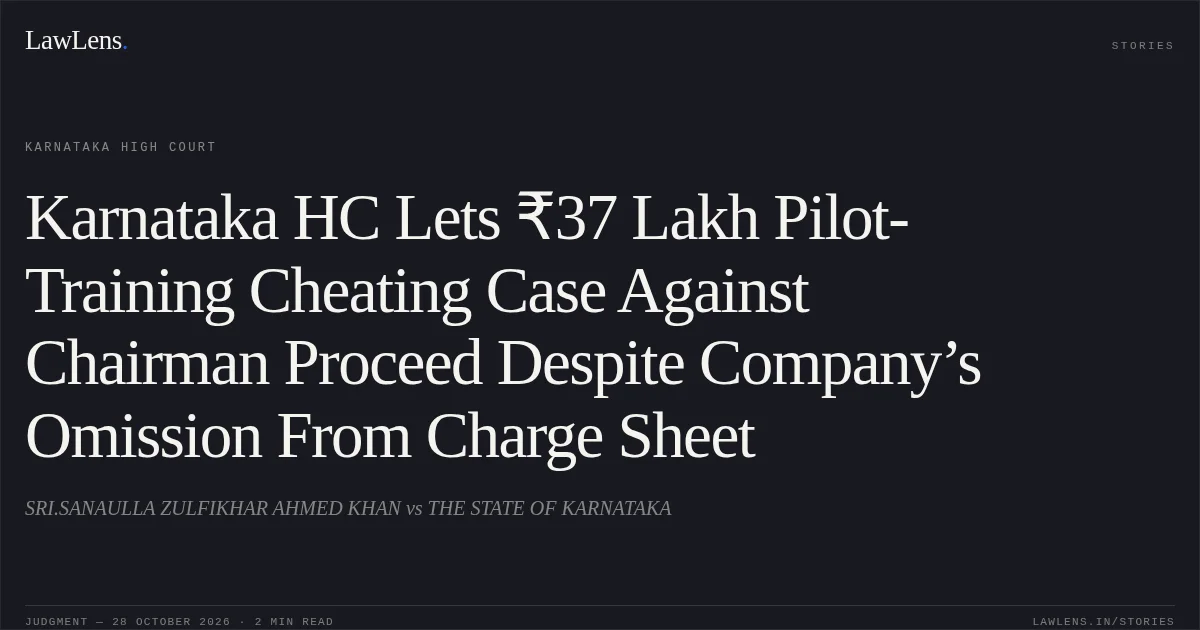
The complainant alleged that he paid ₹37,00,000 by RTGS to Shikha Developers Company in February 2015 after being promised pilot training. No training was provided. When repayment was sought, a cheque for ₹15,00,000 was honoured, while cheques for the remaining ₹22,00,000 were dishonoured.
p. 3 · ¶ 2The petitioner, alleged to be the company’s Chairman, was charge-sheeted with another accused for offences under Sections 120B, 406 and 420 read with Section 34 IPC. The company was not arraigned as an accused.
pp. 3, 8–9 · ¶ 2, 10–11The petitioner sought to quash the charge sheet and proceedings under Section 482 CrPC, arguing, among other things, that there was no initial intention to cheat and that prosecution was barred because the company had not been made an accused.
pp. 3–6 · ¶ 3–602Issues
i.Whether the charge sheet and proceedings against the petitioner warranted quashing under Section 482 CrPC where the allegations concerned non-performance of a promise and dishonoured repayment cheques.
pp. 3–8 · ¶ 3, 8–10ii.Whether the company’s omission as an accused required quashing the proceedings against the petitioner.
pp. 8–10 · ¶ 11–1203Law Applied
Section 482 CrPC empowers the High Court to prevent abuse of process and secure the ends of justice.
For cheating under Section 420 IPC, dishonest intention must exist at the inception of the transaction; the Court referred to Delhi Race Club (1940) Ltd. v. State of Uttar Pradesh, (2024) 10 SCC 690.
p. 5 · ¶ 5The Court also considered G. Sagar Suri v. State of U.P., (2000) 2 SCC 636, distinguishing a prosecution lacking specific allegations of an accused’s role from one containing such allegations.
pp. 4–5, 7–8 · ¶ 4, 9–10On the omission of the company, it considered the petitioner’s reliance on Aneeta Hada and stated that, under Section 319 CrPC, the company could be added during trial if evidence warranted it.
pp. 5–6, 8–9 · ¶ 6, 11Provisions in the judgment · 6 · Linked ones open on LawLens
Code of Criminal Procedure, 1973 Section 482Section 319
Indian Penal Code, 1860 Section 420Section 406Section 34
Negotiable Instruments Act, 1881 Section 138
04Reasoning
The Court found specific allegations that the petitioner and the co-accused, identified respectively as Chairman and Managing Director, were involved in the company’s affairs and obtained the complainant’s money on a promise of pilot training that was not provided.
pp. 7–8 · ¶ 10Whether the accused had dishonest intent when receiving the money was, in the Court’s view, a matter for trial; the dishonoured repayment cheques and the alleged failure to provide training did not justify quashing at this stage.
p. 8 · ¶ 10It distinguished G. Sagar Suri because, unlike that case, the present charge sheet contained specific allegations concerning the petitioner’s role.
pp. 7–8 · ¶ 9–10The company’s omission was attributed to an investigative lapse; the Court held that it did not, in the circumstances, exonerate the petitioner, particularly as the company had been accused in the complaint and could potentially be added under Section 319 CrPC if evidence supported doing so.
pp. 8–10 · ¶ 11–1205Holding
The Court answered both issues against the petitioner.
p. 10 · ¶ 12–13It held that the allegations and the question of initial dishonest intent required consideration at trial, and that the company’s omission from the charge sheet did not warrant quashing the proceedings against the petitioner.
p. 10 · ¶ 12–13The criminal petition was dismissed.
p. 10 · ¶ 12–13Original Court PDF
SRI.SANAULLA ZULFIKHAR AHMED KHANvsTHE STATE OF KARNATAKA
Click to open original judgment
Original judgment, available to read, download and summarize on LawLens.in