01Facts
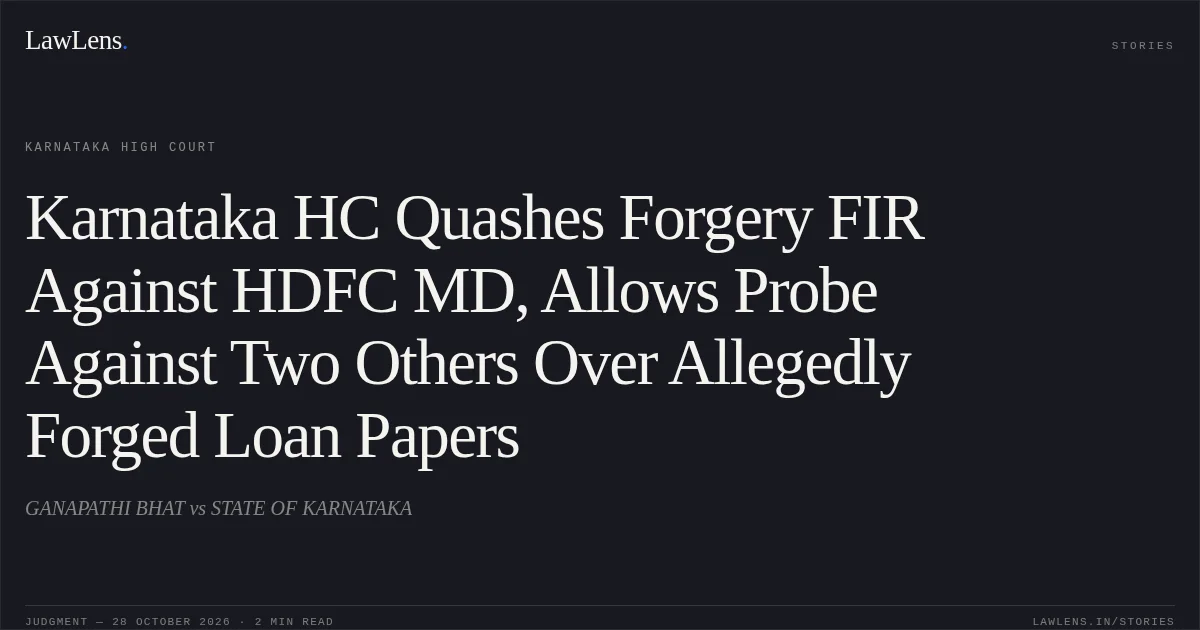
Respondent No. 3 filed a private complaint alleging that bank officials forged his signatures, manipulated records and used forged documents in connection with a car loan and top-up loan.
¶ 2–7 · pp. 3–7The Magistrate referred the complaint for investigation under Section 156(3) Cr.P.C.
¶ 2–7 · pp. 3–7The petitioners—identified in the judgment as the bank’s branch manager and managing director—sought to quash the complaint and FIR under Section 482 Cr.P.C.
¶ 2–7 · pp. 3–7They argued, among other things, that the complaint lacked the affidavit required for a Section 156(3) referral and that the managing director was implicated without specific allegations.
¶ 2–7 · pp. 3–7The complainant relied on documents and a preliminary report said to indicate forgery.
¶ 2–7 · pp. 3–702Issues
i.Whether the complaint and FIR should be quashed because the complainant had not filed the affidavit required when seeking a referral under Section 156(3) Cr.P.C.
¶ 3, 6 · p. 3, 6ii.Whether the allegations and materials disclosed grounds to investigate the alleged forgery and manipulation against the bank officials, or whether the proceedings should be quashed under Section 482 Cr.P.C.
¶ 8–10 · pp. 7–9iii.Whether the proceedings could continue against the managing director in the absence of specific allegations against him
¶ 8 · p. 703Law Applied
Section 156(3) Cr.P.C. permits a Magistrate to refer a complaint for police investigation before taking cognizance; Priyanka Srivastava v. State of Uttar Pradesh, (2015) 6 SCC 287, requires an application invoking that power to be supported by an affidavit.
¶ 3, 9 · p. 3, 8Under Dineshbhai Chandubhai Patel v. State of Gujarat, (2018) 3 SCC 104, the court considering a request to quash must examine whether the complaint’s contents disclose an offence and should not quash proceedings where they do.
¶ 9 · p. 8The Court also considered the petitioners’ reliance on Sections 46A and 47 of the Banking Regulation Act, 1949, but held that the asserted protection did not prevent investigation into allegations of criminal forgery.
¶ 4–5, 10 · pp. 4–5, 9Provisions in the judgment · 9 · Linked ones open on LawLens
Code of Criminal Procedure, 1973 Section 154Section 156Section 482
Indian Penal Code, 1860 Section 34Section 418Section 420Section 468
Banking Regulation Act, 1949 Section 46Section 47
04Reasoning
The Court found that the complaint was supported by a detailed affidavit and that the Magistrate’s Section 156(3) referral was a pre-cognizance order, so the petitioners’ affidavit objection and reliance on an earlier decision concerning cognizance did not warrant quashing.
¶ 6, 9 · p. 6, 8The complaint specifically alleged forged signatures and manipulation of records, and the complainant had produced material said to provide prima facie support; the Court held that these allegations required investigation, rather than determination at the quashing stage.
¶ 7–10 · pp. 7–9By contrast, it found no specific allegations capable of sustaining criminal proceedings against the managing director, who was arraigned as accused No. 3.
¶ 8 · p. 705Holding
The petition was allowed in part.
¶ 11 · p. 10The complaint and FIR in Crime No. 50/2021 were quashed insofar as they concerned accused No. 3, the managing director, for the alleged offences under Sections 418, 420, 468 and 477A read with Section 34 IPC.
¶ 11 · p. 10The petition was dismissed as to accused Nos. 1 and 2, against whom the investigation was permitted to proceed.
¶ 11 · p. 10Original Court PDF
GANAPATHI BHATvsSTATE OF KARNATAKA
Click to open original judgment
Original judgment, available to read, download and summarize on LawLens.in