01Facts
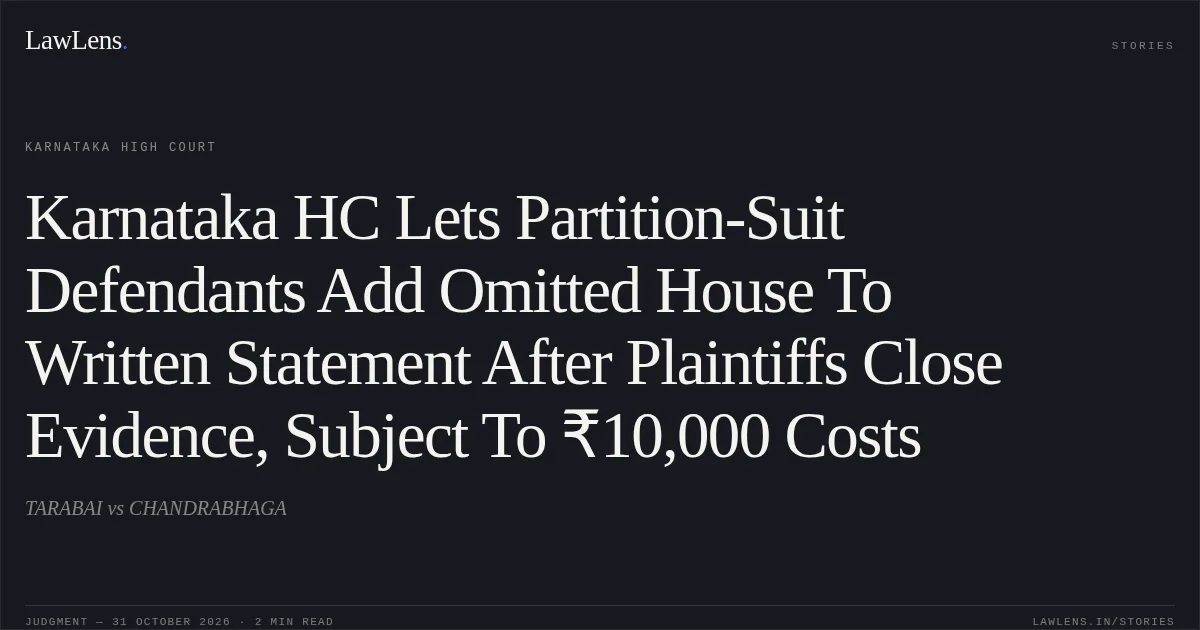
Respondent Nos. 5–7 had filed a partition suit. Petitioner No. 2 filed a written statement and counterclaim.
¶ 1After the plaintiffs closed their evidence and the matter was posted for the defendants’ evidence, the petitioners sought leave under Order VI Rule 17 CPC to amend the written statement by adding a house property allegedly omitted from the plaint schedule.
¶ 2They said they had been unable to obtain the property details and extract from the Gram Panchayat when filing the written statement. The Trial Court rejected the application with costs of ₹3,000. The petitioners challenged that order under Article 227 of the Constitution.
¶ 402Issues
i.Whether the petitioners should be permitted to amend their written statement to include the omitted house property at the stage when the defendants’ evidence was due.
¶ 2 · ¶ 7ii.Whether the Trial Court’s refusal of the amendment warranted interference under Article 227.
¶ 1 · ¶ 903Law Applied
Order VI Rule 17 CPC governs amendments to pleadings; its proviso requires the court to be satisfied that, despite due diligence, the party could not have raised the matter before commencement of trial.
¶ 8The Court relied on Haram ani Sahoo and Others v. Lalita Nayak and Others, 2026 SCC OnLine SC 2123, including the principles that prejudice caused by additional pleadings may be addressed by allowing a response and imposing costs, and that an amendment may be appropriate to avoid fragmented proceedings or inconsistent findings.
¶ 8The cited decision also made clear that allowing an amendment does not determine its merits or foreclose objections to maintainability, limitation, title, or other issues.
¶ 804Reasoning
The Court considered that the proposed amendment sought to add a property allegedly left out of the plaint schedule and held that doing so would not change the nature of the case or its cause of action.
¶ 7Applying the approach in Haramani Sahoo, it concluded that the Trial Court’s refusal was arbitrary and erroneous, and that interference was warranted.
¶ 9Although the amendment was sought after the plaintiffs had closed their evidence, the judgment does not separately set out a factual finding on the proviso’s due-diligence requirement; it refers to the Supreme Court’s discussion of that requirement.
¶ 2 · ¶ 805Holding
The High Court allowed the writ petition, set aside the Trial Court’s order dated 25 July 2025, and allowed the amendment application.
¶ 10The relief was conditional on the petitioners paying ₹10,000 to respondent Nos. 5–7 before the next hearing before the Trial Court.
¶ 10Original Court PDF
TARABAIvsCHANDRABHAGA
Click to open original judgment
Original judgment, available to read, download and summarize on LawLens.in