01Facts
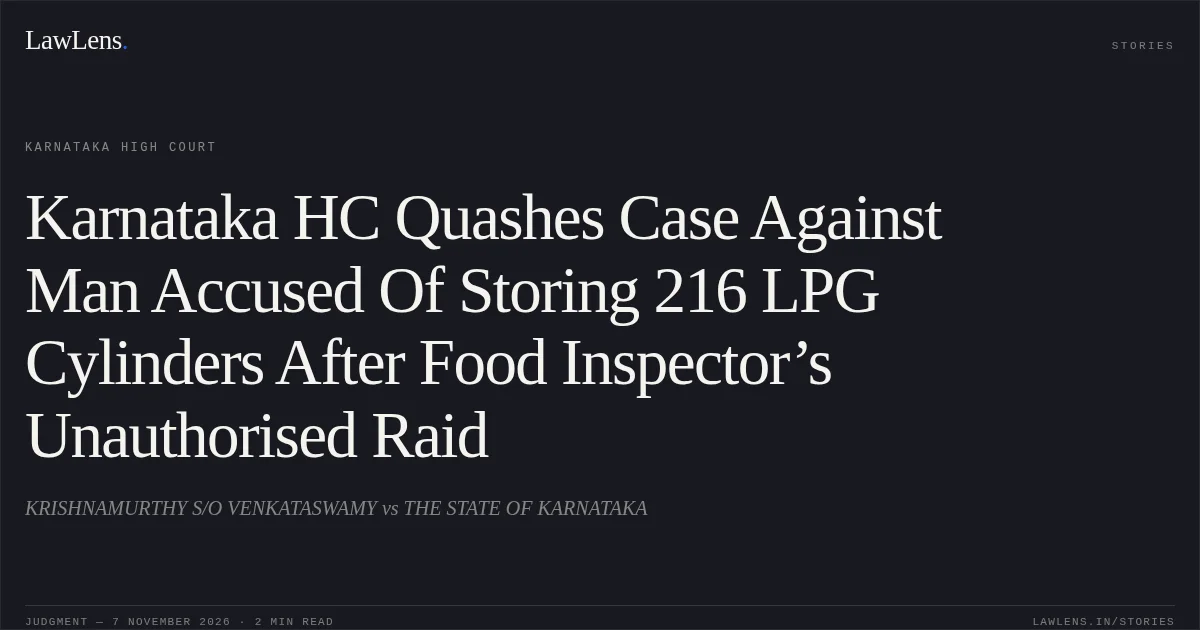
A Food Inspector alleged that the petitioner had illegally stored and refilled LPG cylinders for commercial purposes.
After receiving information on 8 August 2026, the Inspector searched the petitioner’s premises and seized 216 cylinders—186 empty and 30 filled—without first obtaining a search warrant or informing the local police.
pp. 2–3 · ¶ 2–3 · pp. 5–6 · ¶ 7–9He lodged a complaint the following day, leading to registration of Crime No. 151/2026 for offences under Sections 3 and 7 of the Essential Commodities Act, 1955, and Section 287 of the Bharatiya Nyaya Sanhita, 2023.
pp. 2–3 · ¶ 2–3 · pp. 5–6 · ¶ 7–9The petitioner sought to quash the proceedings, contending that the Food Inspector lacked authority under Clause 13 of the Liquefied Petroleum Gas (Regulation of Supply and Distribution) Order, 2000, and that the statutory procedure for cognizable or non-cognizable offences had not been followed.
pp. 3–5 · ¶ 5 · pp. 7–8 · ¶ 1202Issues
i.1. Whether the Food Inspector was authorised under Clause 13 of the LPG Order, 2000, to search for and seize the cylinders in the circumstances of this case.
pp. 3–4 · ¶ 5 · p. 7 · ¶ 11ii.2. Whether the search and seizure, and the subsequent proceedings, could stand when the Inspector did not obtain a search warrant or comply with the applicable procedure under Sections 154 or 155 of the Cr.P.C.
pp. 6–8 · ¶ 10–1203Law Applied
Clause 13 of the Liquefied Petroleum Gas (Regulation of Supply and Distribution) Order, 2000, empowers specified and duly authorised government officers, or authorised officers of a government oil company, to search and seize petroleum products, including LPG cylinders; the court stated that the officer conducting the search must have the requisite authority and secure a search warrant.
pp. 3–4 · ¶ 5 · pp. 6–7 · ¶ 10–11The court also applied Sections 154 and 155(1)–(2) of the Cr.P.C.: information disclosing a cognizable offence is to be dealt with under Section 154, while a non-cognizable case requires compliance with the procedure in Section 155, including the required order before investigation.
pp. 7–8 · ¶ 12Referring to Lalita Kumari , the court noted the duty to register a case where information discloses a cognizable offence.
p. 7 · ¶ 12Provisions in the judgment · 7 · Linked ones open on LawLens
Bharatiya Nagarik Suraksha Sanhita, 2023 Section 528
Code of Criminal Procedure, 1973 Section 482Section 154Section 155
Essential Commodities Act, 1955 Section 3Section 7
Bharatiya Nyaya Sanhita, 2023 Section 287
04Reasoning
The court found that the Food Inspector had conducted the search and seized the cylinders without obtaining a search warrant, and that the record did not establish his authority under Clause 13 of the LPG Order.
pp. 6–7 · ¶ 8–11It further observed that the Inspector had not informed the jurisdictional police before the raid, despite the police station being nearby.
p. 6 · ¶ 10The court concluded that the process was defective whichever classification applied: if the alleged offences were cognizable, the procedure under Section 154 had not been followed; if they were non-cognizable, the requirements of Sections 155(1) and 155(2) had not been met.
pp. 7–8 · ¶ 12In the court’s view, these failures rendered continuation of the proceedings an abuse of process.
05Holding
The High Court allowed the petition and quashed, insofar as the petitioner was concerned, the entire proceedings in Crime No. 151/2026 of Hosahalli Police Station for the alleged offences under Sections 3 and 7 of the Essential Commodities Act, 1955, and Section 287 of the Bharatiya Nyaya Sanhita, 2023.
p. 8, OrderPending interlocutory applications were disposed of as no longer requiring consideration.
p. 8, OrderOriginal Court PDF
KRISHNAMURTHY S/O VENKATASWAMYvsTHE STATE OF KARNATAKA
Click to open original judgment
Original judgment, available to read, download and summarize on LawLens.in