Facts
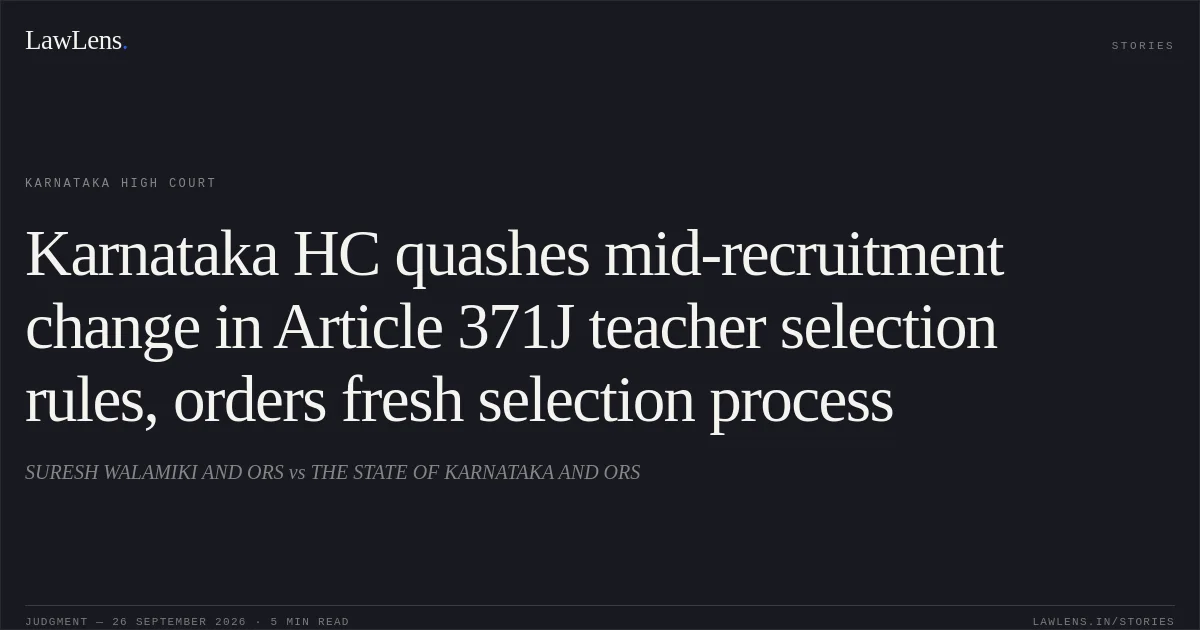
The petitioners were aspirants for appointment as Graduate Primary Teachers for Classes 6–8 in the Hyderabad-Karnataka region under the reservation framework contemplated by Article 371J of the Constitution.
Source reference: pp. 43–45; para. 2(g)–(h)The State issued recruitment notifications on 21 March 2022 for Kalaburagi and Bidar Districts, followed by amendments on 22 and 23 March 2022. The accompanying instructions provided for a single statewide competitive examination, district-wise selection, and an option to Hyderabad-Karnataka local candidates to be considered either for local-cadre or non-local/residual-cadre posts, subject to the applicable consequences under Article 371J.
Source reference: pp. 43–45; para. 2(g)–(h)A 1:2 verification list was published on 29 September 2022, document verification was completed on 12 October 2022, and provisional select lists were published on 18 November 2022. Several petitioners, predominantly non-Hyderabad-Karnataka candidates, were included in those provisional lists for non-local-cadre posts.
Source reference: p. 45; para. 2(i)–(l)On 1 February 2023, during the recruitment process, the Department of Personnel and Administrative Reforms (“DPAR”) issued a circular withdrawing the earlier arrangement under which local candidates had to exercise an option between local and non-local cadres. The circular required local candidates to be considered first for non-local-cadre posts and thereafter for local-cadre posts.
Source reference: pp. 46–48; para. 2(m)–(o)Following the circular, fresh provisional select lists were issued on 27 February 2023, and the petitioners who had appeared in the earlier provisional lists were excluded.
Source reference: pp. 46–48; para. 2(m)–(o)The petitioners challenged the subsequent selection process and the Tribunal’s orders before the High Court under Articles 226 and 227 of the Constitution. The High Court clubbed the matters because they raised a common issue concerning the legality of changing the recruitment procedure after commencement of the selection process.
Source reference: pp. 38–39; para. 1Issues
Whether the State could alter the prescribed procedure for allocation between local-cadre and non-local-cadre posts after commencement of the recruitment process and publication of provisional select lists.
Source reference: pp. 57–61, 64–66; paras. 10–16Whether the DPAR Circular dated 1 February 2023 was arbitrary and violative of Articles 14 and 16 of the Constitution because it displaced candidates provisionally selected under the procedure notified at the commencement of recruitment.
Source reference: pp. 59–66; paras. 11–16Whether the Tribunal’s orders upholding the circular and consequential select lists were liable to be quashed.
Source reference: pp. 67–69; paras. 17–18Law Applied
The Court applied Articles 14 and 16 of the Constitution, which prohibit arbitrary State action and require fairness and equality in public employment.
Source reference: pp. 58–59; para. 11It considered Article 371J and the State of Karnataka (Special Responsibility of Governor for Hyderabad-Karnataka Region) Order, 2013, together with the Karnataka Public Employment (Reservation in Appointment for Hyderabad-Karnataka Region) framework, which provide for reservation and cadre arrangements for persons belonging to the Hyderabad-Karnataka region.
Source reference: pp. 40–42; para. 2(a)–(c)The Court relied principally on the Constitution Bench decision in Tej Prakash Pathak v. Rajasthan High Court, (2025) 2 SCC 1, for the rule that eligibility criteria and the governing rules of recruitment cannot be changed midway unless the extant rules or the advertisement permit such change, and even then the change must satisfy Article 14 and the requirement of non-arbitrariness.
Source reference: pp. 48–50, 61, 64–65; paras. 3, 13, 15The Court further directed compliance with the coordinate Bench’s judgment in Narendra Babu G.V. v. State of Karnataka, W.A. Nos. 305 of 2023 and connected matters, decided on 12 October 2023.
Source reference: pp. 66–68; paras. 17–18Reasoning
The Court held that the recruitment notifications and special instructions had already prescribed the governing procedure: Hyderabad-Karnataka local candidates were required to exercise an option concerning local- or non-local-cadre posts, and the petitioners applied on the basis that the non-local/residual cadre would provide them a genuine opportunity for selection.
Source reference: pp. 60–64; paras. 12–14The DPAR circular was issued nearly one year after the recruitment notifications and after publication of the provisional select lists, thereby changing the operative selection procedure during the recruitment process.
Source reference: p. 66; para. 16The State’s argument that the circular merely filled a procedural gap was rejected because the field was not unregulated; an operative procedure had already been prescribed by the recruitment notifications and earlier circulars.
Source reference: p. 61; para. 13Although the circular was intended to improve the prospects of local candidates and advance the object of Article 371J, the Court held that this objective could not justify retrospectively altering the selection procedure to the prejudice of candidates who had participated under the original rules.
Source reference: pp. 62–66; paras. 14–16The new arrangement enabled local candidates to compete first for non-local posts and then seek local-cadre posts, while displacing petitioners who had been included in the earlier provisional select lists. This differential advantage was found to be arbitrary and inconsistent with Articles 14 and 16.
Source reference: pp. 62–66; paras. 14–16The Court therefore applied the rule against changing the “rules of the game” midway and concluded that the impugned circular could not be sustained, even if the State possessed general authority to issue implementation directions under the Article 371J framework.
Source reference: pp. 55–56, 64–66; paras. 6, 15–16Holding
The writ petitions were allowed.
The High Court quashed the Tribunal’s orders, including the orders dated 31 January 2024, 18 January 2024 and 5 July 2024, which had upheld the impugned selection process.
Source reference: p. 67; para. 18(ii)The DPAR Circular dated 1 February 2023 was quashed as an impermissible and arbitrary alteration of the recruitment procedure.
Source reference: pp. 67–68; para. 18(iii)The provisional select lists dated 27 February 2023, the main select list dated 8 March 2023, and all subsequent provisional or final lists relating to the recruitment of Graduate Primary Teachers in the Hyderabad-Karnataka region were also set aside.
Source reference: p. 68; para. 18(iv)The concerned Selection and Recruitment Authorities were directed to redo the selection process without relying on the impugned circular, while complying with the directions in Narendra Babu G.V., and to prepare a fresh provisional list.
Source reference: pp. 68–69; paras. 18(v)–(vi)They were thereafter directed to publish the final select list and issue appointment orders in accordance with the original recruitment notifications dated 21, 22 and 23 March 2022, as expeditiously as possible and, in any event, within three months from receipt of the certified copy of the judgment.
Source reference: pp. 68–69; paras. 18(v)–(vi)Original Court PDF
SURESH WALAMIKI AND ORSvsTHE STATE OF KARNATAKA AND ORS
Click to open original judgment
Original judgment, available to read, download and summarize on LawLens.in