Facts
On 25 January 2009, the prosecutrix alleged that, while returning home after fetching water, the appellant approached her from behind, touched and held her hands and chest with improper intent, tore her blouse, broke her bangle and struck her near the abdomen. She informed her husband after he returned from duty and lodged the report at Police Station Dharseewa on 26 January 2009
Source reference: para. 2The police investigated the matter, medically examined the prosecutrix, seized relevant articles, arrested the appellant and filed a charge-sheet
Source reference: para. 3The appellant was charged under Sections 323 and 354 of the Indian Penal Code and Section 3(1)(xi) of the Scheduled Castes and Scheduled Tribes (Prevention of Atrocities) Act, 1989
Source reference: para. 4The trial court convicted him under Section 354 IPC and sentenced him to six months’ rigorous imprisonment and a fine of ₹500, with two months’ further rigorous imprisonment in default
Source reference: para. 1In appeal, the appellant challenged the appreciation of evidence and relied on contradictions in the prosecutrix’s testimony
Source reference: para. 5Issues
Whether the prosecution proved beyond reasonable doubt that the appellant committed an offence punishable under Section 354 IPC against the prosecutrix?
Source reference: paras. 7–13Whether the material contradictions and inconsistencies in the prosecutrix’s testimony, together with the non-eyewitness nature of the supporting evidence, rendered the conviction unsafe?
Source reference: paras. 8–12Law Applied
The court applied Section 354 of the Indian Penal Code, which criminalises assault or use of criminal force against a woman with the intent to outrage, or knowledge that the act is likely to outrage, her modesty.
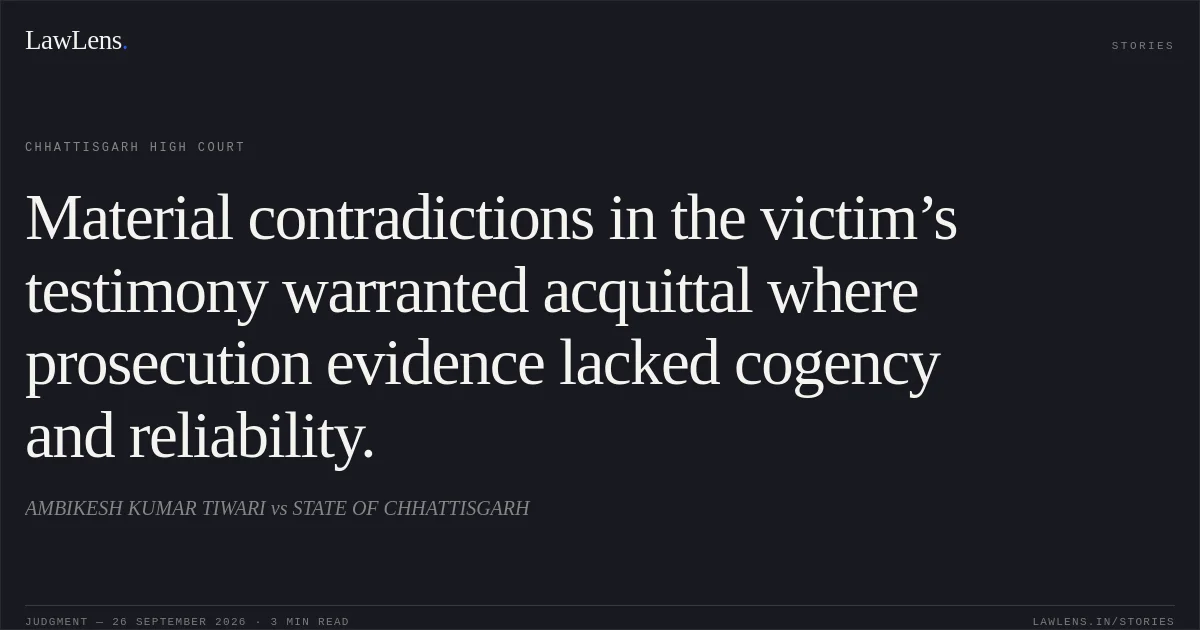
Source reference: no citationThe court also applied the general criminal-law principle that the prosecution must establish the charge through cogent and reliable evidence, and that a conviction cannot be sustained where the principal testimony contains material contradictions on the occurrence and identity of the offender.
Source reference: no citationThe charges under Sections 323 IPC and 3(1)(xi) of the Scheduled Castes and Scheduled Tribes (Prevention of Atrocities) Act were framed at trial, but the appellate conviction under consideration was under Section 354 IPC
Source reference: para. 4Reasoning
The High Court found material inconsistencies in the prosecutrix’s evidence. In examination-in-chief, she stated that the appellant came from behind, caught her and tore her blouse, and that her bangle broke when he caught her hand; after being declared hostile, she further stated that he had caught her hand and chest with improper intent
Source reference: para. 8However, in cross-examination, she stated that she was seeing the appellant for the first time in court and admitted that he had neither assaulted nor molested her
Source reference: para. 9The court treated this as a complete contradiction on the essential question of whether the appellant had committed the alleged act.
Source reference: no citationThe husband and the prosecutrix’s brother were not eyewitnesses; their evidence was based only on what the prosecutrix or another person allegedly told them.
Source reference: para. 10Their testimony also referred inconsistently to an allegation of rape, whereas the charge against the appellant concerned molestation under Section 354 IPC
Source reference: paras. 10–12In the absence of consistent and reliable evidence proving the occurrence and the appellant’s involvement, the prosecution failed to discharge its burden of proof
Source reference: para. 13Holding
The High Court held that the charge under Section 354 IPC was not proved by cogent and reliable evidence.
The appeal was allowed, the conviction and sentence imposed by the trial court were set aside, and the appellant was acquitted.
Source reference: para. 14As he was on bail, his bail bonds were discharged and he was not required to surrender
Source reference: para. 14Acts & Sections Cited
4 provisions across 3 statutes referred to in this judgment. Each provision opens on LawLens.
Indian Penal Code, 18602
Scheduled Castes and the Scheduled Tribes (Prevention of Atrocities) Act, 19891
Code of Criminal Procedure, 19731
Original Court PDF
AMBIKESH KUMAR TIWARIvsSTATE OF CHHATTISGARH
Click to open original judgment
Original judgment, available to read, download and summarize on LawLens.in