01Facts
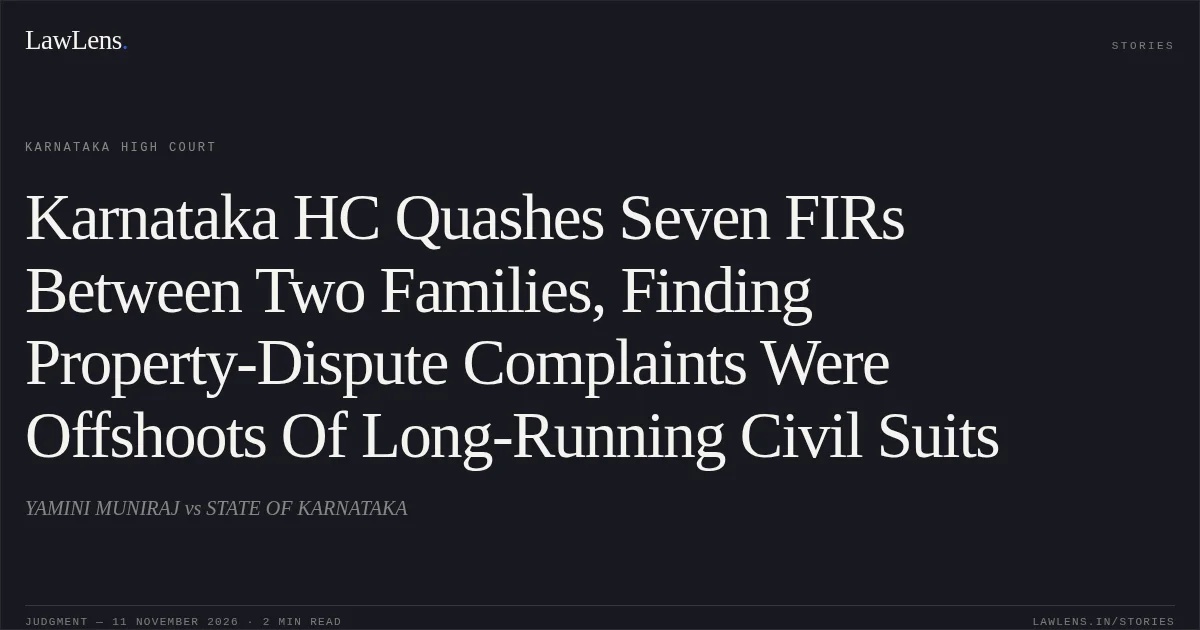
The connected petitions concerned seven cross-complaints registered between parties involved in long-running disputes over property and its possession.
The parties’ property disputes had generated civil proceedings over several years; the Court noted that the impugned criminal proceedings arose against that background and followed the civil litigation, including the dismissal of a suit in July 2023.
¶ 27–28The petitions sought to quash Crime Nos. 229/2023, 231/2023, 73/2025, 93/2025, 74/2025, 103/2025 and 305/2025.
¶ 4–24, 3102Issues
i.1. Whether the allegations in the complaints, taken at face value and in the context of the parties’ ongoing property disputes, disclosed the essential ingredients of the offences alleged.
¶ 25–30ii.2. Whether the registration and continuation of the cross-cases amounted to abuse of criminal process warranting the High Court’s inherent jurisdiction to quash them.
¶ 30–3103Law Applied
The Court applied the inherent jurisdiction to prevent abuse of process and secure the ends of justice, relying on the categories in State of Haryana v. Bhajan Lal, including cases where the allegations do not prima facie constitute an offence or proceedings are maliciously instituted to wreak vengeance.
¶ 30.1For wrongful restraint under IPC §§339–341, the prosecution must allege voluntary obstruction that prevents a person from proceeding in a direction in which they have a right to proceed; the Court relied on Keki Hormusji Gharda v. Meherwan Rustom Irani.
¶ 29.2.1For IPC §§503–504 and 506, criminal intimidation requires a threat accompanied by the requisite intent to cause alarm, while insult under §504 must be intentional and of a kind likely to provoke a breach of the peace; mere abuse is insufficient. The Court relied on Mohd. Wajid v. State of Uttar Pradesh and Madhushree Datta v. State of Karnataka.
¶ 29.3–29.4It also held that the complaints did not disclose the requisite conduct or intent for the offences concerning a woman’s modesty under BNS §§74–76 and 79.
¶ 29.5The Court further relied on authorities cautioning against using criminal proceedings to pursue essentially civil disputes or settle personal scores.
¶ 30.1–30.3Provisions in the judgment · 29 · Linked ones open on LawLens
Code of Criminal Procedure, 1973 Section 482Section 155Section 156Section 91
Indian Penal Code, 1860 12 provisions
Section 34Section 149Section 339Section 341Section 354Section 406Section 420Section 427Section 503Section 504Section 506Section 509Bharatiya Nyaya Sanhita, 2023 12 provisions
Section 3Section 74Section 75Section 76Section 79Section 115Section 118Section 126Section 190Section 324Section 329Section 351Bharatiya Nagarik Suraksha Sanhita, 2023 Section 528
04Reasoning
The Court examined the complaints alongside the history of the parties’ civil disputes and concluded that the allegations, as pleaded, did not establish the necessary elements of the offences charged.
¶ 29.1–29.5In particular, it found that the complaints did not adequately disclose wrongful restraint, the intent and circumstances required for intentional insult or criminal intimidation, or conduct meeting the statutory requirements for the alleged offences concerning women’s modesty.
¶ 29.1–29.5Considered in the context of repeated cross-complaints arising from the same property conflict, the Court inferred that the criminal proceedings were an offshoot of the civil disputes and were being used to give those disputes a criminal colour.
¶ 30It therefore found continuation of the prosecutions to be an abuse of process.
¶ 30.1–30.305Holding
The Court allowed all seven petitions.
¶ 31The Court quashed the impugned crimes in Crime Nos. 229/2023, 231/2023, 73/2025, 93/2025, 74/2025, 103/2025 and 305/2025.
¶ 31Original Court PDF
YAMINI MUNIRAJvsSTATE OF KARNATAKA
Click to open original judgment
Original judgment, available to read, download and summarize on LawLens.in