01Facts
The petitioners, Razorpay’s whole-time Director and Managing Director, sought to quash proceedings in Special C. No. 324 of 2026, including the cognizance order and summons, in which they were arrayed as Accused Nos. 8 and 9.
pp. 2–3The proceedings arose from an SFIO investigation, ordered under Section 212 of the Companies Act, 2013, into Jilian Consultants India Pvt. Ltd. and 32 other companies; Razorpay was not named in the investigation order.
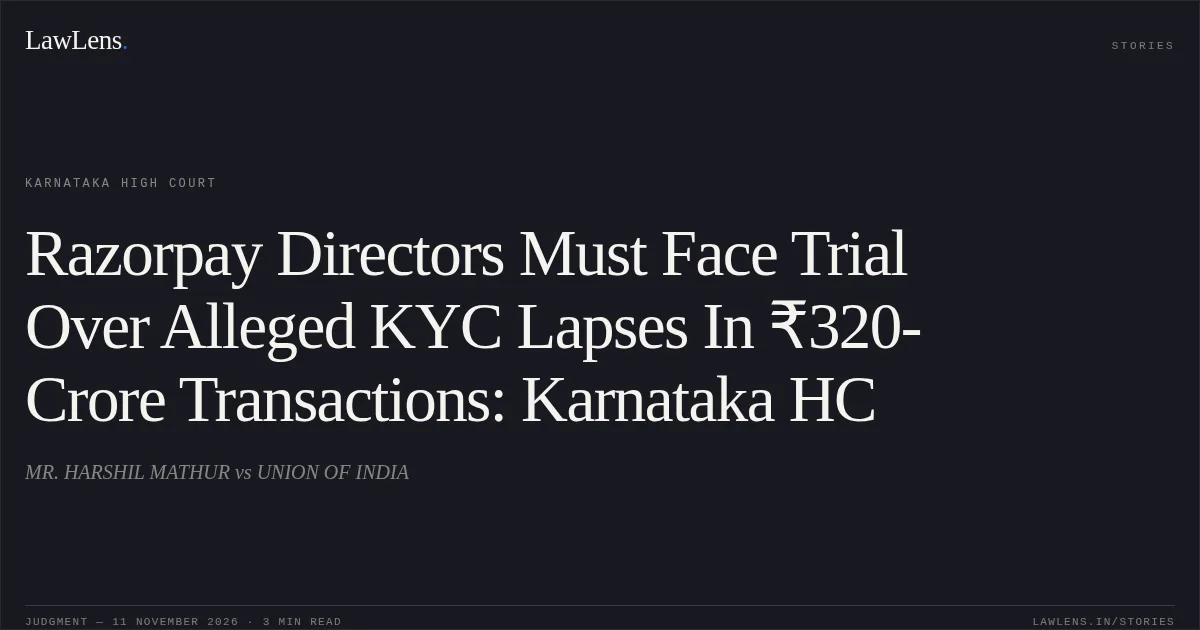
p. 3, 6The complaint alleged that Razorpay had processed approximately ₹320 crore in transactions for Mad Elephant Network Technology Pvt. Ltd. and that the petitioners failed to ensure adequate merchant onboarding, KYC verification, due diligence, and transaction monitoring. It alleged breach of directors’ duties under Section 166 of the Companies Act.
pp. 4–6, 10The petitioners challenged the SFIO’s jurisdiction, the absence of a specific offence or vicarious liability, limitation, and the validity of cognizance under the BNSS.
pp. 6–802Issues
i.1. Whether the SFIO investigation and prosecution could extend to the petitioners, who were not officers of a company named in the Section 212 investigation order, on the basis of their alleged connection to the company’s affairs.
pp. 6–7, 10–11ii.2. Whether the allegations against the petitioners disclosed a basis for prosecution under Section 166 of the Companies Act, including in the absence of Razorpay being made an accused.
pp. 7–8, 10–13iii.3. Whether the proceedings were liable to be quashed on the grounds of limitation or alleged non-compliance with Section 223(1) of the BNSS at the cognizance stage.
pp. 7–803Law Applied
Section 212(1) of the Companies Act permits the Central Government to assign an SFIO investigation into a company’s affairs, while Section 212(14) permits prosecution of the company, its officers or employees, and any other person directly or indirectly connected with its affairs.
pp. 10–11Section 166 concerns directors’ duties, including the duty to exercise due and reasonable care, skill, diligence, and independent judgment.
p. 5, 10The Court applied the principle that quashing jurisdiction under Section 528 of the BNSS is to be exercised sparingly and does not ordinarily permit a mini-trial or determination of disputed facts.
pp. 12–13Relying on Kaptan Singh v. State of Uttar Pradesh, (2021) 9 SCC 35, and Muskan v. Ishaan Khan (Sataniya), 2025 SCC OnLine SC 2355, the Court reiterated that the High Court should not assess disputed evidence or decide the merits of allegations at the quashing stage where triable issues arise.
pp. 13–22Provisions in the judgment · 17 · Linked ones open on LawLens
Bharatiya Nagarik Suraksha Sanhita, 2023 Section 528Section 223
Companies Act, 2013 Section 212Section 166Section 210Section 208
Code of Criminal Procedure, 1973 Section 482Section 173
Indian Penal Code, 1860 9 provisions
Section 147Section 148Section 149Section 406Section 329Section 386Section 467Section 468Section 47104Reasoning
The Court considered the allegation that Razorpay had processed about ₹320 crore in transactions connected with MENTPL and held that whether the petitioners, as Razorpay directors, had discharged their duties or exercised adequate due diligence raised disputed questions of fact requiring trial.
pp. 10–12It also treated the petitioners’ objection that Razorpay itself was not an accused, and their other challenges to the complaint, as matters not suitable for determination at that stage, given the nascent proceedings and the possibility that Razorpay’s role might emerge through further proceedings.
pp. 11–12Applying the rule against conducting a mini-trial in quashing proceedings, the Court declined to determine the merits of the limitation and BNSS cognizance challenges separately.
pp. 12–1305Holding
The Court rejected the writ petition for want of merit and declined to quash the complaint, cognizance order, summons, or consequential proceedings against the petitioners.
p. 23The allegations and disputed questions concerning the petitioners’ duties and conduct were left to be addressed in the proceedings before the trial court.
Original Court PDF
MR. HARSHIL MATHURvsUNION OF INDIA
Click to open original judgment
Original judgment, available to read, download and summarize on LawLens.in