01Facts
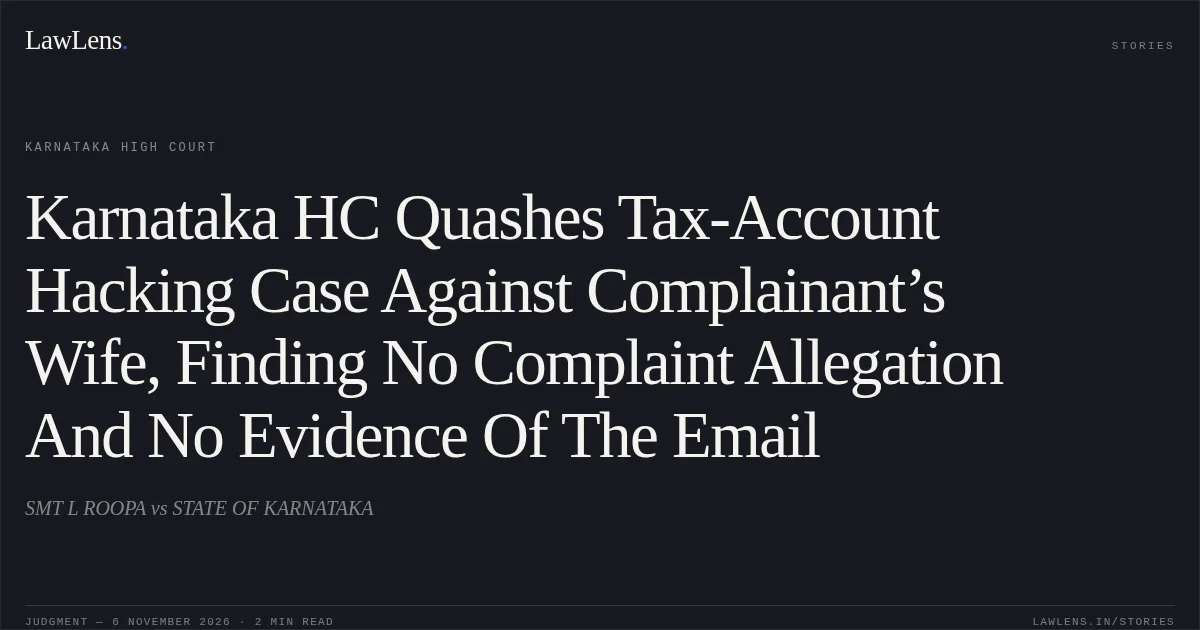
Respondent No. 2 complained that his Income Tax account had been accessed without authorisation; the complaint and FIR named Arvind G. as the accused.
pp. 3–4Following investigation, a charge sheet was filed against Arvind, Madhusudan K. Nagara (Accused No. 2), and the petitioner, L. Roopa (Accused No. 3), for alleged offences under Sections 66B and 66C of the Information Technology Act, 2000.
pp. 7–8In an earlier proceeding, the High Court had quashed the case against Accused No. 2, finding that the allegation that he had emailed Accused No. 3 was unsupported by the charge-sheet material.
pp. 3–9Roopa sought quashing of the proceedings against her under Section 482 CrPC/Section 528 BNSS.
pp. 1–202Issues
i.1. Whether the complaint, FIR, charge-sheet material, documents, or witness statements disclosed a basis to prosecute the petitioner for offences under Sections 66B and 66C of the Information Technology Act, 2000
pp. 9–10ii.2. Whether the proceedings against the petitioner should be quashed, including by applying the doctrine of parity following the quashing of proceedings against Accused No. 2
pp. 9–1003Law Applied
The Court considered its inherent jurisdiction under Section 482 CrPC, corresponding to Section 528 BNSS, to quash criminal proceedings where the available material does not disclose an offence and continuation would amount to an abuse of process.
pp. 1–2, 9–10The alleged offences were under Sections 66B and 66C of the Information Technology Act, 2000.
p. 1, 10The Court also applied the doctrine of parity, relying on its earlier order in Crl.P. No. 2916/2025, which had quashed proceedings against Accused No. 2 because the alleged email to Accused No. 3 was not substantiated by the investigation material.
pp. 3–9Provisions in the judgment · 3 · Linked ones open on LawLens
Code of Criminal Procedure, 1973 Section 482
Bharatiya Nagarik Suraksha Sanhita, 2023 Section 528
Indian Penal Code, 1860 Section 420
04Reasoning
The Court found that the original complaint and FIR contained no allegation against the petitioner.
pp. 9–10The charge sheet’s only relevant assertion was that Accused No. 2 had sent an email to the petitioner, but the alleged email was not produced and was not supported by the witness statements or other prosecution material.
pp. 9–10Because the same unsupported email allegation had formed the basis for quashing proceedings against Accused No. 2, the Court applied parity and concluded that the material did not disclose an offence by the petitioner.
pp. 9–10It also noted that the petitioner was the complainant’s wife and that she had instituted matrimonial proceedings against him, but its conclusion rested on the absence of supporting allegations and evidence.
p. 1005Holding
The Court allowed the petition and quashed the proceedings in C.C. No. 3171/2018, arising from Crime No. 252/2017, insofar as they concerned the petitioner/Accused No. 3.
p. 10Original Court PDF
SMT L ROOPAvsSTATE OF KARNATAKA
Click to open original judgment
Original judgment, available to read, download and summarize on LawLens.in