01Facts
The complainant alleged that he met Petitioner No. 1 through a matrimonial website and that the parties communicated through digital platforms.
¶ 3–4He alleged that the petitioners threatened and cheated him, including by taking ₹50,000 in Mumbai, and used or threatened to use his photographs to blackmail him.
¶ 3–4A charge sheet was filed in Bengaluru for offences under Sections 66C and 66D of the Information Technology Act, 2000, and Sections 384, 419, 420, 506 and 507 read with Section 149 of the IPC
¶ 3–4The petitioners sought to quash the proceedings under Section 482 Cr.P.C., contending that the complaint was retaliatory—since the complainant had previously been prosecuted in Mumbai on the petitioners’ complaint—and that the alleged events occurred in Mumbai, leaving Bengaluru without territorial jurisdiction.
¶ 5–12The complainant relied on the parties’ digital communications and alleged consequences in Bengaluru to support the proceedings there.
¶ 22–2302Issues
i.Whether the High Court should exercise its inherent jurisdiction under Section 482 Cr.P.C. to quash the proceedings on the grounds of mala fides, lack of territorial jurisdiction, and insufficient basis to proceed
¶ 16ii.Whether the territorial-jurisdiction objection could warrant quashing at this stage, after investigation, filing of the charge sheet and taking of cognizance
¶ 23–25, 3003Law Applied
Section 482 Cr.P.C. permits the High Court to prevent abuse of process, but it is not ordinarily appropriate to determine disputed factual allegations or assess evidence at the quashing stage; the court generally proceeds on the complaint and accompanying material
¶ 20 · ¶ 27Under Sections 177–179 and 178(c) Cr.P.C., an offence is generally tried where committed, but where the place is uncertain, several acts occur in different areas, an offence continues across areas, or an act and its consequence occur in different places, jurisdiction may lie in any relevant local area
¶ 25–27Territorial jurisdiction ordinarily concerns the court’s inquiry or trial; it does not, by itself, prevent investigation or taking cognizance, and the issue may be raised before the trial court
¶ 13, 23, 25 · ¶ 27The court also considered *Amish Devgan v. Union of India*, *Rhea Chakraborty v. State of Bihar*, *Kaushik Chatterjee v. State of Haryana*, *Lalita Kumari v. Government of Uttar Pradesh*, and *Nasiruddin Khan v. State of Bihar*
¶ 7–11, 18–21, 27–28Provisions in the judgment · 38 · Linked ones open on LawLens
Code of Criminal Procedure, 1973 27 provisions
Section 2Section 102Section 154Section 156Section 157Section 162Section 174Section 175Section 176Section 177Section 178Section 179Section 180Section 181Section 182Section 183Section 184Section 185Section 186Section 218Section 219Section 220Section 221Section 222Section 223Section 482Section 531Indian Penal Code, 1860 10 provisions
Section 149Section 384Section 417Section 419Section 420Section 494Section 495Section 506Section 507Section 509Information Technology Act, 2000 Section 67
04Reasoning
The Court found that the parties’ relationship and digital communications were not in dispute, while the allegations concerning threats, demands, money and the use of photographs involved factual matters that could not be resolved in a Section 482 petition.
¶ 24, 26The prior Mumbai case did not establish, by itself, that the Bengaluru complaint was malicious or brought solely to wreak vengeance.
¶ 24, 26Nor did the allegation that ₹50,000 was taken in Mumbai conclusively exclude Bengaluru jurisdiction: the complaint also concerned communications and alleged consequences said to have arisen there, engaging the territorial-jurisdiction principles in Sections 177–179 and 178(c) Cr.P.C.
¶ 22, 25–27The Court held that the petitioners could raise the jurisdictional objection before the trial court and that the competing allegations and prosecution evidence should be tested at trial, not determined in the quashing proceeding.
¶ 25–3005Holding
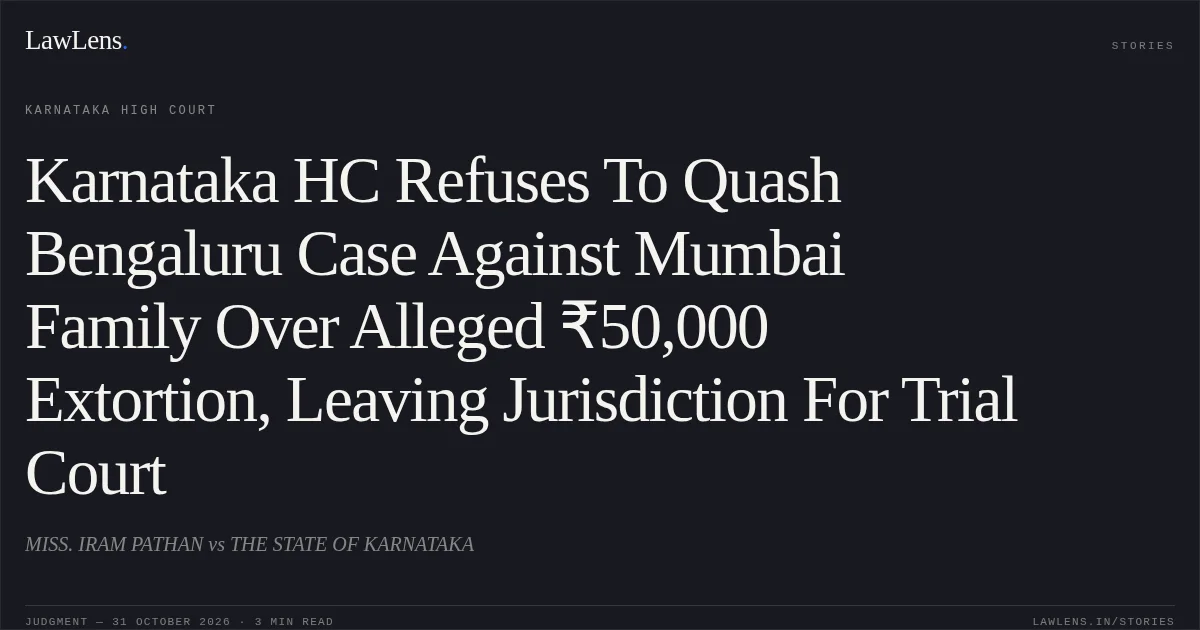
The Court answered the principal issue against the petitioners and dismissed the petition, declining to quash C.C. No. 28674/2021.
¶ 30–31The petitioners remained at liberty to raise their territorial-jurisdiction objection before the trial court.
¶ 30Original Court PDF
MISS. IRAM PATHANvsTHE STATE OF KARNATAKA
Click to open original judgment
Original judgment, available to read, download and summarize on LawLens.in