01Facts
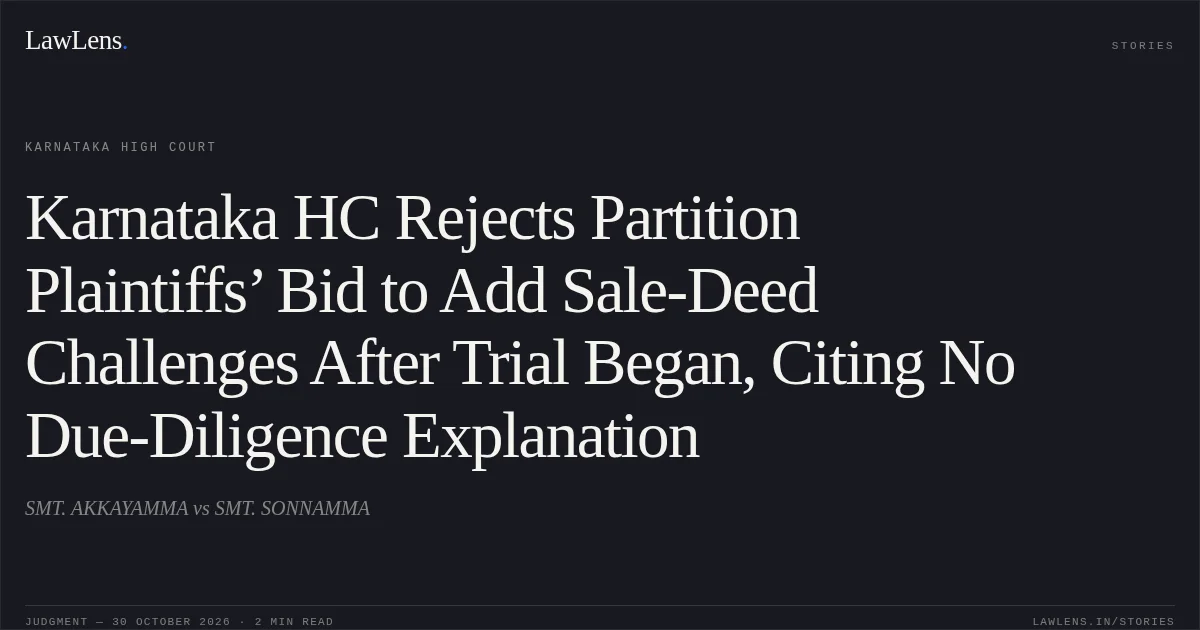
The plaintiffs in O.S. No. 520/2010, a partition suit, sought amendment of the plaint under Order VI Rule 17 CPC. The proposed amendments included prayers challenging sale deeds; the petitioners claimed rights under those deeds.
The High Court noted that the plaintiffs had knowledge of the transactions, which were also referred to in defendant No. 17’s written statement filed in 2019.
p. 7The suit had reached the plaintiffs’ evidence stage, with the first evidence date fixed for 27 August 2024; the amendment application was filed on 6 June 2025.
p. 8The Trial Court allowed the application on 2 February 2026, and the petitioners challenged that order under Article 227 of the Constitution.
p. 5, 802Issues
i.1. Whether the Trial Court could allow the proposed substantive amendments after commencement of trial when the applicants had not shown that, despite due diligence, they could not have raised the matter earlier.
pp. 8–10ii.2. Whether the proposed amendments concerning prayers (aa), (ab), (ac) and (ad) should be disallowed while permitting the remaining corrections and amendments.
p. 1103Law Applied
The proviso to Order VI Rule 17 CPC bars an amendment after commencement of trial unless the court is satisfied that, despite due diligence, the party could not have raised the matter before trial commenced.
p. 9The burden of establishing due diligence rests on the party seeking the amendment; the necessity of an amendment for complete adjudication does not, by itself, dispense with that requirement.
pp. 9–10The Court relied on Basavaraj v. Indira & Ors., (2024) 3 SCC 705, for these principles.
pp. 9–1004Reasoning
The plaintiffs knew of the sale transactions and the sale deeds had been referred to in the 2019 written statement, yet the amendment application was filed after the suit had reached the evidence stage.
pp. 7–8The application and supporting affidavit did not explain how the due-diligence requirement was met; the asserted oversight by counsel was not a sufficient explanation.
pp. 8–10Accordingly, the Trial Court erred in allowing the substantive prayers, notwithstanding the respondents’ contention that the amendment would facilitate complete adjudication.
pp. 6, 10–12The Court did not decide the petitioners’ limitation objection; it allowed the petitioners’ concession that typographical corrections could be made to be reflected in the order.
p. 1105Holding
The writ petition was allowed in part. The amendments introducing prayers (aa), (ab), (ac) and (ad) were disallowed, while the other corrections and amendments sought in I.A. No. 9 were permitted; the Trial Court’s order was set aside to that extent.
pp. 11–12The Trial Court was directed to dispose of the suit within one year of receiving the High Court’s order.
p. 12Original Court PDF
SMT. AKKAYAMMAvsSMT. SONNAMMA
Click to open original judgment
Original judgment, available to read, download and summarize on LawLens.in