01Facts
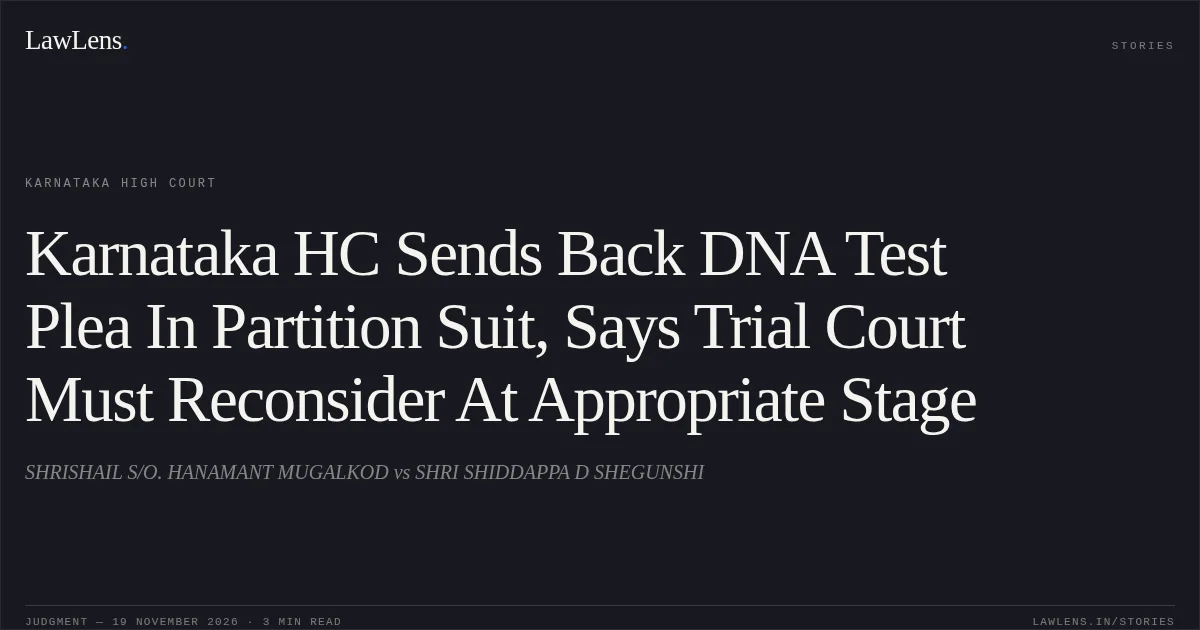
The petitioner, defendant No. 16 in O.S. No. 97/2016, challenged the Trial Court's order dated 30.07.2026 on I.A. No. 49 under Order XXVI Rule 10A read with Section 151 CPC. The application sought DNA profiling of plaintiff-respondent No. 1.
¶ 1The petitioner relied on a genealogy showing the propositus Gurlingappa had three children, Yamanappa, Dundavva and Basappa, and that the petitioner belongs to Basappa's branch.
¶ 2 · pp. 5–6A prior partition suit by Basappa's branch had attained finality.
¶ 2 · p. 6The plaintiff claims to be the son of Dundavva and seeks partition. The petitioner disputes this, contending the plaintiff was born to one Bourawwa and that an earlier memo stated Dundavva died issueless.
¶ 2 · p. 6The Trial Court rejected I.A. No. 49, holding that the burden lay on the plaintiff to first prove his parentage, after which the burden could shift to the defendants, and that evidence was still incomplete.
¶ 3 · pp. 6–7 · ¶ 6 · pp. 7–9The Trial Court held the application premature and described a DNA test at that stage as impermissible collection of evidence.
¶ 6 · pp. 8–9The plaintiff contended that DNA testing cannot be ordered without following the guidelines in Ashok Kumar v. Raj Gupta and relied on the order in Sri Hareesh v. Sri A.S. Umesh (W.P. No. 20342/2025).
¶ 4 · p. 702Issues
i.1. Whether the Trial Court was justified in rejecting the application for DNA profiling of the plaintiff on the ground that it was premature, since the plaintiff had not yet discharged the initial burden of proving that he is the son of Dundavva.
¶ 6 · pp. 7–9 · ¶ 7 · pp. 8–9ii.2. Whether the impugned order warrants interference under Articles 226 and 227 of the Constitution, or whether the matter should be remitted to the Trial Court for fresh consideration.
¶ 7 · pp. 8–9 · ¶ 8 · p. 903Law Applied
The Court relied on Order XXVI Rule 10A and Section 151 CPC, under which the application was filed.
¶ 1 · p. 5The Court recorded the Trial Court's reliance on the principle, drawn from the judgments cited before it, that a DNA test may be ordered only where the result is directly in issue, no other evidence on record can substitute for it, and it serves the best interest of the parties and the interests of justice.
¶ 6 · p. 8The Court recorded the Trial Court's rule on the burden of proof, under which the plaintiff must first prove he is the son of Dundavva before the burden shifts to the defendants to disprove it.
¶ 6 · pp. 7–8The Court noted the petitioner's reliance on Mohammed Refeeq v. Mohammed Refeeq, 2024 KHC 1341, recognising DNA profiling.
¶ 3 · pp. 6–7The Court noted the plaintiff's reliance on Ashok Kumar v. Raj Gupta (Civil Appeal No. 6153 of 2021) and Sri Hareesh v. Sri A.S. Umesh (W.P. No. 20342/2025) for the proposition that DNA testing requires adherence to prescribed procedure and guidelines.
¶ 4 · p. 7Provisions in the judgment · 1 · Linked ones open on LawLens
Code of Civil Procedure, 1908 Section 151
04Reasoning
The Court did not examine whether DNA testing was warranted on the merits. It noted that the Trial Court found the application premature because the plaintiff had not yet discharged the burden of proving that he is Dundavva's son, and that the defendants' burden would arise only after that discharge.
¶ 7 · pp. 8–9Since the Trial Court had not rejected the application on its merits, the High Court declined to rule on the substance of the application. Instead, it found the Trial Court itself had identified the stage as inappropriate and that the application should be reconsidered at the proper stage.
¶ 7 · pp. 8–9 · ¶ 7 · p. 9The Court therefore treated the impugned order as a procedural rejection, not a reasoned decision on the principles governing DNA testing, and restored the application for fresh consideration under the principles in the cited judgments.
¶ 8(iv) · p. 905Holding
The Court did not decide whether the Trial Court was correct on the merits of the DNA-profiling request. It held that the Trial Court had rejected I.A. No. 49 at an inappropriate stage and without a merits determination.
¶ 7 · pp. 8–9The writ petition is allowed, the order dated 30.07.2026 on I.A. No. 49 in O.S. No. 97/2016 is quashed, the application is restored, and the matter is remitted to the Trial Court to reconsider the application "at appropriate stage" in light of the principles in the cited judgments. The parties are at liberty to urge permissible grounds.
¶ 8(i)–(iv) · p. 9 · ¶ 8(v) · p. 9Original Court PDF
SHRISHAIL S/O. HANAMANT MUGALKODvsSHRI SHIDDAPPA D SHEGUNSHI
Click to open original judgment
Original judgment, available to read, download and summarize on LawLens.in