01Facts
The petitioners in the two connected writ petitions were manufacturers and personnel associated with manufacturers of hand sanitizers during the COVID-19 pandemic.
The complaints alleged discrepancies between the products and their labels: in one instance, the label referred to isopropyl alcohol but ethanol was detected; in another, the quantity of alcohol in the sample allegedly fell short of the labelled quantity.
p. 6 · ¶ 4–5The petitioners sought to quash the complaints and proceedings for alleged offences under the Drugs and Cosmetics Act, 1940.
p. 7 · ¶ 7–11The State opposed the petitions, contending that the public had been misled and that the products were sub-standard.
p. 9 · ¶ 1202Issues
i.1. Whether the alleged mismatch between the sanitizer contents and the label, including the substitution of ethanol for isopropyl alcohol, was sufficient to sustain the prosecutions under the Drugs and Cosmetics Act, 1940.
pp. 7–9 · ¶ 7–8, 15–16ii.2. Whether the criminal proceedings should be quashed subject to payment of compensation to the Chief Minister’s Relief Fund, Karnataka State.
pp. 9–11 · ¶ 11, 17–1803Law Applied
The complaints invoked Sections 18(a)(i), 17(b) and/or 17B(d) of the Drugs and Cosmetics Act, 1940, with the alleged offences punishable under Sections 27(c) and 27(d).
pp. 2–4The petitions invoked Articles 226 and 227 of the Constitution and Section 482 of the Code of Criminal Procedure, 1973, seeking quashing of the complaints and proceedings.
pp. 2–4The Court observed that both isopropyl alcohol and ethyl alcohol were permitted for preparing sanitizers and held that mere non-description of the chemical found in the seized bottles would not, by itself, result in an offence.
p. 10 · ¶ 15–16Provisions in the judgment · 4 · Linked ones open on LawLens
Code of Criminal Procedure, 1973 Section 482
Drugs and Cosmetics Act, 1940 Section 17Section 18Section 27
04Reasoning
The Court accepted that the contents did not match the labels, but considered the pandemic context and the fact that both isopropyl and ethyl alcohol were permitted ingredients in sanitizers.
p. 10 · ¶ 14–16It concluded that the chemical-description discrepancy alone did not establish an offence.
p. 10 · ¶ 14–16Nevertheless, because a mismatch remained between the labels and the sampled contents, the Court considered a payment of ₹3,50,000 in each petition appropriate to meet the ends of justice and made quashing conditional on that payment.
p. 10 · ¶ 1705Holding
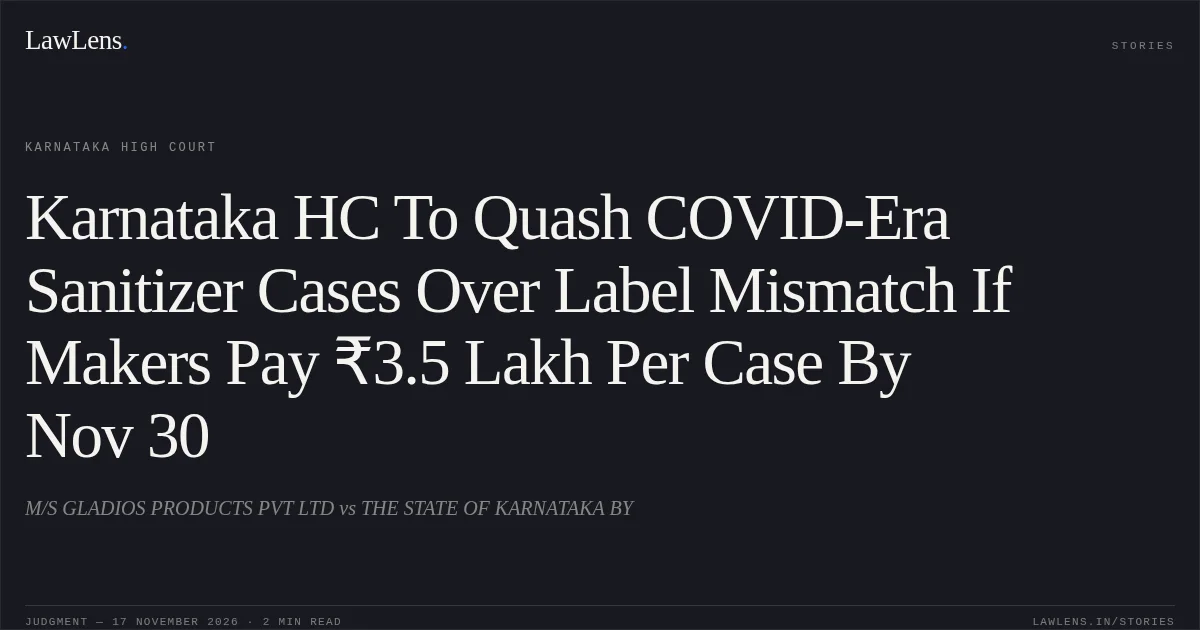
The High Court allowed both writ petitions subject to payment of ₹3,50,000 in each petition to the Chief Minister’s Relief Fund, Karnataka State, by 30 November 2026.
pp. 10–11 · ¶ 18Upon payment, the proceedings in C.C. No. 243/2023 and Spl. C. No. 2400/2023 were to stand quashed qua the respective petitioners.
pp. 10–11 · ¶ 18Original Court PDF
M/S GLADIOS PRODUCTS PVT LTDvsTHE STATE OF KARNATAKA BY
Click to open original judgment
Original judgment, available to read, download and summarize on LawLens.in