01Facts
The deceased was allegedly 17 years old at the time of the incident.
¶ 3Accused No. 1 (husband) allegedly loved her. Accused Nos. 2 to 4 (in-laws and brother-in-law) performed the marriage with Accused No. 1 on 13.05.2021 at Hale Bangargund, knowing she was a minor, and took her to their house.
¶ 4The prosecution alleged that the accused nagged her about cooking and harassed her to bring property from her parents. Due to this harassment she consumed poison (herbicide) kept in Accused No. 1's house and died at BLDE Hospital, Vijayapura, on 27.08.2021.
¶ 4, 16Accused No. 5 allegedly attended the marriage.
¶ 5The incident occurred on 17.08.2021. No complaint was lodged until 23.08.2021, and the deceased did not disclose the reason for consuming poison while under treatment.
¶ 37The Trial Court took cognizance on 27.11.2021. Charges were framed on 24.06.2022 under Sections 143, 147, 376(2)(n), 498-A, 304-B IPC, and Sections 9 and 10 of the Prohibition of Child Marriage Act, 2006 (PCMA).
¶ 6The prosecution examined PW1 to PW34 and marked Exs. P1 to P64 and MOs 1, 2, 2A.
¶ 7Accused were not guilty on Section 313 CrPC examination.
¶ 8The Trial Court answered all nine points in the negative and acquitted the accused on 16.03.2024.
¶ 9–10The State filed this appeal under Sections 378(1) and (3) CrPC / 419 BNSS. The State contended that the Trial Court gave undue weight to minor discrepancies, that PW1–PW8 proved cruelty, that the death within seven years of marriage at the matrimonial home raised a presumption, and that Ex. P42 (post-mortem report) showed paraquat poisoning, indicating suicide.
¶ 1, 13, 1402Issues
i.1. Whether the State has established that the Trial Court's judgment of acquittal dated 16.03.2024 is arbitrary and erroneous, warranting interference in appeal.
¶ 15, Point No. 1ii.2. Whether the prosecution proved the deceased's minority at the time of marriage, such that the offences under PCMA Sections 9 and 10 and POCSO Section 6 were made out.
¶ 39–41, 44iii.3. Whether the prosecution established matrimonial cruelty and dowry-related harassment attracting Sections 498-A and 304-B IPC.
¶ 37, 13iv.4. Whether the prosecution established membership of an unlawful assembly and common object under Sections 143, 147 and 149 IPC.
¶ 38, 4403Law Applied
The restricted scope of appellate review in acquittal appeals under Section 378 CrPC, as explained in H.D. Sundara v. State of Karnataka (2023) 9 SCC 581. Under this rule, the appellate court must first decide whether the Trial Court's view is a possible view on the evidence, and cannot reverse acquittal merely because another view is possible.
¶ 46Where two views are possible, the view favouring the accused must be adopted (Sharad Birdhichand Sarda, (1984) 4 SCC 116; Chandrappa v. State of Karnataka, (2007) 4 SCC 415; Tota Singh v. State of Punjab, (1987) 2 SCC 529).
¶ 47, 49, 50An acquittal should be disturbed only for compelling and substantial reasons (State of Rajasthan v. Raja Ram, (2003) 8 SCC 180; Surajpal Singh v. State, 1951 SCC 1207).
¶ 51, 52The presumption of innocence is reinforced by acquittal (Ramanand Yadav; C.K. Dase Gowda, (2003) 12 SCC 606).
¶ 59On age proof, Section 94 of the Juvenile Justice (Care and Protection of Children) Act, 2015 provides that a school certificate or birth certificate from the Corporation/Registrar is the primary evidence of age, with ossification testing as the fallback.
¶ 40Mallikarjun v. State of Karnataka, 2024 (1) KCCR 258 (DB) and Mohan Kumar v. State of Karnataka, 2021 (2) KCCR 1152 (DB) were relied upon on the age and minority issue.
¶ 42, 43On POCSO, the Court referred to State of U.P. v. Anurudh (2026 SCC OnLine SC 40).
¶ 54On consensual relations based on promise to marry, the Court relied on Nitin B. Nikhare.
¶ 55On the standard for convicting on immorality or surmise, the Court relied on Paramjit Singh Bedi and Debraj Dutta.
¶ 57, 58Provisions in the judgment · 14 · Linked ones open on LawLens
Code of Criminal Procedure, 1973 Section 207Section 313Section 378
Bharatiya Nagarik Suraksha Sanhita, 2023 Section 419
Indian Penal Code, 1860 Section 143Section 147Section 149Section 366Section 376
Protection of Children from Sexual Offences Act, 2012 Section 6Section 29
Prohibition of Child Marriage Act, 2006 Section 9Section 10
Juvenile Justice (Care and Protection of Children) Act, 2015. Section 94
04Reasoning
The Court held that the Trial Court's acquittal was a possible view on the evidence and was not perverse.
¶ 45, 60On age, the prosecution produced no birth certificate from the Corporation or Registrar of Births and Deaths and conducted no ossification test. The only age evidence was the school certificate from PW28, who admitted in cross-examination that he was not a teacher at admission and disclaimed knowledge of the admission documents. Given these gaps, the Court found it difficult to accept that the deceased was a minor at the time of marriage, and this foundation undermined the PCMA and POCSO charges.
¶ 39, 41On the cause of death and cruelty, the Court relied on the delay of about eight days before the complaint, the deceased's silence during her seven-day hospitalisation before ventilation, and the absence of any explanation for the delay. It also held that the complaint was founded on hearsay from the deceased, which was inadmissible.
¶ 37The prosecution examined only relatives and no independent neighbours, and it produced no evidence of dowry demand or cruelty by the accused.
¶ 37On unlawful assembly under Sections 143, 147 and 149 IPC, no witness established membership of an unlawful assembly or a common object.
¶ 38Applying the "two views" principle, the Court held that the Trial Court's view on these evidentiary gaps was reasonable and therefore could not be disturbed.
¶ 46, 49, 50, 5905Holding
The State failed to show that the acquittal was arbitrary or erroneous, so Point No. 1 is answered in the negative.
¶ 60, 61The Court held that the Trial Court's view was a possible view on the evidence and declined to interfere.
¶ 60The Criminal Appeal is dismissed, and the judgment and order of acquittal dated 16.03.2024 in Special Case (POCSO) No. 46 of 2021 (Additional Sessions Judge, Fast Track Special Court-I, Vijayapura), acquitting Accused Nos. 1 to 5 under Sections 143, 147, 376(2)(n), 498-A, 304-B read with 149 IPC, Section 6 POCSO, and Sections 9 and 10 PCMA, is confirmed.
¶ 62(i)–(ii)Original Court PDF
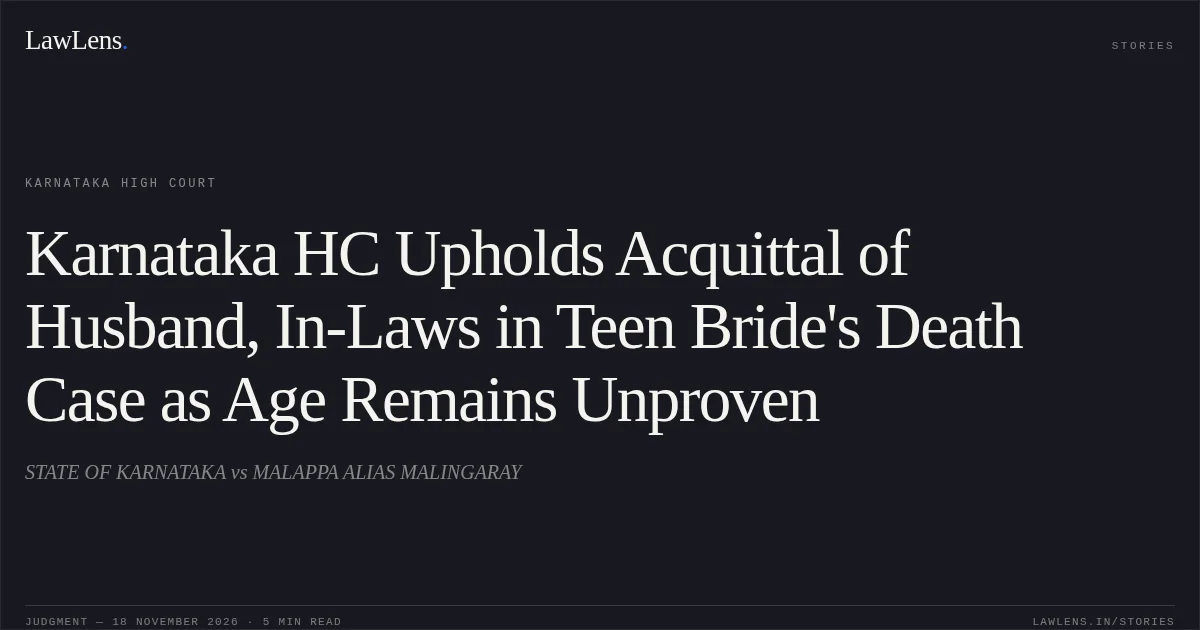
STATE OF KARNATAKAvsMALAPPA ALIAS MALINGARAY
Click to open original judgment
Original judgment, available to read, download and summarize on LawLens.in