01Facts
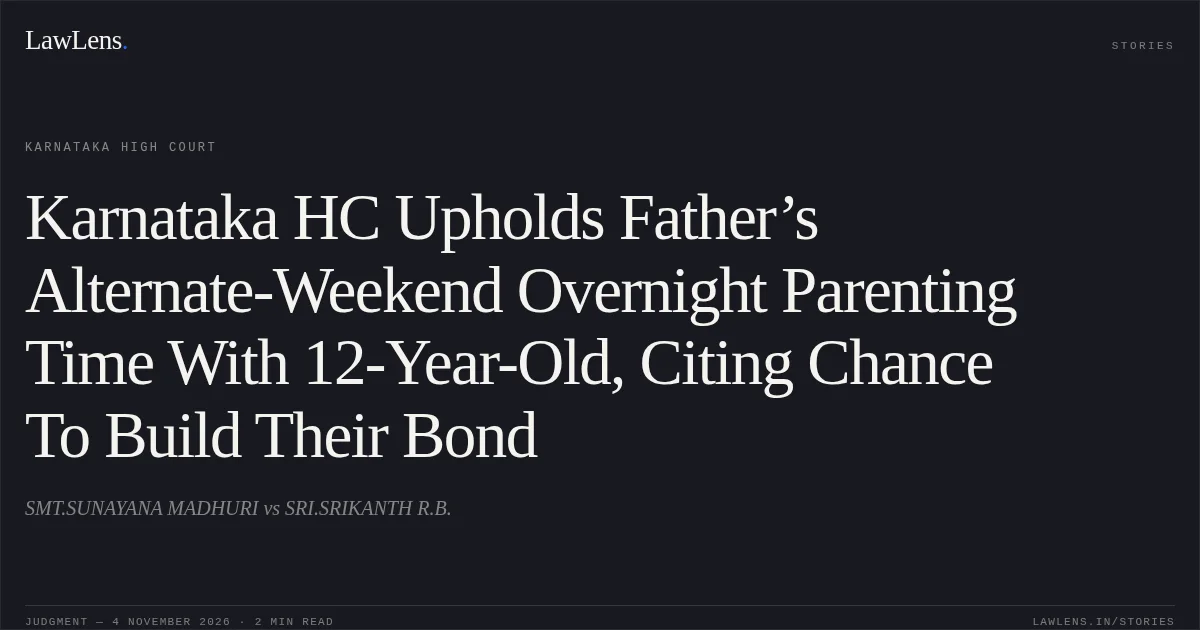
The mother had petitioned for divorce, and the father sought parenting time with their minor son. The Family Court initially granted daytime access on the first and third Saturdays of each month. The mother’s application to restrict visits to the Family Court’s visitation room was dismissed; the father then sought overnight access.
p. 3By order dated 20 August 2026, the Family Court permitted the father to collect the child at 6:00 p.m. on Friday and return him by 6:00 p.m. on Sunday, on the first and third weekends.
p. 4The mother challenged the overnight arrangement, alleging, among other things, emotional manipulation and concerns about the child’s health, safety and well-being; the father maintained that the child enjoyed his company.
pp. 4–6During the writ proceedings, the High Court permitted one overnight visit and later interacted with both parents and the child in chambers.
p. 602Issues
i.1. Whether the Family Court’s order granting the father overnight parenting time on the first and third weekends warranted interference under Articles 226 and 227 of the Constitution.
pp. 2, 7–9ii.2. Whether the mother’s objections established genuine, material concerns about the child’s welfare sufficient to displace the overnight arrangement.
pp. 7–903Law Applied
The child’s welfare is the paramount consideration in deciding parenting-time arrangements, but that principle is not a convenient basis for disregarding an order made after judicial consideration; objections concerning health, safety or emotional well-being must be assessed on their material merits.
p. 7In Yashita Sahu v. State of Rajasthan, the Supreme Court emphasised the child’s interest in receiving the care and companionship of both parents, notwithstanding their matrimonial differences.
p. 8In Eby Cherian v. Jerema John, the Supreme Court recognised the value of predictable overnight-access arrangements and the harm caused by requiring repeated applications to secure such access.
p. 8The Court also recognised that a parent may seek reconsideration if changed circumstances or genuine discomfort supported by material arise.
p. 904Reasoning
The Court considered the mother’s allegations against the need for the child to develop a meaningful relationship with his father.
pp. 7–8It reasoned that overnight access allows a child to experience ordinary family life, including shared meals and routines, and that limited visiting hours may not enable a genuine bond to develop.
pp. 7–8The Court distinguished genuine, material concerns about the child’s welfare from objections that merely reflect a parent’s unwillingness to permit overnight access, and found no sufficient basis in this case to interfere with the Family Court’s order.
pp. 8–9It left open the possibility of a further application if genuine discomfort or changed circumstances could be shown with material.
p. 905Holding
The High Court dismissed the writ petition and declined to interfere with the Family Court’s order granting overnight parenting time to the father on the first and third weekends.
p. 9It closed the pending interlocutory applications and clarified that the mother could approach the Family Court if changed circumstances or genuine, materially supported concerns arose.
p. 9Original Court PDF
SMT.SUNAYANA MADHURIvsSRI.SRIKANTH R.B.
Click to open original judgment
Original judgment, available to read, download and summarize on LawLens.in