01Facts
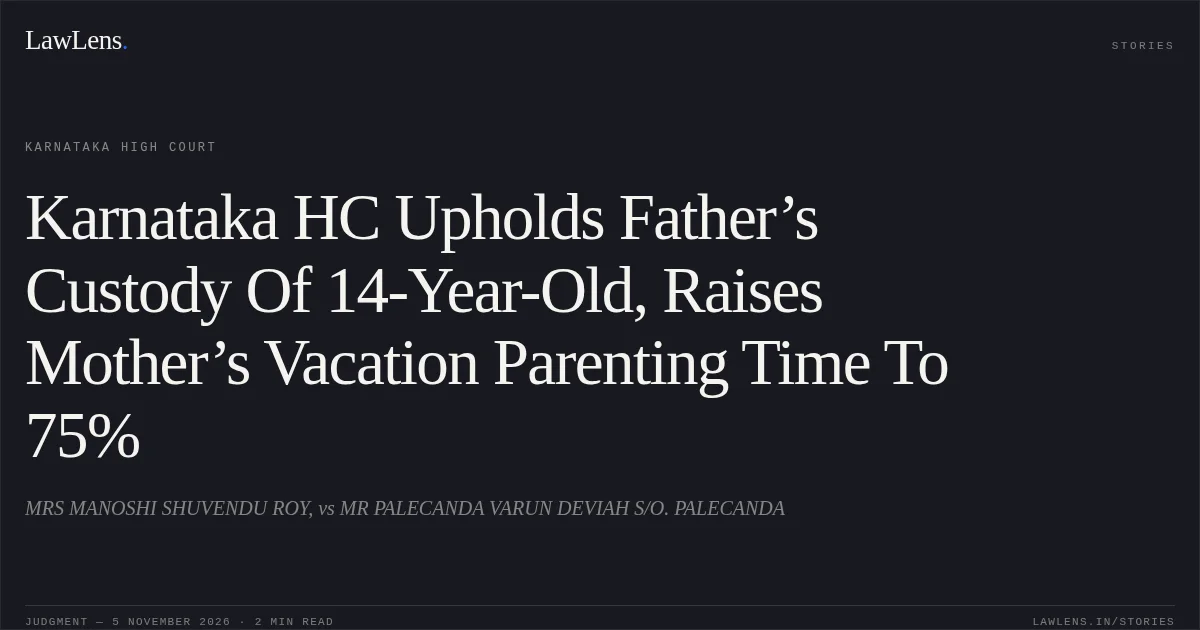
The parties, who were living separately, have a 14-year-old son.
The mother had taken the child with her to Pune, where he had been residing since 2024; the father lived in Belagavi and sought custody before the Family Court under Sections 25 and 12 of the Guardians and Wards Act, 1890, and Section 8 of the Hindu Minority and Guardianship Act, 1956
pp. 3, 5–6The Family Court found that both parents had cared for the child, but directed that the child reside with the father, while granting the mother parenting time on weekends, for 50% of specified school vacations, and regular communication.
pp. 4–6The mother appealed under Section 47(c) of the Guardians and Wards Act, seeking continued custody, subject to appropriate access for the father.
p. 202Issues
i.1. Whether the Family Court’s order placing the child in the father’s custody, having regard to the child’s welfare and the circumstances of both parents, warranted appellate interference.
pp. 7–8, 11–12ii.2. Whether the mother’s parenting time during the child’s vacations should be increased.
p. 903Law Applied
The Court applied the principle that, in custody disputes, the child’s interests are paramount and the parents’ rights are subordinate to the child’s welfare.
p. 7It invoked the parens patriae principle in assessing the child’s best interests.
p. 8The proceedings arose under Sections 25 and 12 of the Guardians and Wards Act, 1890, and Section 8 of the Hindu Minority and Guardianship Act, 1956; the appeal was brought under Section 47(c) of the Guardians and Wards Act.
p. 2, 5The judgment cites no specific precedent.
Provisions in the judgment · 4 · Linked ones open on LawLens
Guardians and Wards Act, 1890 Section 47Section 25Section 12
Hindu Minority and Guardianship Act, 1956 Section 8
04Reasoning
The Court accepted the Family Court’s finding that both parents had cared for the child and noted that neither parent’s caregiving had been shown to be deficient.
p. 4, 7It considered the father’s substantially greater income, the facilities available in his Belagavi home, and the support of the paternal grandparents, alongside the fact that the child was 14 years old.
pp. 4, 7–8Applying the child-welfare and parens patriae principles, the Court found no sufficient basis to disturb the decision placing the child with the father; the mother had not demonstrated why the Family Court’s conclusions should be displaced.
p. 8The father’s lack of objection to extending the mother’s parenting time supported increasing her vacation entitlement from 50% to 75%.
p. 905Holding
The appeal was disposed of by modifying the Family Court’s order to increase the mother’s parenting time during the specified vacations from 50% to 75%; the order was upheld in all other respects, including the child’s residence with the father.
p. 9Either parent was granted liberty to seek modification if the other behaved irresponsibly in a manner detrimental to the child’s interests.
p. 9Original Court PDF
MRS MANOSHI SHUVENDU ROY,vsMR PALECANDA VARUN DEVIAH S/O. PALECANDA
Click to open original judgment
Original judgment, available to read, download and summarize on LawLens.in