01Facts
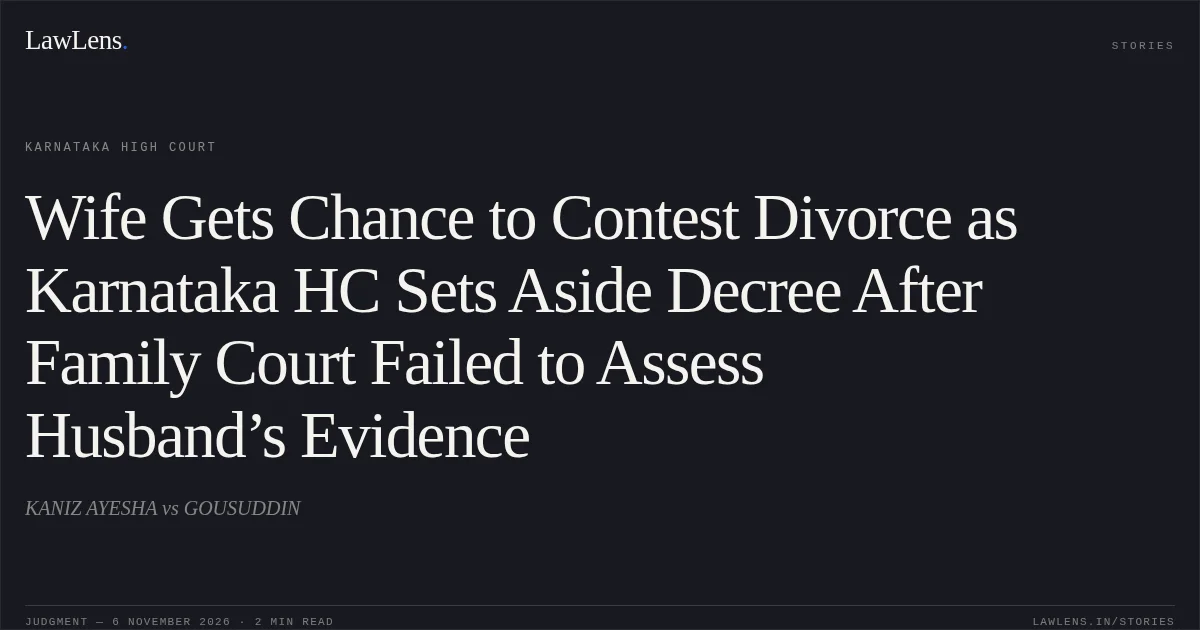
Gousuddin filed O.S. No. 21/2020 before the Principal Judge, Family Court, Kalaburagi, seeking dissolution of his marriage to Kaniz Ayesha, solemnised on 15 November 2011 under Muslim law.
pp. 2–5He alleged that she had refused to return to the matrimonial home and that her conduct amounted to desertion and mental cruelty.
pp. 2–5The parties had three children.
pp. 2–5Kaniz filed a written statement denying the plaint allegations but did not give evidence or produce documents. The Family Court decreed the suit on 7 January 2022.
pp. 5–6On appeal, Kaniz sought a further opportunity to participate and lead evidence, attributing her absence to health-related and communication difficulties.
pp. 6–702Issues
i.Whether the Family Court’s judgment and decree dissolving the marriage called for interference in the appeal.
p. 703Law Applied
Under the principle stated in Union of India v. Vasavi Co-op. Housing Society Ltd., (2014) 2 SCC 269, the burden rests on the plaintiff to establish the case and entitlement to relief; a suit cannot be decreed merely because the defendant has not adduced evidence.
pp. 9–10The plaintiff’s case must be assessed on its own merits, rather than on the weakness or omissions of the defendant.
pp. 9–10The appeal was brought under Section 19(1) of the Family Courts Act.
p. 1Provisions in the judgment · 1 · Linked ones open on LawLens
Family Courts Act, 1984 Section 19
04Reasoning
The Family Court noted that Kaniz had not adduced evidence, but did not adequately assess whether Gousuddin had proved the grounds for dissolution.
pp. 8–10Although he testified and produced Exs. P1–P3, the Family Court did not discuss those documents in detail, and no independent witnesses were examined to support his case.
pp. 8–10The High Court therefore found it appropriate to set aside the decree and remand the suit, enabling Kaniz to lead evidence, without deciding the merits of the parties’ claims.
p. 1005Holding
The appeal was allowed.
pp. 10–11The Family Court’s judgment and decree dated 7 January 2022 were set aside, and O.S. No. 21/2020 was restored to its original file.
pp. 10–11The parties were directed to appear before the Family Court on 11 November 2026. The High Court expressly left the merits and all contentions open.
pp. 10–11Original Court PDF
KANIZ AYESHAvsGOUSUDDIN
Click to open original judgment
Original judgment, available to read, download and summarize on LawLens.in