01Facts
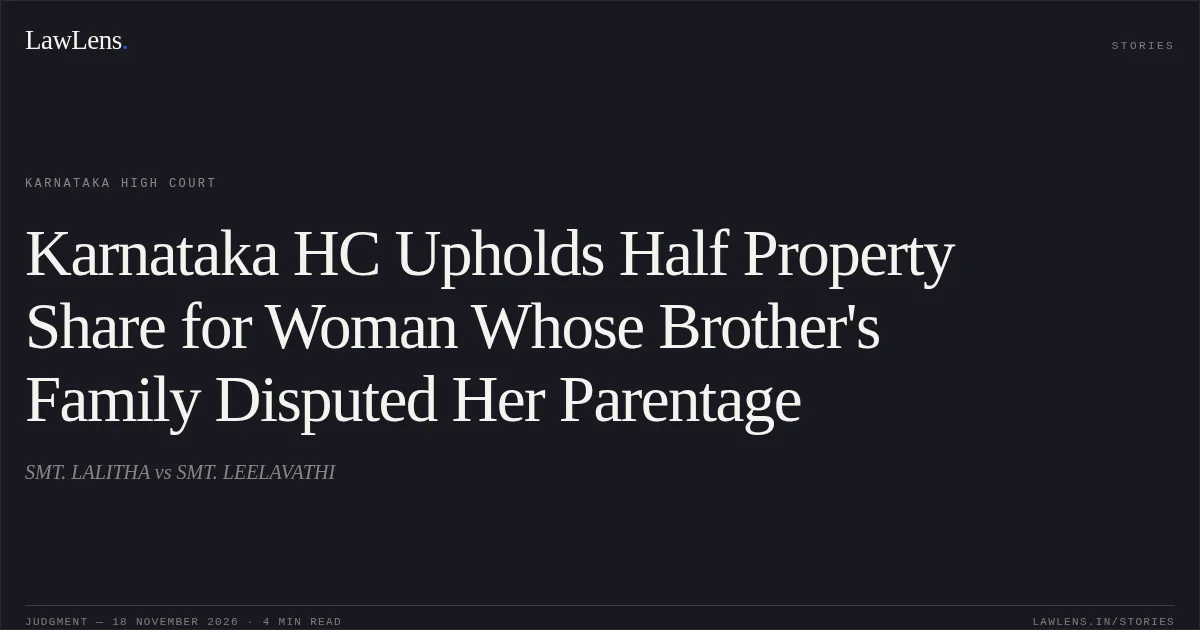
The plaintiff (since deceased; represented by her legal heirs, the respondents) sued in O.S. No. 86/2015 for partition and possession of a half share in the suit property. She claimed to be the daughter of Dombaiahchari and Venkamma.
¶ 3The property was granted to Dombaiahchari, and after his death, khata was transferred to his son Nanu Poojari, the husband of Defendant No. 1. After Nanu Poojari's death, the plaintiff demanded a half share, which the defendants refused.
¶ 3Defendant No. 1 denied that the plaintiff was Dombaiahchari's daughter, asserting that the couple had only one son, Nanu Poojari.
¶ 4The Trial Court framed issues on joint family status, entitlement to a half share, and an additional issue on the plaintiff's parentage.
¶ 5During pendency, the plaintiff died and her heirs were substituted. PW-2 and PW-3 gave evidence on relationship; DW-1 and DW-2 deposed for the defendants.
¶ 6The Trial Court (judgment dated 03.11.2022) held that the plaintiff failed to prove her relationship with Dombaiahchari and dismissed the suit.
¶ 7On appeal (R.A. No. 31/2025), the First Appellate Court (judgment dated 10.02.2026) held that the relationship was proved, decreed a half share, and set aside the Trial Court's judgment.
¶ 8–9The defendants filed this second appeal under Section 100 CPC.
¶ 1002Issues
i.1. Whether the First Appellate Court was justified in reversing the Trial Court's finding that the plaintiff failed to prove her relationship with Dombaiahchari, and whether such reversal raises a substantial question of law under Section 100 CPC.
¶ 11–14ii.2. Whether the evidence of PW-2 and PW-3 on the plaintiff's relationship with Dombaiahchari was sufficient to discharge the burden under Section 50 of the Indian Evidence Act, 1872, notwithstanding DW-2's contrary testimony.
¶ 11–12, 1403Law Applied
The Court relied on Section 50 of the Indian Evidence Act, 1872, which the judgment treats as requiring the plaintiff to establish her relationship to Dombaiahchari.
¶ 11, 14The Court applied the evidentiary principle that opinion and knowledge of relationship may be proved through persons with knowledge of the family.
¶ 11, 14The Court applied Section 100 CPC, under which a second appeal lies only on a substantial question of law, and found none arising from concurrent factual findings of the courts below.
¶ 14, 10The Court accepted the principle that the testimony of witnesses who were acquainted with the family, rather than the defendants who "came into the family much later," is the appropriate evidence on pedigree.
¶ 14On succession, the Court accepted that Dombaiahchari died intestate, so the plaintiff, as his child, is entitled to a half share, without citing any statutory provision or precedent for this proposition.
¶ 14No judicial precedents are cited in the judgment.
Provisions in the judgment · 1 · Linked ones open on LawLens
Code of Civil Procedure, 1908 Section 100
04Reasoning
The Court examined the appellants' challenge to PW-2 and PW-3, who were allegedly unaware of the contents of their affidavits, and the Trial Court's reliance on that point. The Court rejected the Trial Court's approach and noted the Trial Court had been "clearly oblivious" that the defendants could not know the plaintiff's relationship to Dombaiahchari, since they joined the family later.
¶ 14DW-1 was the wife of Nanu Poojari, aged 40 at the time of filing, and her children could not competently depose to the plaintiff's parentage. DW-2's testimony that the couple had only a son was therefore given limited weight, as the defendants' denial appeared to be a routine traverse rather than a matter within their knowledge.
¶ 14PW-3 deposed that he worked with Dombaiahchari and knew his family, which the Court treated as direct evidence satisfying the Section 50 requirement.
¶ 14The Court also distinguished the Trial Court's view that an affidavit filed five years earlier could not be expected to be remembered by a villager, a point the respondents relied on.
¶ 12The First Appellate Court's finding of fact on relationship and intestate succession was therefore upheld as a reasoned appreciation of evidence, leaving no substantial question of law.
¶ 14The judgment does not expressly address the First Appellate Court's points on additional evidence and DNA testing, nor does it address the inconsistent naming of the parties (the plaintiff is referred to as "Gopamma" in para. 14 only).
05Holding
The Court held that no substantial question of law arises for consideration under Section 100 CPC, and that the First Appellate Court rightly found the plaintiff had proved her relationship with Dombaiahchari and was entitled to a half share in the suit property.
¶ 14The Regular Second Appeal is dismissed. All pending interlocutory applications stand dismissed as not surviving. The First Appellate Court's judgment and decree dated 10.02.2026 in R.A. No. 31/2025, decreeing the plaintiff's half share, are accordingly affirmed.
¶ 14–16Original Court PDF
SMT. LALITHAvsSMT. LEELAVATHI
Click to open original judgment
Original judgment, available to read, download and summarize on LawLens.in