01Facts
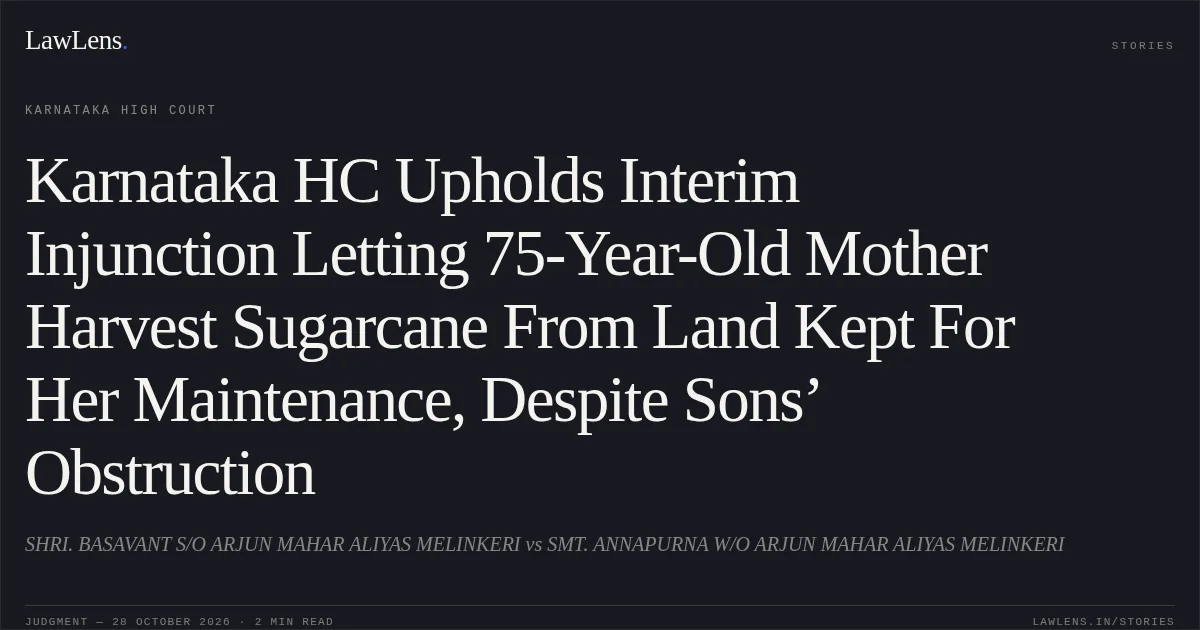
The plaintiff, Annapurna, sued for declaration and injunction concerning the suit property and sought temporary relief restraining defendants 1 and 2 from obstructing her in harvesting sugarcane and supplying it to a factory.
pp. 3–4The defendants disputed her possession and cultivation and asserted that defendant 1 owned and possessed the relevant portion of the property
pp. 3–4The Trial Court rejected the injunction application.
pp. 4–5On appeal, the First Appellate Court allowed the plaintiff’s Section 5 Limitation Act application, set aside the Trial Court’s order, and granted the temporary injunction.
pp. 4–5Defendants 1 and 2 challenged that order under Article 227 of the Constitution
pp. 1–202Issues
i.1. Whether the First Appellate Court was justified in granting temporary injunction in favour of the plaintiff on the material then available, including the mutation entry and sugarcane records.
pp. 6–9ii.2. Whether the First Appellate Court’s order warranted interference under Article 227 of the Constitution.
pp. 5–6, 9–1003Law Applied
Order XXXIX Rules 1 and 2 of the Code of Civil Procedure govern temporary injunctions; the court considers whether the applicant has shown a prima facie case, balance of convenience, and risk of irreparable injury, with the parties’ conduct also relevant.
p. 8Section 5 of the Limitation Act permits an appeal to be admitted after the prescribed period where sufficient cause for delay is shown; the First Appellate Court allowed the application under that provision.
p. 2, 5Article 227 of the Constitution provides supervisory jurisdiction over subordinate courts, which the High Court exercised to assess whether the challenged appellate order contained an infirmity warranting intervention.
pp. 1, 9–10Provisions in the judgment · 2 · Linked ones open on LawLens
Limitation Act, 1963 Section 5
Code of Civil Procedure, 1908 Section 151
04Reasoning
The High Court upheld the First Appellate Court’s reliance on the mutation extract, which indicated that the suit property had been retained for the plaintiff’s maintenance during her lifetime, and which the defendants had not challenged.
pp. 6–8The plaintiff had also produced sugarcane-supply records and bills supporting her case that she had supplied produce to the factory through 2022; the defendants had not produced documents showing that they cultivated sugarcane on the suit property.
pp. 6–8The Court considered the plaintiff’s age and the evidence of her prior use of the property, and found that the Trial Court had failed to account for relevant material.
pp. 9–10It therefore found no infirmity in the appellate order sufficient to justify supervisory interference.
pp. 9–1005Holding
The Court answered the issues in the affirmative as to the First Appellate Court’s grant of temporary injunction and in the negative as to the need for interference under Article 227.
p. 10It dismissed the writ petition and confirmed the order dated 5 December 2023 in M.A. No. 5/2023.
p. 10The Trial Court was requested to expedite the suit, and both parties were directed to cooperate and avoid unnecessary adjournments.
p. 10Original Court PDF
SHRI. BASAVANT S/O ARJUN MAHAR ALIYAS MELINKERIvsSMT. ANNAPURNA W/O ARJUN MAHAR ALIYAS MELINKERI
Click to open original judgment
Original judgment, available to read, download and summarize on LawLens.in