01Facts
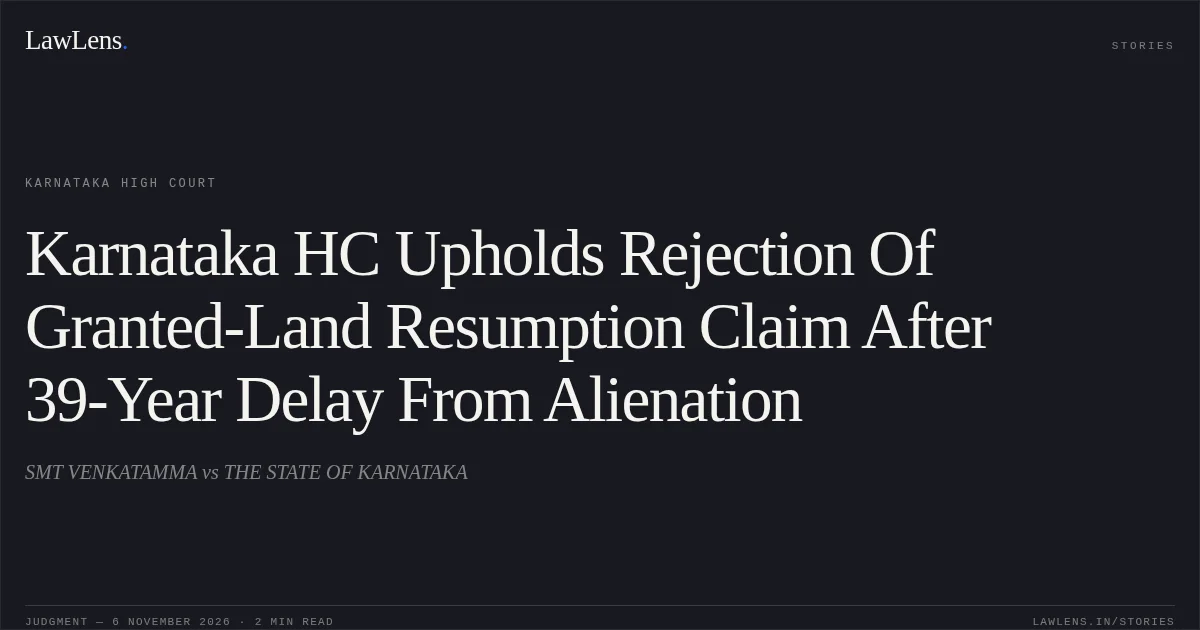
The petitioners challenged orders of the Assistant Commissioner and Deputy Commissioner rejecting proceedings to resume granted land.
The land was originally granted in 1943–44, and a portion was alienated in 1974; resumption proceedings were initiated in 2013, approximately 39 years after the alienation.
The Assistant Commissioner rejected the resumption claim, and the Deputy Commissioner affirmed that order.
p. 5The petitioners sought certiorari, contending, among other things, that an amendment to the Act meant laches did not apply.
pp. 3–402Issues
i.1. Whether the authorities’ rejection of the resumption claim, initiated long after the 1974 alienation, warranted interference under Articles 226 and 227.
pp. 4–5ii.2. Whether the petitioners’ contention that the amendment to the Act displaced the application of laches justified setting aside the authorities’ orders.
p. 403Law Applied
The Court applied the protective purpose of the Karnataka Scheduled Castes and Scheduled Tribes (Prohibition of Transfer of Certain Lands) Act (PTCL Act), which it described as prohibiting alienation of granted lands without prior permission and providing a remedy of resumption for unauthorised transfers.
p. 6It treated laches as a primary consideration in resumption proceedings, stating that restoration action brought after significant delay may be barred by laches, and referred to a Division Bench’s clarification to that effect.
p. 5The Court also stated that a grantee who voluntarily executes a registered sale deed cannot later use the Act to repudiate that transaction, and that estoppel may apply; it distinguished protection against exploitation by others from repudiation of one’s own act.
p. 6The judgment does not identify the amendment or the Division Bench decision by name or citation.
04Reasoning
The Court considered the approximately 39-year interval between the 1974 alienation and the 2013 resumption proceedings, together with the concurrent findings of the Assistant Commissioner and Deputy Commissioner rejecting resumption.
p. 5It held that the delay and those findings provided no basis to interfere.
p. 5Although the petitioners argued that the Act’s amendment excluded laches, the Court did not separately analyse the amendment or explain its effect; it relied on the stated principles concerning delay and, more generally, the limits on a grantee’s ability to challenge a voluntary transaction.
pp. 4–605Holding
The Court held that the concurrent orders did not warrant interference and dismissed the writ petition as lacking merit.
pp. 6–7Any interim order stood discharged, and pending interlocutory applications were disposed of.
p. 7Original Court PDF
SMT VENKATAMMAvsTHE STATE OF KARNATAKA
Click to open original judgment
Original judgment, available to read, download and summarize on LawLens.in