01Facts
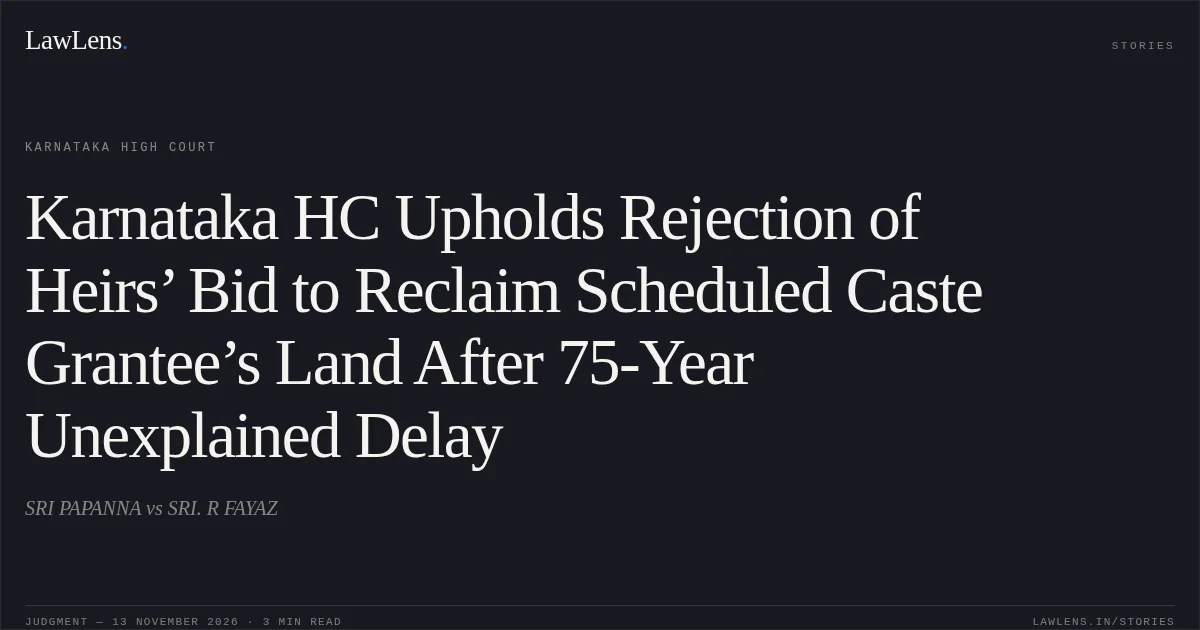
The appellants claimed through the legal heirs of a Scheduled Caste grantee, to whom two acres of land had been granted in 1941 subject to a permanent non-alienation condition.
¶ 2–4After an initial sale in 1946 was followed by reconveyance in 1947, the grantee sold the land again in 1949; the respondents traced their title through that transaction and later conveyances.
¶ 2–4In 2024, the appellants sought resumption and restoration under Section 5 of the Karnataka Scheduled Castes and Scheduled Tribes (Prohibition of Transfer of Certain Lands) Act, 1978 (“PTCL Act”).
¶ 5–6The Assistant Commissioner allowed the application, and the Deputy Commissioner dismissed the respondents’ appeal.
¶ 5–6The Single Judge set aside those orders and dismissed the application, relying on both alleged perfection of title by prescription and the delay in bringing the proceedings.
¶ 8–9The appellants challenged that decision in this writ appeal.
¶ 102Issues
i.1. Whether the Single Judge’s decision could be sustained on the ground that the Section 5 proceedings were initiated after an inordinate and unexplained delay, notwithstanding the appellants’ challenge to the finding of title by prescription.
¶ 11–13, 20–22ii.2. Whether the 2023 amendment to Section 5 of the PTCL Act, providing that there is no limitation of time, precluded consideration of delay and laches.
¶ 14–1603Law Applied
Section 5 of the PTCL Act provides for resumption and restoration of land transferred in contravention of the Act.
¶ 14–16Although Act No. 30 of 2023 amended Section 5(1) to provide that there is no limitation of time for invoking the Act, the principles of delay and laches remain applicable.
¶ 14–16Under Nekkanti Rama Lakshmi v. State of Karnataka and Vivek M. Hinduja v. M. Aswatha, statutory powers of resumption and restoration must be exercised within a reasonable time even where the statute prescribes no limitation period; Chhedi Lal v. Hari Kishore Yadav similarly requires action within a reasonable time.
¶ 13, 17Smt. Gouramma @ Gangamma v. Deputy Commissioner and Smt. M. Manjula v. Deputy Commissioner hold that the 2023 amendment does not displace delay-and-laches principles.
¶ 14–16Manchegowda v. State of Karnataka recognizes an exception where a transferee had perfected title by prescription before the Act commenced, but the appeal was resolved on delay without deciding the appellants’ challenge to the prescription finding.
¶ 8, 11–12, 21Provisions in the judgment · 4 · Linked ones open on LawLens
KARNATAKA HIGH COURT ACT, 1961 Section 4
KARNATAKA SCHEDULED CASTES AND SCHEDULED TRIBES (PROHIBITION OF TRANSFER OF CERTAIN LANDS) ACT, 1978 Section 4Section 5
Indian Penal Code, 1860 Section 420
04Reasoning
The 1949 alienation preceded the commencement of the PTCL Act in 1979, while the appellants initiated restoration proceedings only in 2024—approximately 75 years after the alienation and 45 years after the Act came into force.
¶ 10, 20The Court held that the 2023 amendment removed a limitation bar but did not exclude equitable scrutiny for delay and laches.
¶ 14–16The appellants’ objection that the Single Judge lacked pleadings and evidence to find title perfected by prescription did not warrant interference, because the decision could independently rest on the substantial delay in initiating proceedings.
¶ 11–12, 21The authorities had not adequately considered the effect of that delay.
¶ 2005Holding
The Court held that the delay-and-laches ground independently sustained the Single Judge’s decision, and that the 2023 amendment did not justify reopening the decades-old transaction.
¶ 16, 21–22It dismissed the writ appeal, affirmed the order dated 7 August 2026 setting aside the Assistant Commissioner’s and Deputy Commissioner’s orders and dismissing the appellants’ Section 5 application, and disposed of pending interlocutory applications.
¶ 22–23Original Court PDF
SRI PAPANNAvsSRI. R FAYAZ
Click to open original judgment
Original judgment, available to read, download and summarize on LawLens.in