Facts
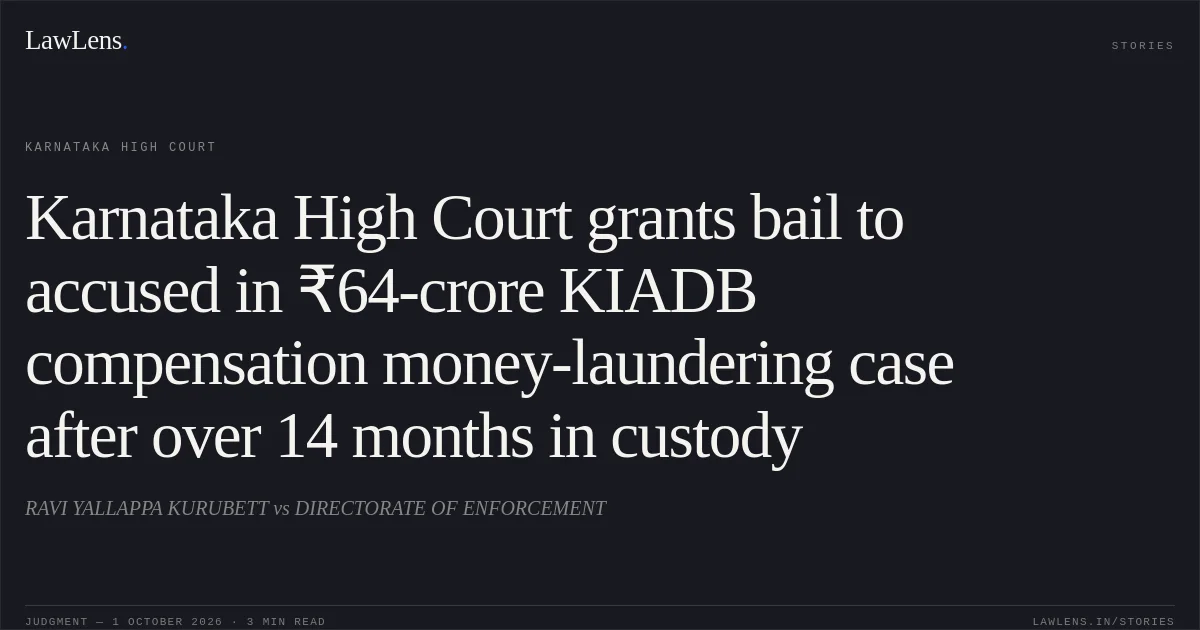
The petitioner, Accused No. 23, sought regular bail in a PMLA prosecution arising from alleged fraudulent claims and awards of land-acquisition compensation, said to have resulted in misappropriation of ₹64.01 crore.
Source reference: no citationThe prosecution alleged that the petitioner withdrew proceeds of crime and used them to acquire properties; it attributed approximately ₹1.36 crore in misappropriation to him, and properties allegedly purchased with proceeds of crime had been provisionally attached.
Source reference: paras. 9–10The petitioner was arrested on 8 July 2025 and a supplementary prosecution complaint was filed against him and other accused on 4 September 2025.
Source reference: para. 5His earlier bail petition was rejected in November 2025. By the present application, he relied, among other matters, on his incarceration of over 14 months, the release on bail of the other accused, and the fact that the case remained at the pre-cognizance stage.
Source reference: paras. 5–6, 11–12, 16Issues
1. Whether the petitioner should be granted regular bail under Section 45 of the Prevention of Money Laundering Act, 2002, having regard to the allegations and material relied on by the prosecution.
Source reference: paras. 8–10, 132. Whether continued custody was justified where the petitioner had been incarcerated for over 14 months and the trial was unlikely to commence in the near future.
Source reference: paras. 14–16Law Applied
Sections 3 and 4 of the Prevention of Money Laundering Act, 2002, define the alleged money-laundering offence and its punishment; Section 45 imposes twin conditions for bail, requiring an opportunity for the Public Prosecutor to oppose release and, where opposed, the court to be satisfied that there are reasonable grounds to believe the accused is not guilty and is unlikely to commit an offence while on bail.
Source reference: para. 13The Court relied on Vijay Madanlal Choudhary v. Union of India for the principle that Section 45’s conditions restrict, but do not absolutely bar, bail, and on Manish Sisodia (II) v. Directorate of Enforcement for the rule that bail is the norm and jail the exception.
Source reference: para. 13It further applied the Article 21 speedy-trial principles discussed in Prema Prakash v. Union of India, Arvind Dham v. Directorate of Enforcement, and Udhaw Singh v. Enforcement Directorate, including the principle in V. Senthil Balaji v. Deputy Director, Directorate of Enforcement that constitutional courts may grant bail where trial is unlikely to conclude within a reasonable time, notwithstanding statutory bail restrictions.
Source reference: paras. 13–15Reasoning
Although the prosecution alleged substantial proceeds of crime and opposed bail under Section 45, the Court considered the petitioner’s prolonged custody, the fact that all other accused had been granted bail, and the procedural position of the case.
Source reference: paras. 11–12, 16The matter remained at the pre-cognizance stage, making an early commencement of trial “very remote”.
Source reference: paras. 11–12, 16Applying the cited Article 21 authorities, the Court concluded that continued detention in those circumstances supported granting bail despite the PMLA’s stringent bail framework.
Source reference: paras. 13–16Holding
The Court allowed the petition and directed that the petitioner be released on bail in the PMLA case.
Conditions included executing a personal bond of ₹1,00,000 with two sureties for the like amount, appearing before the trial court unless exempted, not threatening or tampering with witnesses, not committing similar offences, and not leaving the trial court’s jurisdiction without permission.
Source reference: para. 16Acts & Sections Cited
9 provisions across 4 statutes referred to in this judgment. Each provision opens on LawLens.
Code of Criminal Procedure, 19731
Bharatiya Nagarik Suraksha Sanhita, 20231
Prevention of Money-Laundering Act, 20023
Indian Penal Code, 18604
Original Court PDF
RAVI YALLAPPA KURUBETTvsDIRECTORATE OF ENFORCEMENT
Click to open original judgment
Original judgment, available to read, download and summarize on LawLens.in