Facts
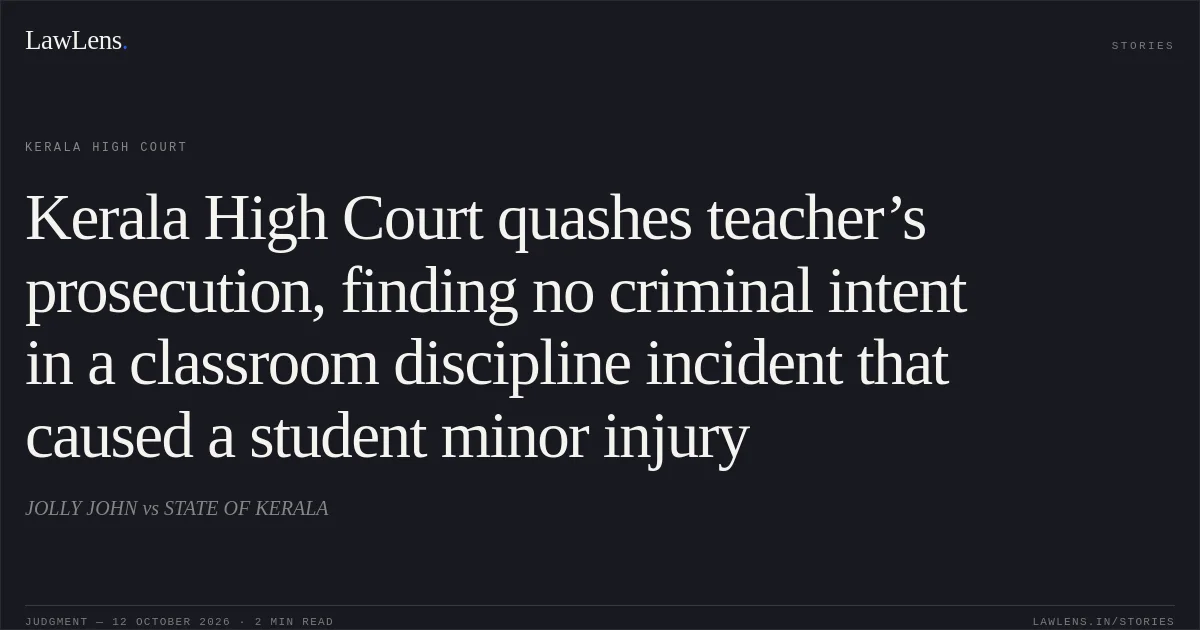
The petitioner, a teacher and class teacher of Standard V-C at MGM School, Thiruvalla, was accused of catching hold of a student’s hand and pulling her while attempting to maintain classroom discipline.
Source reference: p. 1, 4The student’s leg allegedly became entangled in a bench, causing pain and a contusion to her right knee.
Source reference: p. 1, 4The police initially registered the crime under Sections 75 of the Juvenile Justice (Care and Protection of Children) Act, 2015 (“JJ Act”) and 323 of the IPC, but filed a final report alleging offences under Section 82(1) of the JJ Act and Section 323 of the IPC.
Source reference: p. 1The petitioner sought to quash the final report and proceedings in S.C. No. 657/2024, contending that the incident involved only a disciplinary measure and that the materials did not establish the offences.
Source reference: p. 2–3Issues
Whether the allegations and investigation materials disclosed the ingredients of an offence under Section 82(1) of the JJ Act or Section 323 of the IPC.
Source reference: p. 4–6Whether the High Court should exercise its inherent power under Section 528 of the BNSS to quash the final report and pending proceedings.
Source reference: p. 6Law Applied
Section 82(1) of the JJ Act addresses corporal punishment, and Section 323 of the IPC concerns voluntarily causing hurt.
Source reference: p. 1, 6The Court stated that a teacher’s trivial punishment, imposed as a corrective measure or to maintain discipline, does not by itself warrant criminal prosecution; however, corporal punishment inflicted with mala fide intent and potentially serious consequences for a child must be dealt with seriously.
Source reference: p. 4–5Under Section 528 of the BNSS, the High Court may exercise its inherent power to prevent abuse of the process of court and secure the ends of justice.
Source reference: p. 6Reasoning
The Court considered the witness statements, which indicated that the petitioner caught and pulled the student’s hands as a measure to maintain classroom discipline, without an apparent mala fide intention to harass, abuse, or injure her.
Source reference: p. 5–6The wound certificate recorded only minor injuries, and the investigation materials did not establish the requisite criminal conduct for either alleged offence.
Source reference: p. 6In those circumstances, the Court found that continuing the prosecution would amount to an abuse of process and justified invoking Section 528 of the BNSS.
Source reference: p. 6Holding
The Court held that the ingredients of offences under Section 82(1) of the JJ Act and Section 323 of the IPC were not made out on the materials collected.
It allowed the petition and quashed the final report in Crime No. 158/2019 and all further proceedings in S.C. No. 657/2024 before the Additional Sessions Court-I, Pathanamthitta.
Source reference: p. 6Acts & Sections Cited
4 provisions across 3 statutes referred to in this judgment. Each provision opens on LawLens.
Juvenile Justice (Care and Protection of Children) Act, 2015.2
Indian Penal Code, 18601
Bharatiya Nagarik Suraksha Sanhita, 20231
Original Court PDF
JOLLY JOHNvsSTATE OF KERALA
Click to open original judgment
Original judgment, available to read, download and summarize on LawLens.in