Facts
The appellant, a 100% Export Oriented Unit manufacturing rubber-industry equipment, entered into an Asset Sale and Purchase Agreement dated 25 September 2008 with Carbrasive Pty Ltd., Australia, for the purchase of plant and equipment, raw materials, customer records, know-how, supplier records, domain names and brand rights.
Source reference: para. 2The consideration was allocated as USD 4,00,000 for plant and equipment, USD 1,50,000 for know-how and non-compete obligations, and USD 1,00,000 for the brand, domain name and customer records, totalling USD 6,50,000.
Source reference: para. 2The appellant paid customs duty on the plant and equipment component but treated the remaining USD 2,50,000 as consideration for acquired assets, outside the scope of service tax.
Source reference: para. 3Following an audit, the Department alleged that this amount represented consideration for taxable “Intellectual Property Right Service,” particularly because royalty was payable for five years based on future gross sales.
Source reference: para. 4A show-cause notice dated 7 March 2014 proposed service tax of Rs. 14,71,966 with interest and penalties, invoking the extended limitation period on the grounds of non-registration and non-filing of returns.
Source reference: para. 4The adjudicating authority confirmed the demand and penalties; the Commissioner (Appeals) upheld the demand and reduced the penalties under Sections 77(1)(a) and 77(2) to Rs. 5,000 each.
Source reference: paras. 5–6The appellant challenged the appellate order before the CESTAT.
Source reference: paras. 5–6Issues
1. Whether the amount of USD 2,50,000 represented consideration for a permanent sale of assets or consideration for taxable Intellectual Property Right Service under Sections 65(55a), 65(55b) and 65(105)(zzr) of the Finance Act, 1994.
Source reference: para. 10(A)2. Whether know-how constituted an “intellectual property right” recognised under any law for the time being in force in India within the meaning of Section 65(55a).
Source reference: para. 10(B)3. Whether the five-year know-how royalty payable under Clause 7.3 of the agreement negated the alleged permanent transfer and established a continuing licence or temporary transfer.
Source reference: para. 10(C)4. Whether invocation of the extended period of limitation under the proviso to Section 73(1) was legally sustainable.
Source reference: para. 10(D)5. Whether penalties under Sections 77(1)(a), 77(2) and 78(1) were sustainable and whether the appellant was entitled to the benefit of Section 80.
Source reference: para. 10(E)Law Applied
Section 65(55a) of the Finance Act, 1994 defined “intellectual property right” as a right to intangible property, including trademarks, designs, patents or similar intangible property, recognised under any law for the time being in force, excluding copyright; Section 65(55b) covered the temporary transfer of, or permission to use or enjoy, such a right, while Section 65(105)(zzr) taxed the corresponding service.
Source reference: para. 11The Tribunal held that both requirements must be cumulatively satisfied: the subject matter must be an intellectual property right recognised under Indian law, and the transaction must involve a temporary transfer or permission to use, rather than a permanent transfer.
Source reference: para. 11CBIC Circular No. 80/10/2004-ST clarified that permanent transfer of an intellectual property right is not a taxable service because the transferor ceases to remain its holder.
Source reference: paras. 12–13The Tribunal relied on Hyundai Motor India Ltd. v. CGST & C.Ex., Chambal Fertilizers & Chemicals Ltd. v. CCE, and Munjal Showa Ltd. v. CCE & ST, including the Supreme Court’s affirmation in Commissioner of C.Ex. & ST v. Munjal Showa Ltd., for the principle that only intellectual property rights recognised under Indian law are taxable under this category.
Source reference: para. 12It further relied on Thermax Ltd. v. CCE, SKOL Breweries Ltd. v. CCE & CST and Suzlon Energy Ltd. v. Commissioner of Customs, Excise and Service Tax for the principle that an outright and permanent transfer is not an IPR service.
Source reference: para. 13A deferred or instalment-based payment of consideration does not, by itself, convert an outright sale into a continuing licence.
Source reference: para. 15Reasoning
The Tribunal read the agreement as a whole and found that title, property and risk in the assets passed to the appellant on completion, free from encumbrances.
Source reference: para. 14Clause 7.2 prohibited Carbrasive from using or disclosing the know-how after completion without the appellant’s consent, which indicated an absolute transfer rather than retention of a right to use.
Source reference: para. 14Clause 7.3 expressly described the royalty as part of the consideration for the sale of the know-how.
Source reference: para. 15Accordingly, the five-year royalty, although calculated by reference to future gross sales, was treated as deferred sale consideration and not as consideration for a continuing licence.
Source reference: para. 15Independently, the Department failed to establish that know-how was an intellectual property right recognised under any Indian statute, which was itself fatal to its classification as taxable IPR service.
Source reference: para. 12The Tribunal also held that the appellant’s customs valuation treatment could not conclusively determine service-tax liability under the separate statutory definitions in the Finance Act, 1994.
Source reference: para. 17Further, the demand covered the entire USD 2,50,000 even though the Department’s own reasoning concerned only the USD 1,50,000 know-how component; no corresponding continuing payment was shown for the brand, domain name and customer records valued at USD 1,00,000.
Source reference: para. 16Since the demand failed on merits, the Tribunal found it unnecessary to decide the limitation issue, though it observed that the appellant’s limitation arguments appeared prima facie favourable.
Source reference: para. 19The penalties also could not survive because the underlying tax liability and the alleged registration obligation were absent; in any event, the appellant’s bona fide interpretation and prior correspondence with the Department constituted reasonable cause under Section 80.
Source reference: para. 20Holding
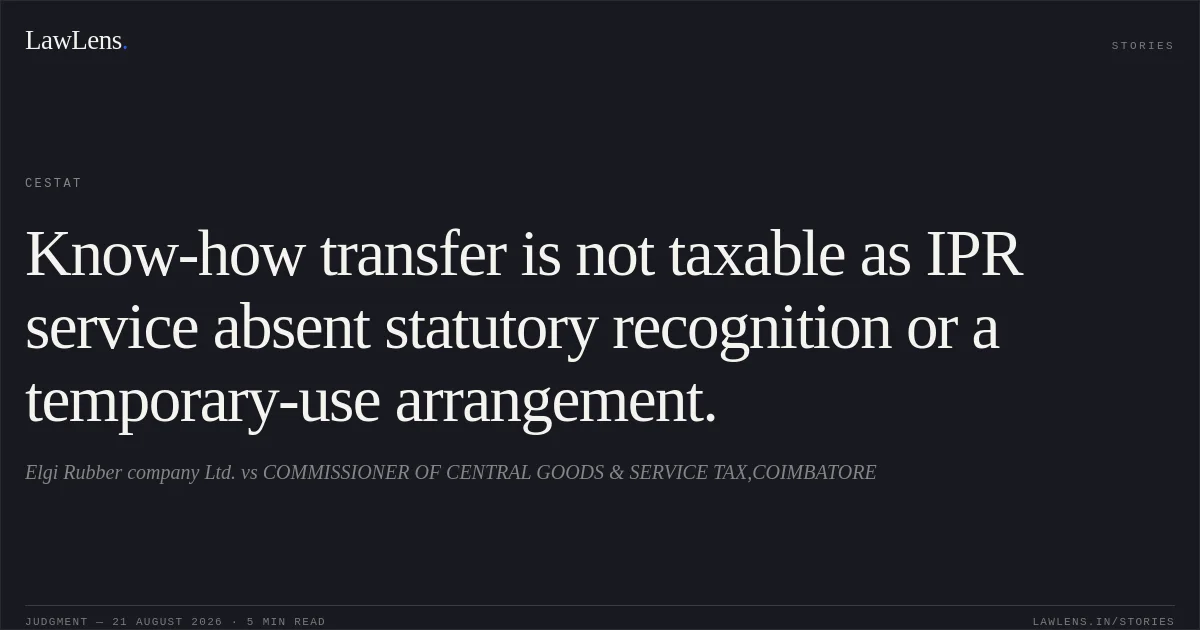
The CESTAT held that know-how was not an intellectual property right recognised under Indian law for the purposes of Section 65(55a), and that the agreement evidenced a permanent, outright transfer of the assets rather than a temporary transfer or permission to use an intellectual property right.
The demand for service tax of Rs. 14,71,966, along with applicable interest, was therefore unsustainable and set aside in its entirety.
Source reference: para. 20The penalties under Sections 78(1), 77(1)(a) and 77(2) were also set aside, with the Tribunal additionally holding that Section 80 would independently justify waiver of penalties.
Source reference: para. 20The impugned Order-in-Appeal dated 18 May 2016 was set aside and the appeal was allowed with consequential relief, if any, in accordance with law.
Source reference: para. 21Acts & Sections Cited
1 provisions across 1 statute referred to in this judgment. Each provision opens on LawLens.
Customs Tariff Act, 19751
Original Court PDF
Elgi Rubber company Ltd.vsCOMMISSIONER OF CENTRAL GOODS & SERVICE TAX,COIMBATORE
Click to open original judgment
Original judgment, available to read, download and summarize on LawLens.in