Facts
The applicant filed his first bail application under Section 483 of the Bhartiya Nagrik Suraksha Sanhita, 2023 (BNSS), seeking regular bail following his arrest on September 11, 2025.
Source reference: para. 1, 3The prosecution alleged that the applicant’s bank account served as a "mule account" within a larger organized cyber fraud network investigated by the Indian Criminal Coordinator Centre.
Source reference: para. 2, 7Investigations revealed that approximately ₹97,83,492/- was fraudulently transferred across 82 bank accounts.
Source reference: para. 2, 8Specifically, the applicant opened a Kotak Mahindra Bank account and allegedly provided the credentials to co-accused Amit Dewangan in exchange for a 5% commission on transactions.
Source reference: para. 6, 8Records indicated transactions totaling ₹3,43,348/- (credits) and ₹3,39,485/- (debits) in the applicant’s account, including specific fraudulent sums linked to a complaint in Madhya Pradesh.
Source reference: para. 8Issues
Whether the applicant is entitled to the grant of regular bail considering his role as a "mule account" holder in an organized cyber fraud operation under the Bhartiya Nyaya Sanhita (BNS).
Source reference: para. 1, 7Law Applied
Section 483 of the Bhartiya Nagrik Suraksha Sanhita, 2023, regarding the grant of regular bail.
Source reference: para. 1Bhartiya Nyaya Sanhita (BNS), specifically Sections 61 (Criminal Conspiracy), 317(5) (Stolen Property), 318(4) (Cheating), 111(3)(4) (Organized Crime), and 323 (Voluntarily causing hurt).
Source reference: para. 1The court emphasized the legal threshold for bail in cases involving deep-rooted, profit-oriented criminal conspiracies and the necessity of assessing the gravity of the offence and the risk of the accused absconding or influencing witnesses.
Source reference: para. 4, 9Reasoning
The court analyzed the evidence submitted via an affidavit by the Investigating Officer, which detailed the applicant's "indispensable and conscious role" in facilitating large-scale cyber fraud.
Source reference: para. 4, 6The court noted that while the applicant claimed false implication and pointed to the filing of the charge-sheet, the material on record—including memorandum statements from the applicant and co-accused, bank statements, and seized mobile devices—prima facie established his involvement.
Source reference: para. 3, 6, 9The court reasoned that knowingly allowing a personal bank account to be used for routing proceeds of crime constitutes conscious participation in organized illegal activity.
Source reference: para. 9Given the magnitude of the transactions (₹97,83,492/- across the network) and the organized modus operandi adopted, the court found the nature and gravity of the offence too severe to warrant bail, despite the applicant’s period of incarceration since September 2025.
Source reference: para. 8, 9Holding
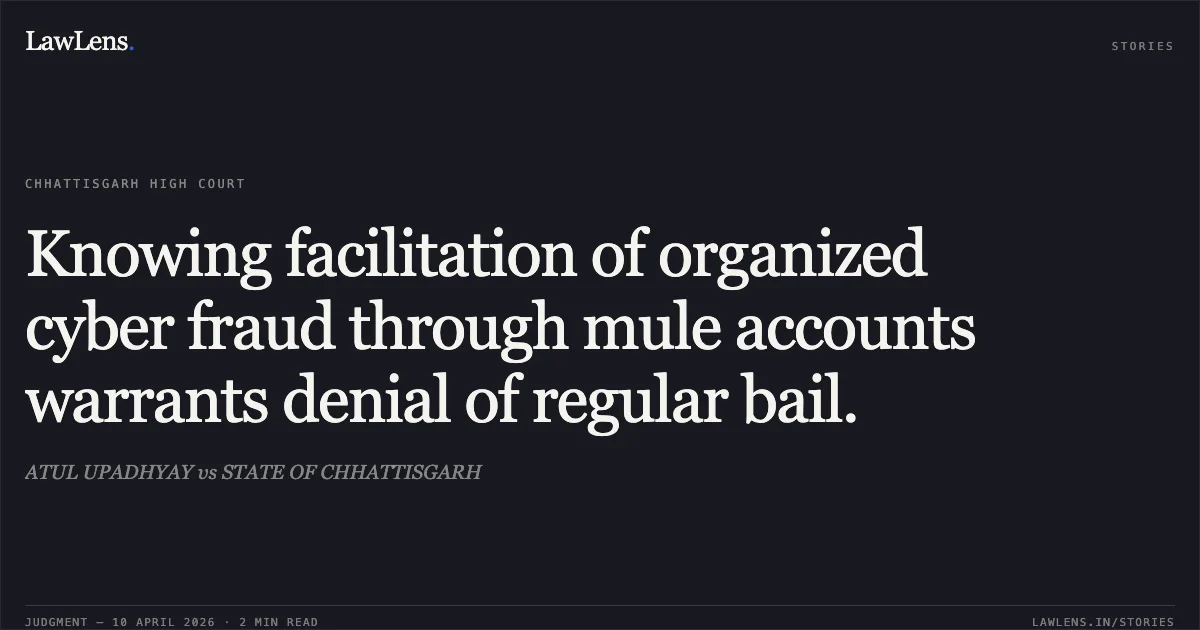
The High Court of Chhattisgarh rejected the bail application, holding that a prima facie case of organized cyber fraud exists against the applicant.
The court concluded that the organized nature of the crime and the potential risk of the applicant absconding or influencing witnesses outweighed the arguments for release.
Source reference: para. 9The court directed the trial court to proceed with and conclude the trial expeditiously.
Source reference: para. 11Acts & Sections Cited
6 provisions across 2 statutes referred to in this judgment. Each provision opens on LawLens.
Bharatiya Nagarik Suraksha Sanhita, 20231
Bharatiya Nyaya Sanhita, 20235
Original Court PDF
ATUL UPADHYAYvsSTATE OF CHHATTISGARH
Click to open original judgment
Original judgment, available to read, download and summarize on LawLens.in